


Confused by piano notes? You’re not alone. The best place to start is understanding how notes are named and where to find them on the keyboard, everything else, from sheet music to rhythm, builds on that. This guide walks you through reading notes on the keys and on the staff, with diagrams, mnemonics, and a couple of quick ways to practice as you go.
Quick answer
Piano notes follow a repeating 12-note musical alphabet: seven white keys named A to G, and five black keys — the sharps and flats — filling the gaps between them.
|
A–G
|
White keys The musical alphabet — A to G — repeats across the keyboard. |
|
C
|
Finding C The white key just left of every group of two black keys. |
|
F
|
Finding F The white key just left of every group of three black keys. |
|
♯
|
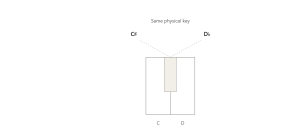
Black keys Named with sharps (♯) or flats (♭) — like C♯ and D♭ for the same key. |
|
☰
|
Reading the staff Treble: E-G-B-D-F lines, F-A-C-E spaces. Bass: G-B-D-F-A lines, A-C-E-G spaces. |
Try it live in the Note Finder below — click a note on the staff to see it light up on the keyboard.
What are piano notes?
Each musical note on a piano has a letter name, and those letters run A to G, just like the start of the alphabet, before looping back to A again. Here’s the simplest way to find your place on the keyboard:

- C sits directly to the left of every group of two black keys.
- F sits directly to the left of every group of three black keys.
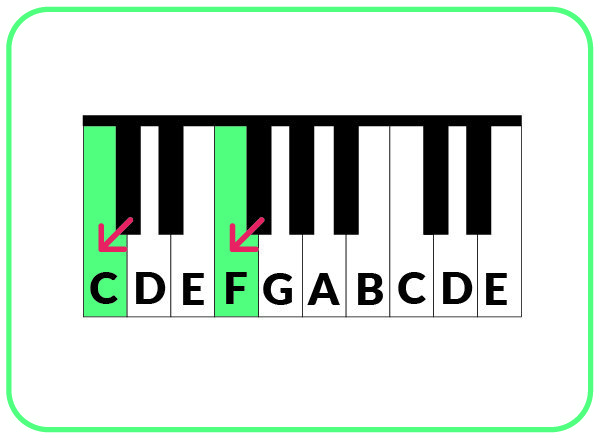
All the notes on a piano are arranged in octaves, repeating groups of eight notes (C, D, E, F, G, A, B, C). Moving left lowers the pitch; moving right raises it.
Not every note lives on a white key. The black keys are named using sharps (♯) and flats (♭), and here’s the part that trips a lot of beginners up: the same black key can go by two different names depending on which direction you’re counting from. The key between C and D, for example, is both C♯ and D♭. These dual names are called enharmonic equivalents, and once you know they exist, sheet music stops looking inconsistent and starts making sense.
Sharps and flats (black keys)
Piano notes on sheet music use sharps, flats, and naturals to alter written pitches:
- Flats (♭) lower a note by a half step, moving to the nearest key to the left. E♭ sits just to the left of E.
- Sharps (♯) raise a note by a half step, moving to the nearest key to the right. G♯ sits just to the right of G.
- Naturals (♮) are the white keys that represent the standard notes without any alteration. E.g., C♮ (C natural) is the regular C found on a white key.

Piano notes chart: The keyboard notes labeled
It’s important to know how these notes are written down. Music is written on a staff, five horizontal lines with four spaces between them. At the start of every line, you’ll see a symbol called a clef, which tells you how to read the notes that follow.
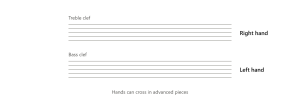
Piano music almost always uses two clefs at once: the treble clef for your right hand, and the bass clef for your left.
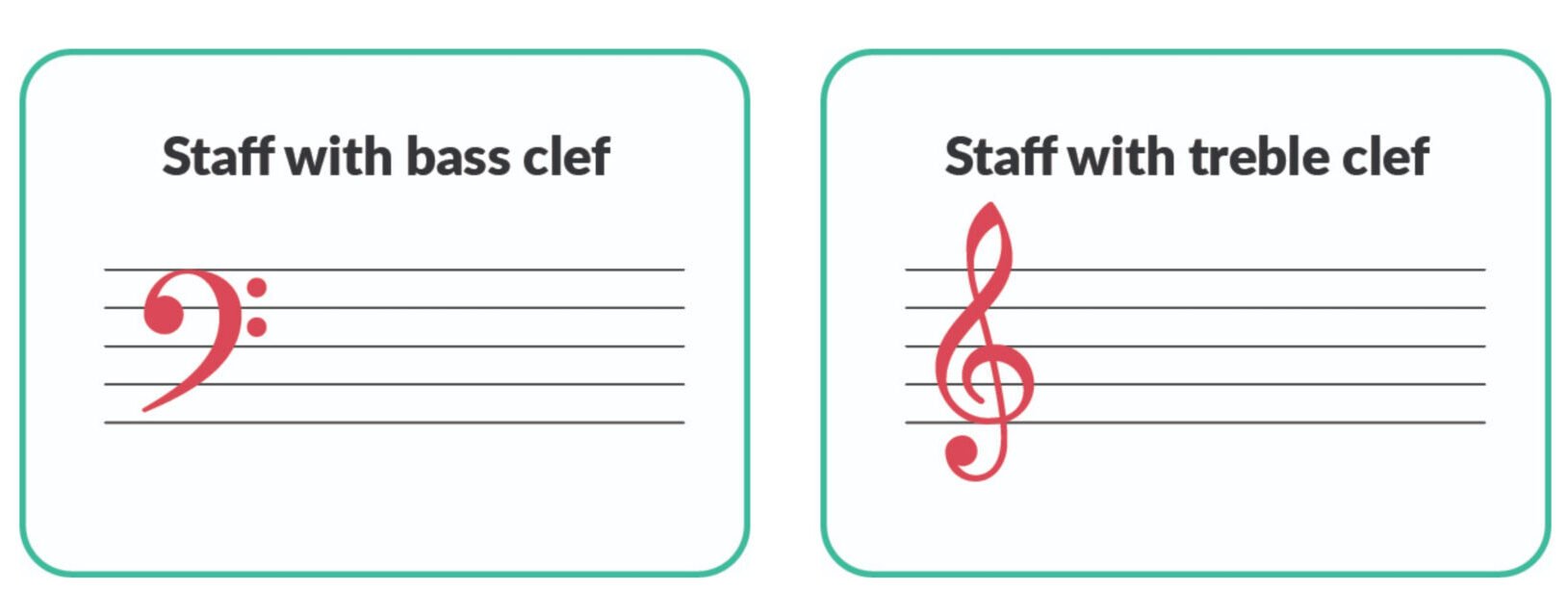
Treble clef notes
Reading from bottom to top:
- Lines: E – G – B – D – F (“Every Good Boy Does Fine”)

- Spaces: F – A – C – E (spells “FACE”)
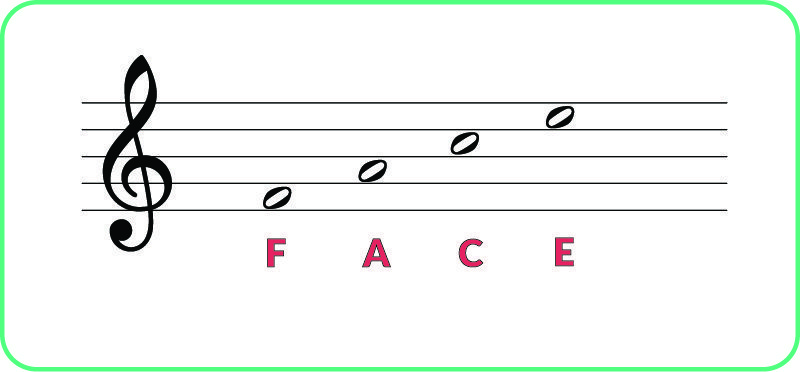
Bass clef notes:
Reading from bottom to top:
- Lines: G – B – D – F – A (“Good Boys Deserve Food Always”)

- Spaces: A – C – E – G (“All Cows Eat Grass”)
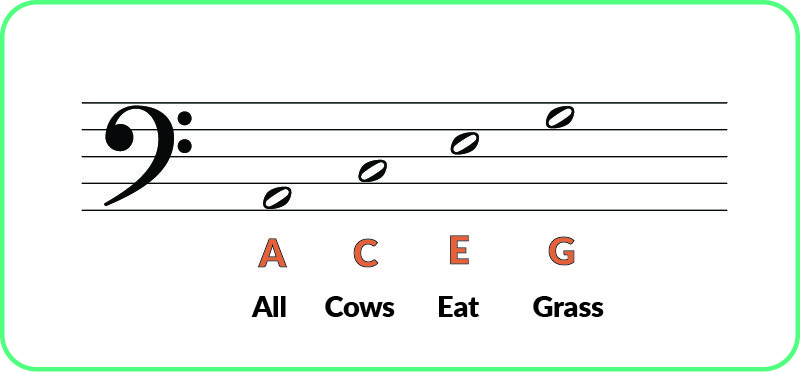
In piano music, two staffs, one treble, one bass, are held together by a brace. This is known as a grand staff. Notice the pattern: every note’s position on the keyboard repeats identically each octave, and its position on the staff moves in step. The chart below lines up every white key with its exact spot on both clefs.
Keep this handy note-to-key table close by a quick glance is all you need to get back on track.
| White key | Treble clef position | Bass clef position | Sharp/flat neighbor |
|---|---|---|---|
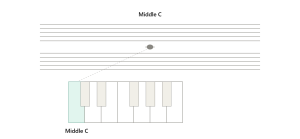
| C | Middle C (ledger line) | 2nd space | C♯ / D♭ |
| D | Below staff | 2nd line | D♯ / E♭ |
| E | 1st line | 1st space | none (E–F is a half step) |
| F | 1st space | 4th line (bottom) | F♯ / G♭ |
| G | 2nd line | Below staff | G♯ / A♭ |
| A | 2nd space | Below staff | A♯ / B♭ |
| B | 3rd line (middle) | Below staff | none (B-C is a half step) |
Once you can name notes on sight, our Twinkle, Twinkle, Little Star tutorial is a good next step, it’s built around single-note reading, so you’ll be applying exactly what you just learned.
Reading key signatures
A key signature groups all the sharps (♯) or flats (♭) used throughout a piece into one place, right after the clef, so you don’t need a symbol next to every single note. Sharps and flats always appear in the same order:
- Sharps: F♯, C♯, G♯, D♯, A♯, E♯, B♯ (“Father Charles Goes Down And Ends Battle”)
- Flats: B♭, E♭, A♭, D♭, G♭, C♭, F♭ (“Battle Ends And Down Goes Charles’ Father”)

Beyond notes: rhythm and dynamics
Once you’re comfortable finding and naming notes, the next layer is timing and expression:
- Rhythm and note values – how long each note lasts.
- Time signatures – how beats are grouped into each bar.
- Dotted notes and ties – ways of extending a note’s length.
- Dynamics – how loud or soft to play. Symbols range from pp (very quiet) to ff (very loud), usually written just below the staff.
Note values — relative duration
Each note gets half the length of the one before it.
| Whole note | 4 beats | |
| Half note | 2 beats | |
| Quarter note | 1 beat | |
| Eighth note | ½ beat |
Dynamics — soft to loud
Written below the staff, telling you how much volume to use.
|
pp |
p |
mp |
mf |
f |
ff |
pianissimo → piano → mezzo-piano → mezzo-forte → forte → fortissimo
Quiz: Name the piano note
You’ve learned how notes are named, found on the keyboard, and read on both clefs, now let’s see if it’s stuck. Try naming all fourteen notes below, treble and bass mixed together and shuffled each round, so you’re actually testing yourself rather than memorizing a pattern.
Congrats on making it through the practice round! If you scored 10 or higher out of 14, you’ve got a solid handle on note names, you’re ready to start applying that on real songs. Scored below 10? That’s completely normal at this stage, and a bit more hands-on practice is all it takes to make it stick.
Either way, Skoove is here to help you build on it. Try it free today and turn what you just learned into real playing.
FAQs
A standard piano keyboard has 88 keys, but smaller keyboards often have 61, 76 or 49 keys.