




A data analysis of 1.1 million learners shows: May is the best month for a fresh start. May learners are 23% more likely to stick with it than the average.
The month that makes the difference
Around 90% of all beginner musicians quit within the first twelve months, as Fender CEO Andy Mooney noted back in 2019. But when someone starts appears to make a real difference.
In early 2026, piano learning app Skoove and Berlin-based DataPulse Research published an analysis of usage data from 1,137,446 learners over four years (2021 to 2024). The findings sparked debate. Now, three months on, the data speaks even more clearly: May is the best month to begin. And those who start now will be playing their first favourite songs by August.
The best and the worst month to start
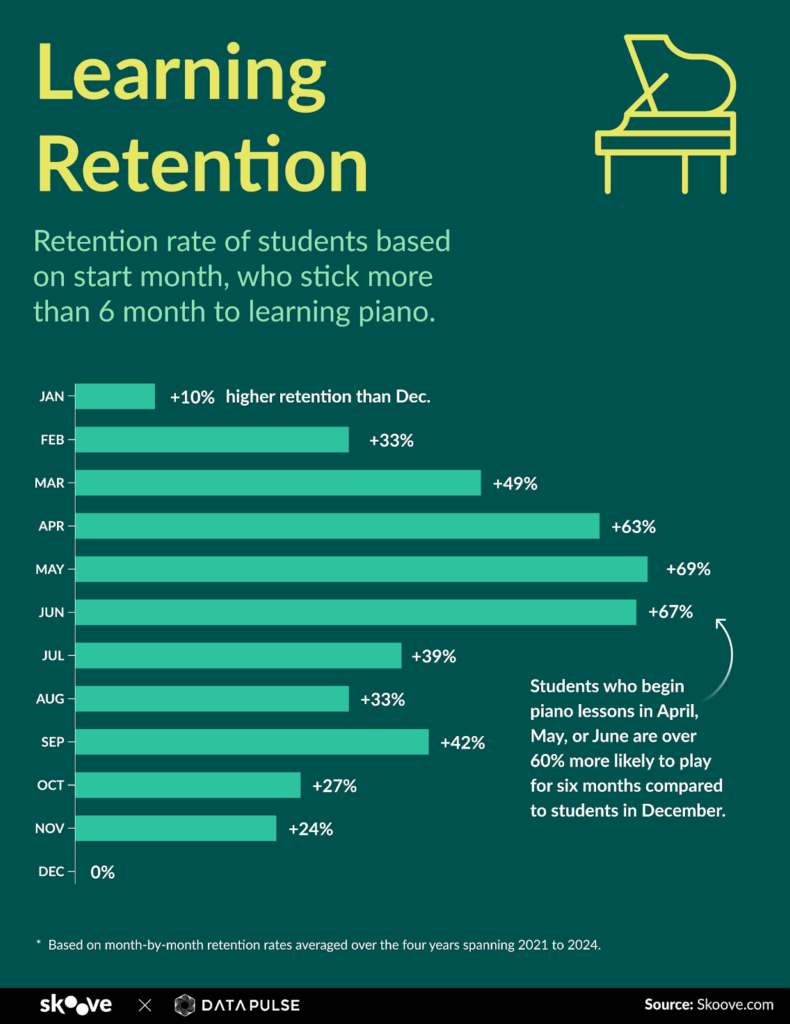
At the heart of the analysis is user activity over a six-month period. Learners were grouped into cohorts by the month they signed up, and their engagement rates were compared. The results are clear:
- May starters are 23% more likely to still be active after six months – the highest rate of any month.
- April starters sit 18% above the average; June starters at +21%.
- January starters – the classic New Year’s resolution cohort – fall 21% below the average.
- December starters perform worst of all: 28% below the average.
The gap between the best and worst starting month amounts to over 50 percentage points.
Some important context: January brings by far the most sign-ups, May significantly fewer. An obvious objection: do May starters only perform better because they’re a smaller, inherently more motivated group? Probably yes, and that’s exactly the point. People who start without the pressure of a symbolic date are making a more deliberate decision, and that turns out to be a strong predictor of whether they’ll stick with it.
Why timing matters more than motivation
Behavioural science offers an explanation: the so-called "Fresh Start Effect." A 2014 study published in Management Science by researchers at the Wharton School (Dai, Milkman & Riis) found that temporal landmarks like New Year’s motivate people to begin new endeavours – but offer no guarantee they’ll follow through.
In May, there’s no external trigger, no societal ritual pushing people to act. Instead, seasonal factors provide a natural foundation: longer days, more light, more energy. People who start now are doing it on their own terms, not because the calendar tells them to.
The 66-day hurdle: When intentions become habits
Behavioural researcher Phillippa Lally (University College London) demonstrated in 2010 that it takes an average of 66 days for a new behaviour to become automatic – far longer than the popular but debunked "21-day rule." This period coincides with what music educators call the "Beginner’s Wall": the point where technical difficulty starts to outweigh initial enthusiasm.
The Skoove data shows that the steepest drop in activity occurs between the second and third month – precisely the window that research identifies as the critical phase of habit formation.
This is where the practical value of the May finding comes in. Someone who starts in May hits the 66-day mark in mid-July, right in the middle of summer. Long evenings, less daily stress, and good weather create ideal conditions for pushing through the wall. By August, they’re on the other side – ready to play their first favourite songs.
What the data doesn’t show
What the data doesn’t show is the qualitative difference in behaviour. Florian Plenge, CEO of Skoove, observes a different attitude at the instrument when it comes to May starters:
"What still surprises me about May starters is the question they come in with. January learners want to know how quickly they’ll see progress. May learners are more likely to ask which song they should learn next. It sounds trivial, but it’s a completely different mindset, and it’s exactly what carries them through the first difficult weeks.”
Methodology
This analysis is based on engagement data from the piano learning app Skoove (Mixpanel retention report). 1,137,446 anonymised users who signed up between January 2021 and December 2024 were grouped into cohorts by their starting month. Activity rates were tracked over six months and averaged across the four-year period. The figures shown represent the percentage deviation of each monthly cohort from the overall average of all users.
The analysis reflects engagement patterns within the Skoove platform. Learning activity outside the app (in-person lessons, self-directed practice) is not captured. Factors such as self-selection – May starters may be making a more deliberate choice than January starters – may influence the results. A breakdown by age and region is planned for a follow-up analysis.
Study by: Skoove & DataPulse Research
Edited by: Susana Pérez Posada

With over seven years of piano education and a deep passion for music therapy, Susana brings a unique blend of expertise to Skoove. A graduate in Music Therapy from SRH Hochschule Heidelberg and an experienced classical pianist from Universidad EAFIT, she infuses her teaching with a holistic approach that transcends traditional piano lessons. Susana's writings for Skoove combine her rich musical knowledge with engaging storytelling, enriching the learning experience for pianists of all levels. Away from the piano, she loves exploring new places and immersing herself in a good book, believing these diverse experiences enhance her creative teaching style.
References
Dai, H., Milkman, K. L., & Riis, J. (2014). The Fresh Start Effect: Temporal Landmarks Motivate Aspirational Behavior. Management Science, 60(10), 2563–2582.
Lally, P., van Jaarsveld, C. H. M., Potts, H. W. W., & Wardle, J. (2010). How are habits formed: Modelling habit formation in the real world. European Journal of Social Psychology, 40(6), 998–1009.