SkooveLearn PianoDownload on the App Store
Install Now

How to play D major chord on piano?

The D major piano chord is a chord with a major quality built on the root note of D. The notes in a D piano chord are D, F# and A. This combination of notes is one of the most common chords in music, appearing in songs across all genres, so it is essential for beginner pianists to learn. This article will cover the proper finger placement, technique, inversions, simple chord progressions and explore songs where you can put this newfound knowledge to use. Getting familiar with the D chord is just the start of the many skills we help you develop as you progress through your learning journey. Let’s get playing!

How do you play a D major chord on the piano?

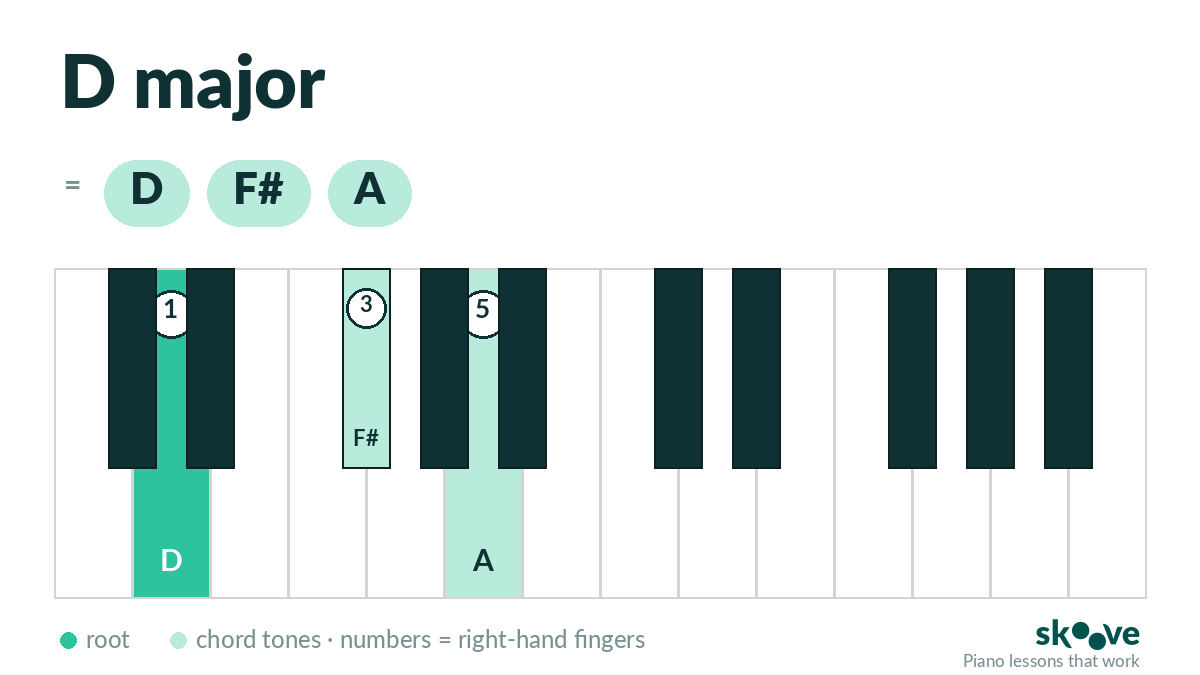
To play any of the chords you need to learn on piano you need to be able to find the notes on the keyboard. To play a D major chord find these three notes: D, F# and A. First find D, the white key in between the pair of black keys. Then add F#, the first of the three black keys, and A, the white key before the last of the three black keys.

D major chord

What is the fingering for a D major chord?

This is to place your fingers for the D major chord for both your left and right hand.

To play this chord in its root position (basic form) with your right hand, use these fingers:

  • A – Fifth finger (5)
  • F# – Third finger (3)
  • D – Thumb (1)

For the left hand, use the following fingers:

  • A – Thumb (1)
  • F# – Third finger (3)
  • D – Fifth finger (5)

When you play these notes together, they create a bright and full major sound.

What are the intervals in D major chord?

All major chords, like D major, are defined by their matching interval structure. Each note has a name based on its function within the chord.

  • D – Root
  • F# – Third
  • A – Fifth

This structure in root position is:

d major chord

From the root to the third of a major chord (D to F#) is 4 semitones, a major third. From the third to the fifth (F# to A) is 3 semitones, a minor third. This structure of a major and minor third creates a perfect fifth (7 semitones) between the root and the fifth (D to A).

Try separating these notes out and play them one by one as a broken chord. Do this with this root position chord and with the inversions we will cover later. This will give you a more in depth understanding of how these chords sound and function.

What are the inversions of a D major chord?

Chord inversions allow you to play the same chord with a different sound and control how you emphasize each note of the chord. The inversions of the D major piano chord are formed by rearranging the order in which the notes are played.

The D major chord has two inversions. First inversion places D at the top of the chord, leaving F# as the lowest note. Second inversion places both D and F# at the top, leaving A as the lowest note. Let’s take a look at these in more detail.

How to play D major first inversion?

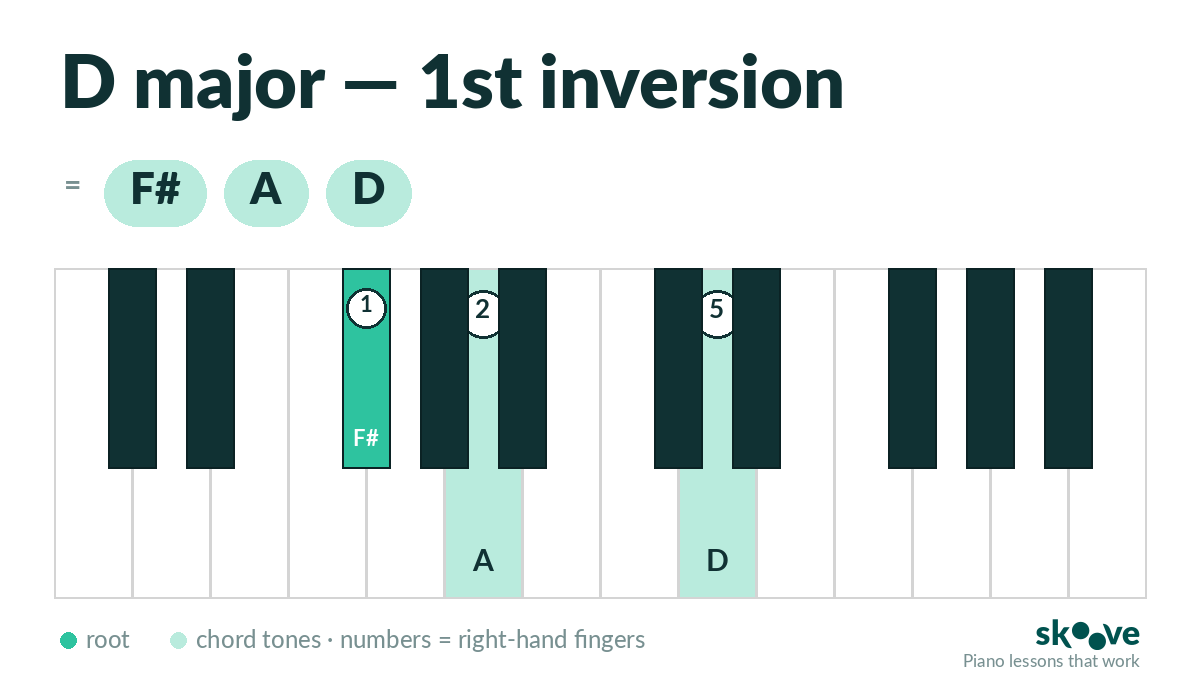
To play the 1st inversion of the D major piano chord, start with F# as the lowest note. Next, play A above it and finally add D as the highest note. This gives the chord a fresh sound that’s great for smooth transitions between chords.

D major 1st inversion

For the right hand, use these fingers:

  • D – Fifth finger (5)
  • A – Second finger (2)
  • F# – Thumb (1)

For the left hand, use these fingers:

  • D – Thumb (1)
  • A – Third finger (3)
  • F# – Fifth finger (5)

How to play D major second inversion?

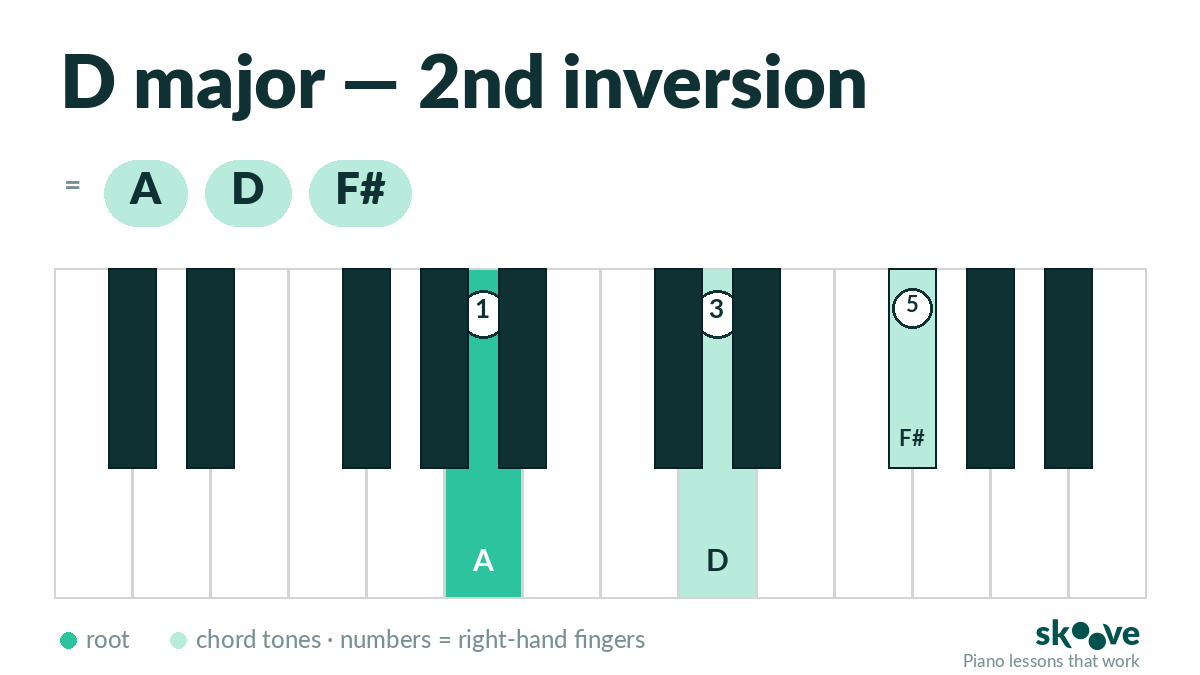
To play the 2nd inversion of the D major piano chord, start with A as the lowest note. Then play D above it and finally add F# as the highest note. This inversion gives the chord a different sound and is often used to make chord resolutions more interesting.

D major 2nd inversion

For the right hand, use these fingers:

  • F# – Fifth finger (5)
  • D – Middle finger (3)
  • A – Thumb (1)

For the left hand, use these fingers:

  • F# – Thumb (1)
  • D – Second finger (2)
  • A – Fifth finger (5)

Common D chord variations

There are lots of other types of D chord that you will come across on your piano playing journey. Here are some common variations for you to get familiar with in a handy table.

Chord Notes (root position) 1st inversion 2nd inversion 3rd inversion Character / use
D7 (dominant 7) D – F# – A – C F# – A – C – D A – C – D – F# C – D – F# – A Very common in blues and jazz
Dmaj7 (D major 7) D – F# – A – C# F# – A – C# – D A – C# – D – F# C# – D – F# – A Smooth, rich, jazzy sound
Dsus2 D – E – A E – A – D A – D – E Open, unresolved sound
Dsus4 D – G – A G – A – D A – D – G Open, suspended tension
D augmented (Daug) D – F# – A# F# – A# – D A# – D – F# Dramatic, unstable sound
D diminished chord D – F# – A# F – Ab – D D – F – Ab Tense, crunchy sound

D major chord progression

The D major chord progression is widely used in various musical genres, from rock and pop to jazz and classical music. D major chord progressions often include chords like D, A, G and Bm. Here are some popular D major chord progressions for you to try:

  • D – Bm – G – A
  • D – G – A – D
  • D – G – Bm – A
  • D – G – F#m – A 

These progressions highlight the versatility of the D major key, offering a range of moods from uplifting to warm and emotional. They are a great way to put your knowledge of piano chords to the test. To understand these chord symbols and how to play them, check out Skoove’s tailor-made beginner chord progression courses.


Play chord progressions

Piano chords generator

💡 If you are reading this from a mobile device, rotate it to display the tool in full width.


1. Click on “Chords”
2. Choose the “Root” of the chord
3. Choose the “Chord qualities” (major, minor, etc.)
4. Click “Display”

Final tips for practicing the D major chord

Once you understand the basics of the D major chord, a few simple habits can help you play it more confidently and use it in real music.

  • Start slow: Be sure to play the D chord piano shape slowly so each note sounds clean and even.
  • Keep your hands relaxed: Tension in your body slows you down. Stay loose so your chords sound smooth and natural.
  • Memorize the D chord notes: Think D – F# – A. Knowing the notes in the d major chord helps you build other chords faster.
  • Practice both hands separately first: This makes it easier to control your fingering before combining hands.
  • Use inversions to stay comfortable: Move between root position and the chord inversions we looked at to avoid jumping around the keyboard when playing chords in songs.
  • Try simple progressions: Use the songs we will take a look at next to practice real musical movement in context.
  • Experiment with variations: Add a D7 chord or a D sus chord, a D augmented chord or even a D diminished chord to hear how the sound changes.

Popular songs to play with the D major piano chord

Putting a newly learned chord into practice is the best way to get familiar with it. Let’s take a look at a selection of songs that make use of the D major chord.

“Another One Bites The Dust” – Queen

This rock classic makes use of a D chord at the end of a four bar looping phrase. This makes it perfect for your first application of this chord in a song.

Start free trial

“Angels” – The XX

“Angels” by The XX makes use of a D chord in a more interesting position, underneath a right hand pattern. This is perfect to progress to once you are more comfortable with the chord.

Start free trial

“Animals” – Maroon 5

This Maroon 5 tune is a great place to put your knowledge to the test. Add in the D major chord to the outlined progression to cement your understanding of this common chord.

Start free trial

A new world of piano chords

Let’s explore more chords! Mastering the D major chord opens the door to countless songs and chord progressions on piano. Once you feel confident with its root position, inversions and broken chord patterns, you can start experimenting with chord variations and progressions in your favorite songs.

To keep building your chord skills, explore more piano chords, dive into chord inversions, or practice seventh chords and suspended chords. With Skoove, you can learn step by step and start playing your favorite songs faster than you think. Keep up the good work!

FAQ

The notes in a D major scale are D – E – F# – G – A – B – C# – D. There are two sharps: F# and C#. These sharps are known as the D major key signature.

The seven diatonic chords in D major are: D major, E minor, F# minor, G major, A major, B minor and C# diminished.

D – A – Bm – G is one of the most popular progressions in pop music. D – G – A – A is another classic that is often used in rock and blues.

The Dmaj7 chord adds the seventh note in the scale, C# (7), to the standard D – F# – A triad (1, 3, and 5) , creating a richer, jazzier sound.

There isn’t really a need for an easy version of D on piano the way there is on guitar. The D major triad (D – F# – A) is beginner-friendly. If you’re struggling, practise each note separately, then add them one at a time.


Author of this blog post:
Matthew Dickman

With over a decade of experience in music education Matthew holds a BA in Music from Paul McCartney’s LIPA and an MA in Composition from the University of Salford. Mathew has developed a distinctive compositional voice and approach to music theory education through his research and work in the music industry. Matthew’s writing for Skoove combines experience from orchestral and media composition, and as a gigging jazz musician, to create a wholistic and accessible pedagogy for musicians of any level. Away from music, he enjoys reading and exploring nature to expand his horizons and knowledge contributing to his holistic teaching style.

Published by the Skoove team

Share this article

Share this article

Updated on April 13, 2026

Don’t leave empty-handed

Get a 7 day trial of Skoove Premium piano lessons