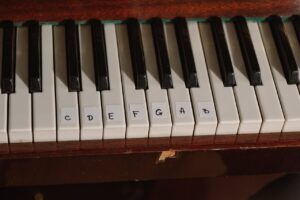




The D minor chord is made up of D, F and A. This chord is widely used across many styles of music, from classical to pop and film music.
In this guide, we will look at how to play the Dm chord on piano, including finger placement, techniques and inversions. We will also take a look at some useful chord progressions and some songs so you can get playing right away. Mastering the Dm piano chord is an important step in developing your piano skills and progressing your understanding of harmony in music. Without further ado, let’s get learning!
How to play the D minor chord?
To play any of the chords you come across on piano, you need to be able to find the notes on the keyboard. The D minor chord consists of the following notes: D, F, and A. This is called the D minor chord. D is the root note, serving as the tonal center of the chord and is the white key in between the two black keys. F is the white key just before the three black keys. A is the white key in between the last two of three black keys. The Dm chord is known for its sad, melancholic, or dramatic sound.
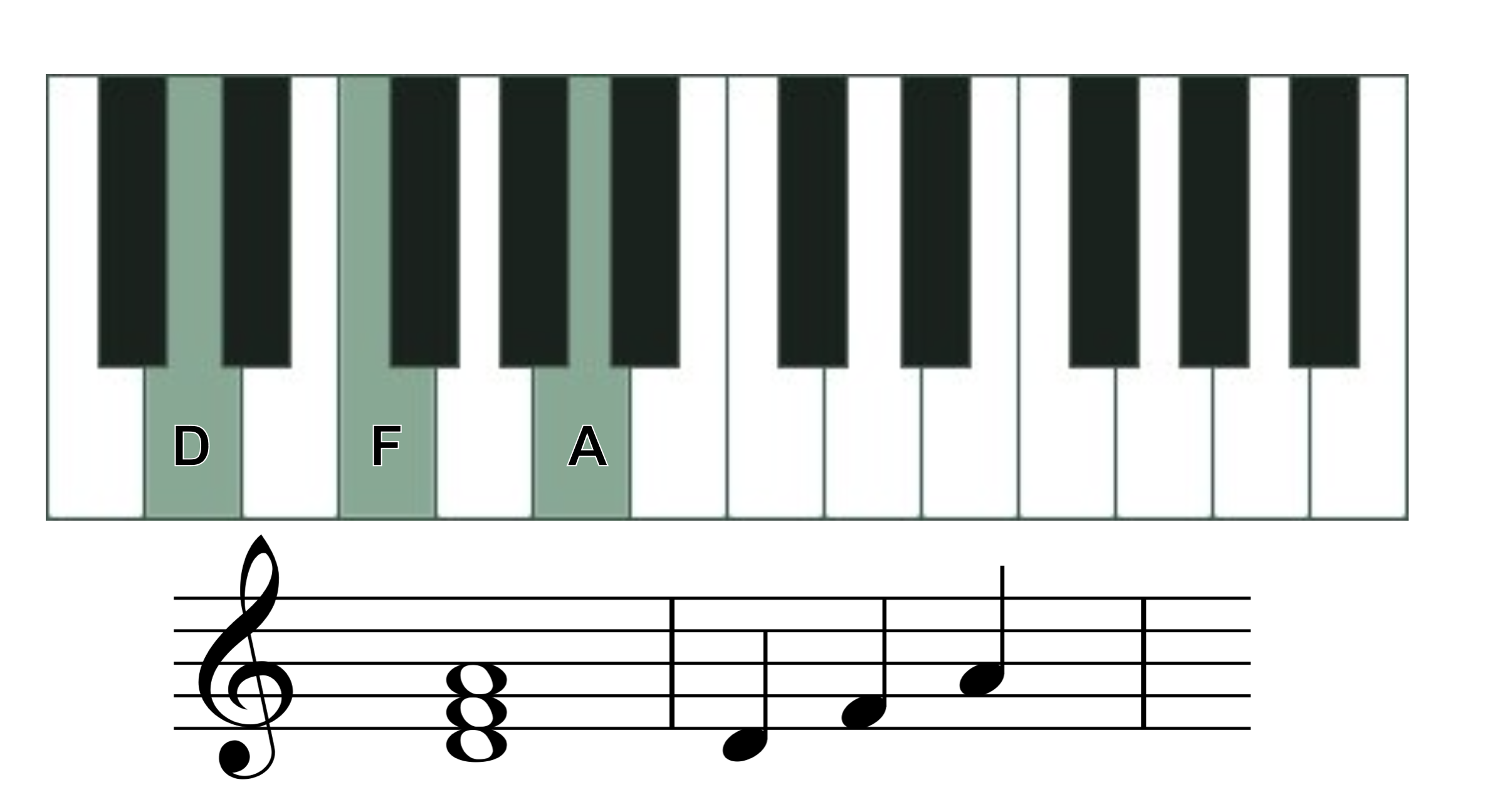
D minor chord fingering: Right & left hand
To play D minor triad in its root position (basic form) with your right hand, use these fingers:
- A – Fifth finger (5)
- F – Third finger (3)
- D – Thumb (1)
For the left hand, use the following fingers:
- A – Thumb (1)
- F – Third finger (3)
- D – Fifth finger (5)
What are the intervals in a D minor chord?
All minor chords follow a specific interval structure that gives them their unique sound. The D minor triad consists of three notes, each corresponding to a specific scale degree:
- D – Root (first degree)
- F – Minor third (third degree)
- A – Fifth (fifth degree)
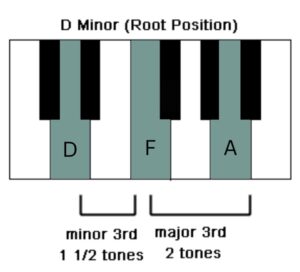
From the root to the third (D to F) is a minor third interval, which is three half steps. From the third to the fifth (F to A) is a major third interval, which is four semitones. This creates a perfect fifth (7 semitones) between D and A.
Have a go at separating these notes out and play them one by one as a broken chord. Have a go at this with this root position chord and with the inversions we will cover later.
What are the inversions of the D minor chord?
Chord inversions let you play a chord with a different sound by changing which note is the bass note, or lowest pitch. Piano triads have two inversions, first and second. In root position, the root of the chord is the bass note, providing the most stability and a strong sense of resolution. In the first inversion, the third becomes the bass note, and in the second inversion, the fifth is the bass note. These inversions create a sense of movement and can make the harmony sound less stable, adding musical interest. Let’s see how that looks on the piano.
How to play D minor first inversion?
To play the first inversion, start with F as the bottom note. Then add an A above it and finally make D the top note. This gives the chord a new feel which can be great for smooth transitions between chords and livening up progressions.
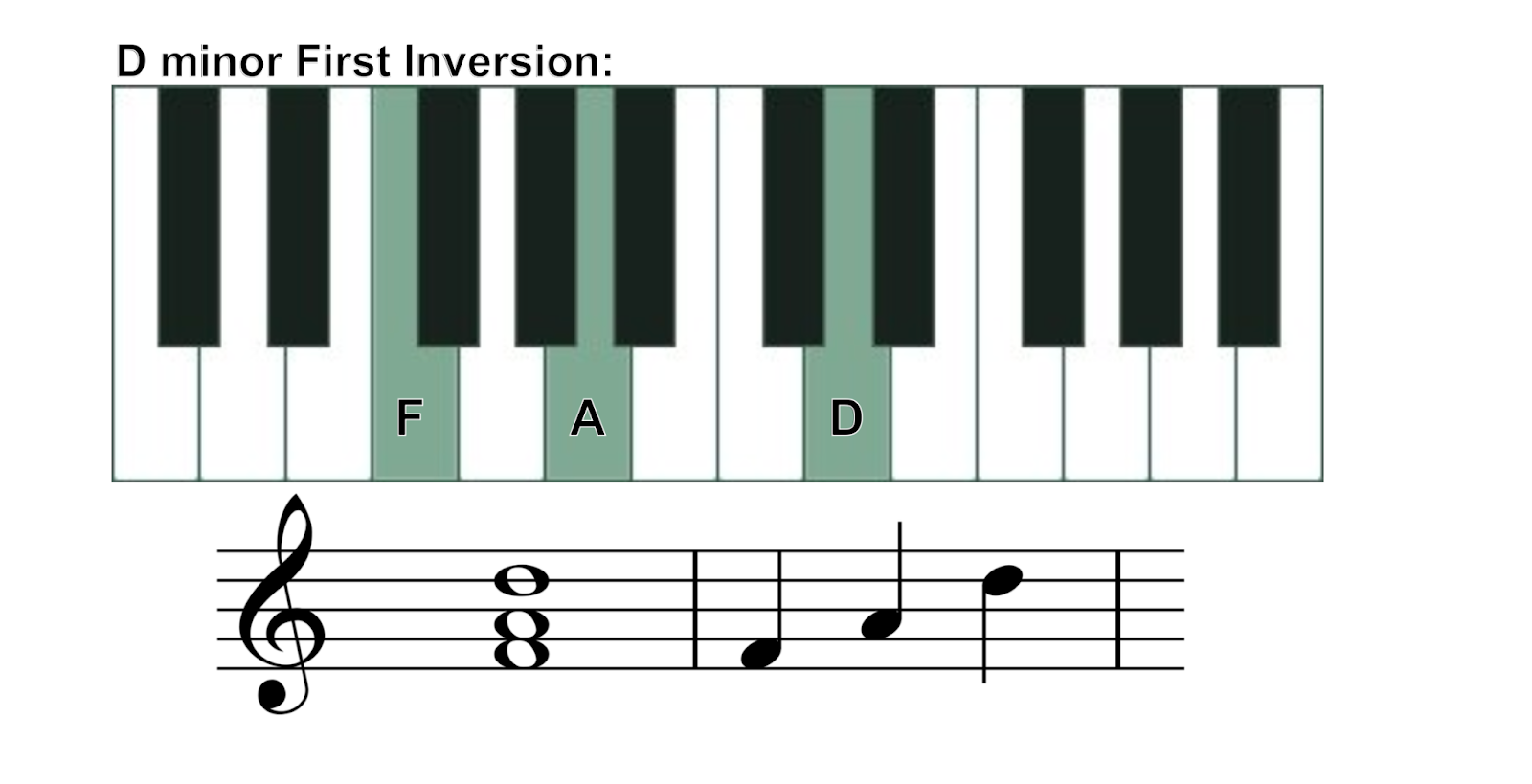
For the right hand, use these fingers:
- F – Thumb (1)
- A – Middle finger (3)
- D – Fifth finger (5)
For the left hand, use these fingers:
- F – Fifth finger (5)
- A – Third finger (3)
- D – Thumb (1)
How to play D minor second inversion?
To play the second inversion, start with A as the low note. Then play D and add F as the highest note. This fun inversion is great for setting up a sense of movement in your chord sequences.
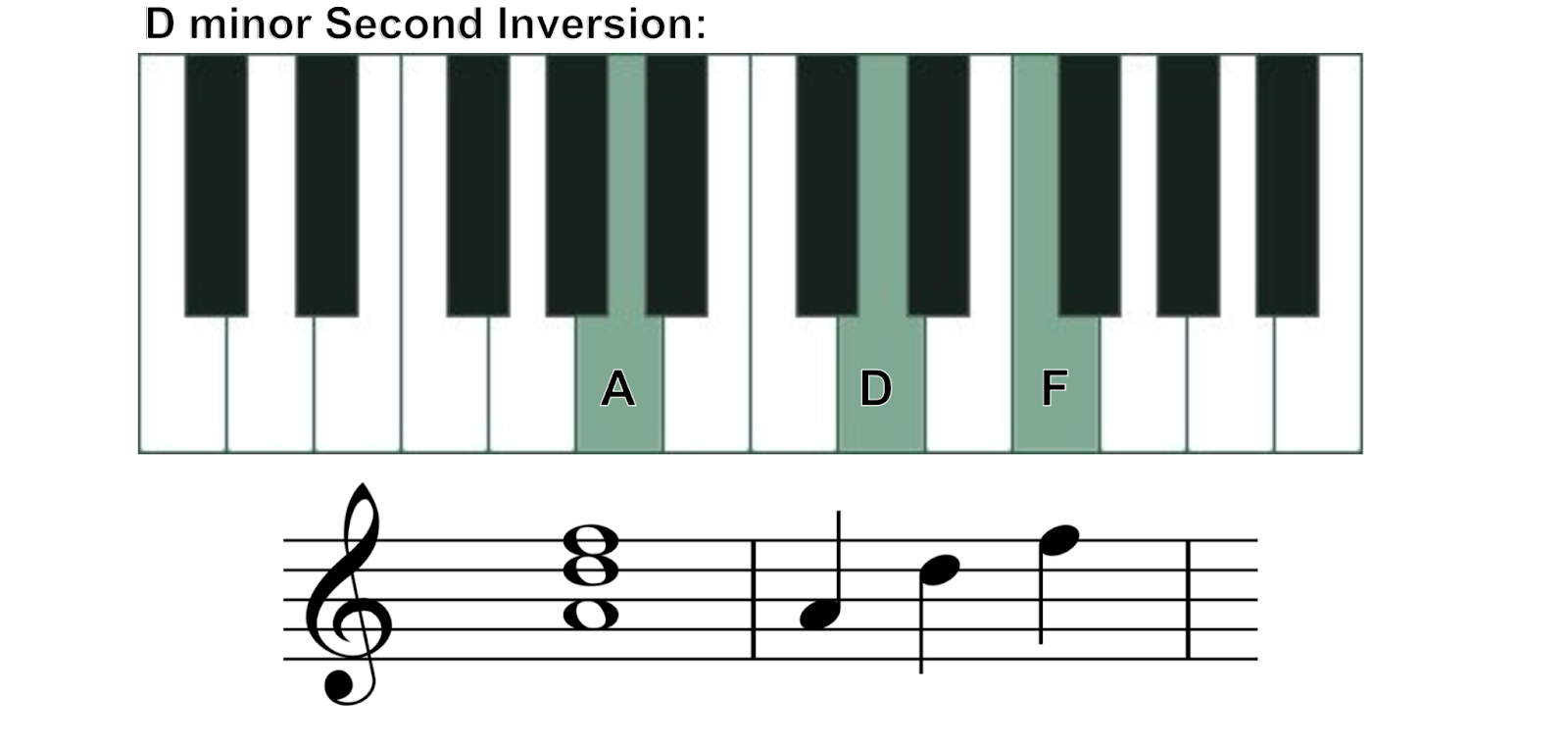
For the right hand, use these fingers:
- A – Thumb (1)
- D – Middle finger (3)
- F – Fifth finger (5)
For the left hand, use these fingers:
- A – Fifth finger (5)
- D – Third finger (3)
- F – Thumb (1)
Common chord progression in the key of D minor
The D minor chord progression is used in a lot of music. Here are some simple diatonic D minor chord progressions that appear in rock and pop to jazz, classical and much more besides:
- Dm – Gm – F – C
- Dm – C – Bb – Am
- Dm – Am – Bb – Gm
- Dm – Bb – C – F
To understand piano chords and chord symbols further and how to play them, have a go at Skoove’s tailor-made beginner chord progression courses.
Piano chords generator
💡 If you are reading this from a mobile device, rotate it to display the tool in full width.
1. Click on “Chords”
2. Choose the “Root” of the chord
3. Choose the “Chord qualities” (major, minor, etc.)
4. Click “Display”
Tips for practicing the D minor chord
Once you understand the basics a few simple practice techniques can help you play chords more confidently and use them in real music.
- Start slow: Be sure to play the D minor chord piano shape slowly so each note sounds at the same time and volume.
- Keep your hands relaxed: Tension in your body slows you down. Stay loose so your chords move smoothly and naturally with the music.
- Memorize the notes: Think D – F – A. Knowing the notes in the D minor chord helps you build other chords faster.
- Practice both hands separately first: This makes it easier to control your fingering before combining hands.
- Use inversions to stay comfortable: Move between root position and the chord inversions. This will help you keep from jumping around the keyboard when playing chords in songs.
- Try simple progressions: Use the songs we will take a look at next to practice real musical movement in context.
- Experiment with variations: Add a D minor 7 chord or a D sus chord, a D augmented chord or even a D diminished chord to hear how the sound changes.
Popular songs to play with the D minor piano chord
Putting new techniques into practice is the best way to make them feel easy. Let’s take a look at a selection of fun songs that you can play with the Skoove app.
Amy Winehouse – “Back to Black”
This soulful classic makes use of a D minor progression starting with a root position chord that appears regularly in the steady chord pattern throughout the piece.
Lady Gaga – “Bloody Mary”
“Bloody Mary” by Lady Gaga is a perfect song to practice if you want to hear how minor chords are used to build emotion and tension in modern pop music.
Sting – “English Man in New York”
The song features smooth chord movement and it’s a perfect place to experiment with the D minor 7 chord. You can have fun adding that extra note to give your playing a richer, more relaxed feel while staying true to the song’s unique vibe.
Bring your playing to life with the Dm chord
The D minor chord has a naturally expressive sound that works in everything from simple melodies to more complex progressions. Keep revisiting the D minor chord in different contexts to keep building your chord skills. With Skoove, you can learn step by step and start playing your favorite songs faster than you think. Keep up the practice!
Author of this blog post:
Matthew Dickman

With over a decade of experience in music education Matthew holds a BA in Music from Paul McCartney’s LIPA and an MA in Composition from the University of Salford. Mathew has developed a distinctive compositional voice and approach to music theory education through his research and work in the music industry. Matthew’s writing for Skoove combines experience from orchestral and media composition, and as a gigging jazz musician, to create a wholistic and accessible pedagogy for musicians of any level. Away from music, he enjoys reading and exploring nature to expand his horizons and knowledge contributing to his holistic teaching style.