


The Eb major chord is made up of Eb, G and Bb. It appears constantly in pop, jazz, soul and classical music. Once you know it, you’ll start hearing it everywhere.
In this guide you’ll learn the Eb chord notes, fingering for both hands, inversions, common chord variations, chord progressions, and a few songs to put it all into practice. Let’s get started.
What are the notes in the Eb Chord?
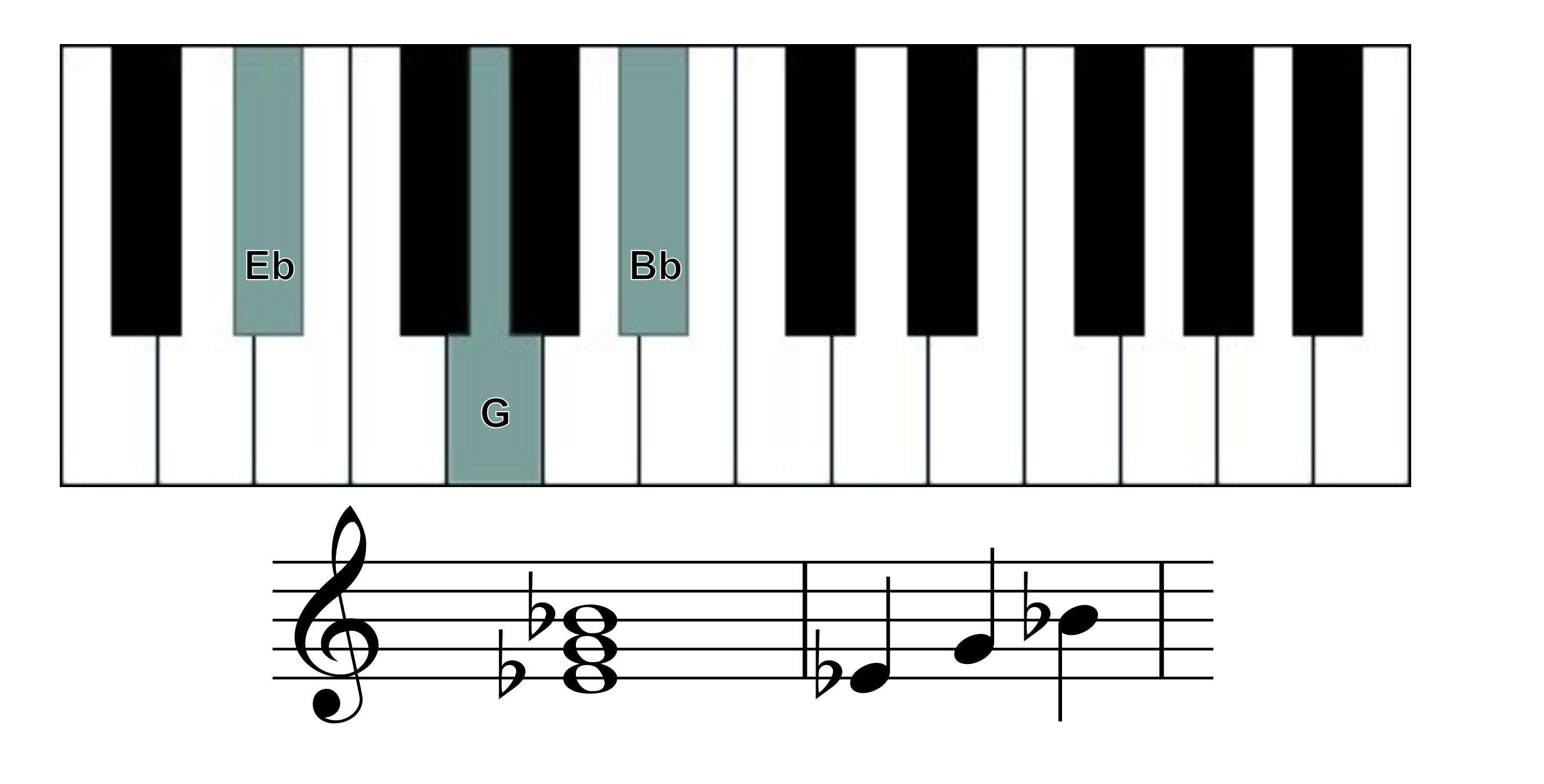
The Eb chord piano consists of the notes Eb, G, and Bb. Eb is the root note of the chord, G is the major third, and Bb (B flat) is the perfect fifth, which is also important in the key signature of E-flat major.
Here’s a quick way to find them on the keyboard:
- Eb – the second of the two black keys in any group of two black keys
- G – the white key sitting between the first two of the three black keys
- Bb – the last of the three black keys
How to play the Eb major chord on piano?
To play the E flat chord on piano, you need to place your fingers in specific positions on Eb, G, and Bb at the same time. Pay attention to the order in which you set your fingers to ensure smooth movement and accuracy. Here is the correct fingering and finger positions for both hands:
Right hand (root position):
- Bb – Fifth finger (5)
- G – Third finger (3)
- Eb – Thumb (1)
Left hand (root position):
- Bb – Thumb (1)
- G – Third finger (3)
- Eb – Fifth finger (5)
Keep your hand relaxed and slightly curved, like you’re holding a small ball. After placing your fingers in the correct positions, check your hand position and play the chord to check that every note sounds at exactly the same time. If one note sounds weaker than the others, isolate it and press it a little more firmly until the chord sounds even.
What are the intervals in a Eb major chord?
The intervals used to build the Eb major triad are derived from the Eb major scale, which provides the foundational notes for the chord. Here’s what’s happening inside the Eb major triad:
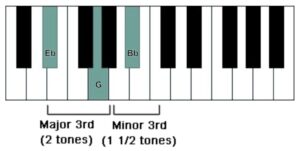
- Eb → G = 4 semitones (a major third)
- G → Bb = 3 semitones (a minor third)
- Eb → Bb = 7 semitones (a perfect fifth)
Every major chord uses this same stacked structure: a major third on the bottom, a minor third on top. Once you understand this formula, you can build any major chord from scratch.
This structure in root position is:
What are the inversions of a Eb major chord?
Chord inversions let you play the same chord with a different sound by changing which note is the bass note. Each inversion of the Eb major triad is defined by a different bass note. In root position, the root note (Eb) is the bass note. The Eb major triad has two inversions, first and second. Let’s take a look at how these work in detail.
How to play Eb chord first inversion?
To play the first inversion, use G as the bass note (the lowest note). Next, play Bb above it and finally, put Eb at the top. This produces a new chord voicing that can be beneficial for smooth chord transitions.
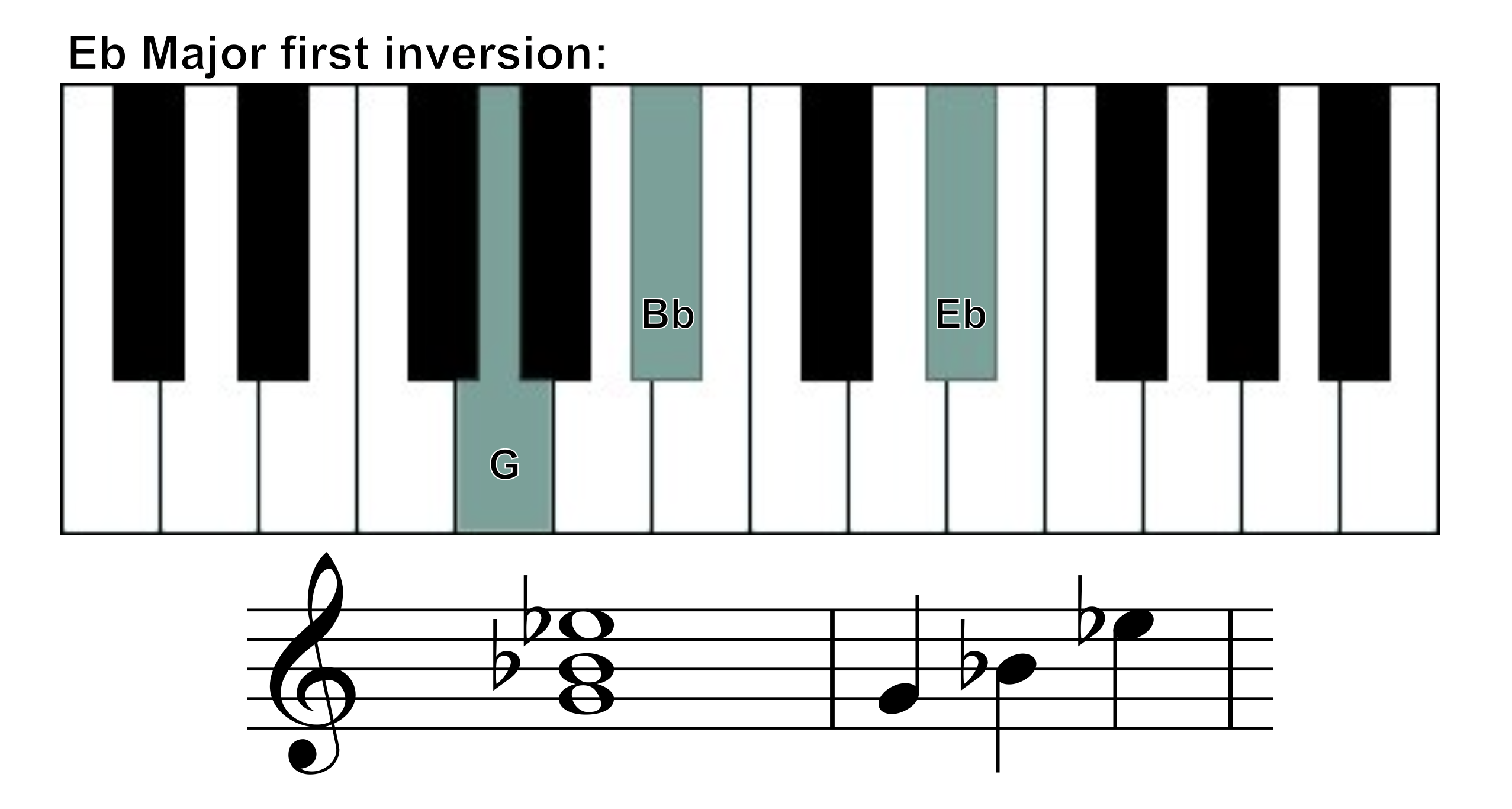
For the right hand, use these fingers:
- Eb – Fifth finger (5)
- Bb – Middle finger (3)
- G – Thumb (1)
For the left hand, use these fingers:
- Eb – Thumb (1)
- Bb – Third finger (3)
- G – Fifth finger (5)
How to play Eb chord second inversion?
To play the 2nd inversion of the Eb major piano chord, use Bb as the bass note (the lowest note). Then, play Eb above it and finally, add G at the top. This variation creates a new feeling for the chord and makes it easier to shift through chord progressions naturally.
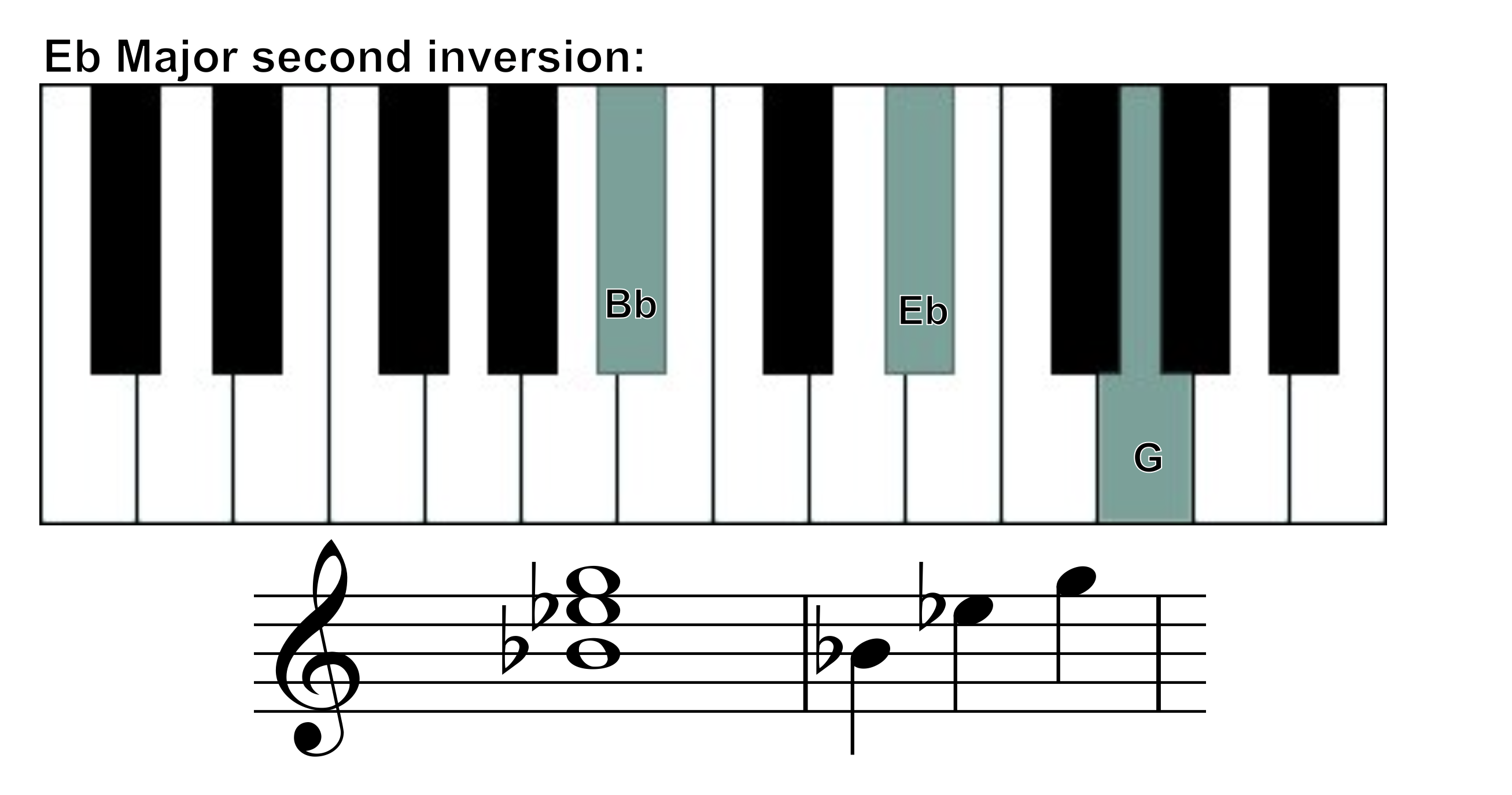
For the right hand, use these fingers:
- G – Fifth finger (5)
- Eb – Middle finger (3)
- Bb – Thumb (1)
For the left hand, use these fingers:
- G – Thumb (1)
- Eb – Third finger (3)
- Bb – Fifth finger (5)
Eb major chord progression
Eb major chord progressions are used in many common chord progressions and follow the same diatonic pattern as every other major key. The diatonic chords in the key of Eb major are:
Eb major — F minor — G minor — Ab major — Bb major — C minor — D diminished
Here are some popular Eb major piano chord progressions:
- Eb – Ab – Bb – Bb
- Cm – Eb – Ab – G
- Eb – Ab – Bb – Ab
- Ab – Cm – Ab – Eb
Play each chord in root position first. Once they feel comfortable, experiment with inversions to make the transitions smoother. Skoove’s beginner chord progression lessons walk you through each of these step by step with real-time feedback.
Piano chords generator
💡 If you are reading this from a mobile device, rotate it to display the tool in full width.
1. Click on “Chords”
2. Choose the “Root” of the chord
3. Choose the “Chord qualities” (major, minor, etc.)
4. Click “Display”
Popular songs to play with the Eb major piano chord
The best way to make any chord feel natural is to use it in real songs. Here are two classics that will put your e flat major chord piano skills to work immediately.
Joseph Kosma – “Autumn Leaves”
One of the most popular jazz standards for beginners, Autumn Leaves uses the Eb major chord naturally within its chord progression. As you get comfortable, try adding the major seventh extension (Ebmaj7) to give it that classic jazz flavour.
Start playing your favourite music with the Eb chord
Learning the Eb chord is a great achievement. Once you’re familiar with it and comfortable with the shape, you’ll notice it everywhere. Take your time with it, play it slowly, experiment with different inversions and have fun using it in a few chord progressions and songs.
With Skoove, you can learn step by step and start playing your favorite songs faster than you think. Keep up the good work!
Author of this blog post:
Matthew Dickman

With over a decade of experience in music education Matthew holds a BA in Music from Paul McCartney’s LIPA and an MA in Composition from the University of Salford. Mathew has developed a distinctive compositional voice and approach to music theory education through his research and work in the music industry. Matthew’s writing for Skoove combines experience from orchestral and media composition, and as a gigging jazz musician, to create a wholistic and accessible pedagogy for musicians of any level. Away from music, he enjoys reading and exploring nature to expand his horizons and knowledge contributing to his holistic teaching style.