


The E major chord is made up of E, G# and B. It’s one of the most common chords you’ll encounter across pop, rock, jazz and classical music. Learning this triad on piano will help you understand how chords work and improve your music theory knowledge. In this guide, you’ll learn how to play the E chord, including finger placement, inversions, chord progressions and some fun variations.
How do you play an E chord?
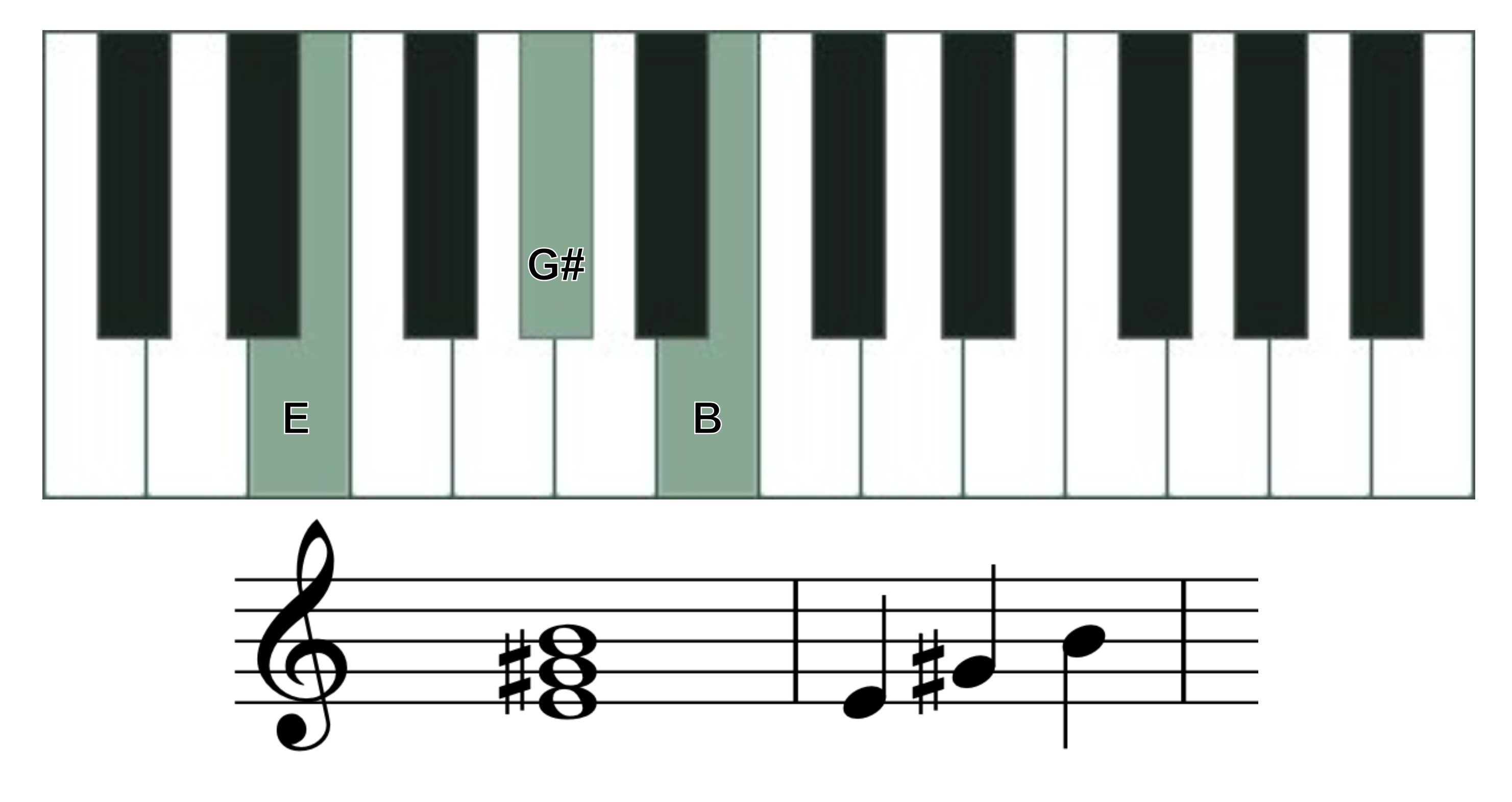
To play the E chord piano shape, you need three notes: E, G# and B.
Here’s where to find them on your keyboard:
- E – the white key immediately to the right of the group of two black keys
- G# – the middle key in the group of three black keys
- B – the white key immediately to the right of the group of three black keys
Play all three notes at the same time and you have your E major chord. It has a bright, open, almost triumphant sound, you’ll recognize it the moment you hear it.
What is the fingering for an E major chord?
To play this chord in its root position (basic form) with your right hand, use these fingers:
- E – Thumb (1)
- G# – Third finger (3)
- B – Fifth finger (5)
For the left hand, use the following fingers:
- E – Fifth finger (5)
- G# – Third finger (3)
- B – Thumb (1)
Keep your hand relaxed and curved, as if you’re holding a small ball. Tension is the enemy of clean chords, if your wrist feels stiff, shake it out and start again.
What are the intervals in an E major chord?
All major chords are defined by their interval structure. Every major chord is a triad, built from three notes: the root note, the third, and the fifth. In the case of the E major chord, the triad consists of the root note E, the major third G#, and the perfect fifth B. Each note has a name based on its function within the chord:
- E – Root
- G# – Third
- B – Fifth
This structure in root position is:
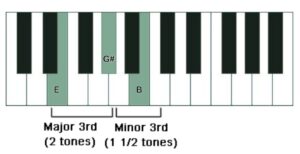
From the root to the third of a major chord (E to G#) is 4 semitones, a major third. From the third to the fifth (G# to B) is 3 semitones, a minor third. This combination of intervals creates a perfect fifth (7 semitones) between the root and the fifth (E to B). A minor chord, by contrast, has a minor third instead of a major third between the root and the third.
Try separating these notes out and play them one by one as a broken chord. This experimentation will give you a more in depth understanding of how these chords sound and function and get you used to playing them, especially if you try with the inversions we are about to look at.
What are the inversions of the E major chord?
Chord inversions let you play the same three notes in a different order. They’re essential for smooth chord transitions because they reduce how far your hand has to move on the keyboard. The E major chord has two inversions.
How to play E chord first inversion?
To play E major chord first inversion, start with G# as the lowest note. Next, play B above it and finally add E as the highest note. This gives the chord a fresh sound that’s great for smooth transitions in progression.
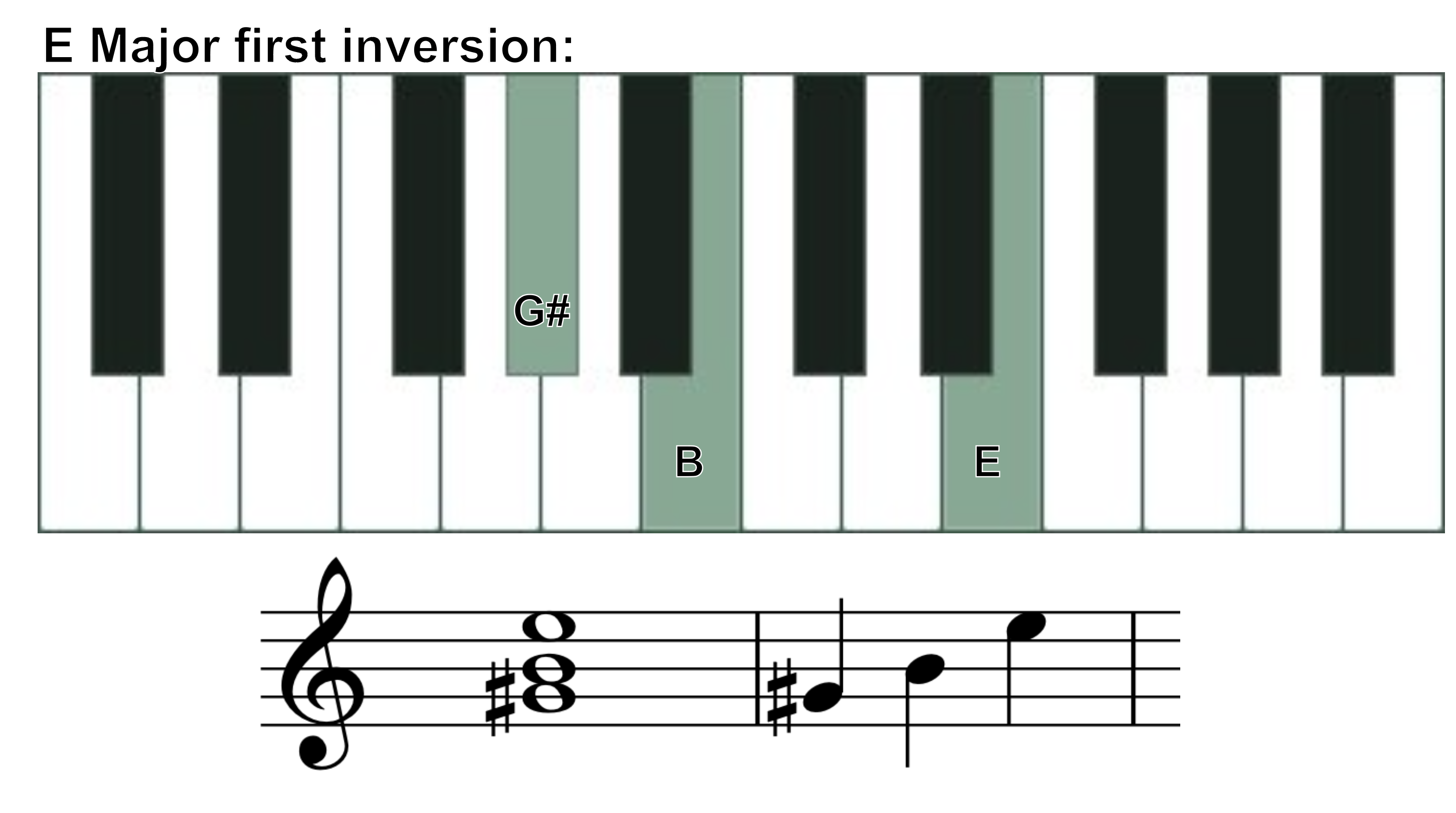
For the right hand, use these fingers:
- E – Fifth finger (5)
- B – Second finger (2)
- G# – Thumb (1)
For the left hand, use these fingers:
- E – Thumb (1)
- B – Second finger (2)
- G# – Third finger (3)
How to play E chord second inversion?
To play E major chord second inversion, start with B as the lowest note. Then play E above it and finally add G# as the highest note.
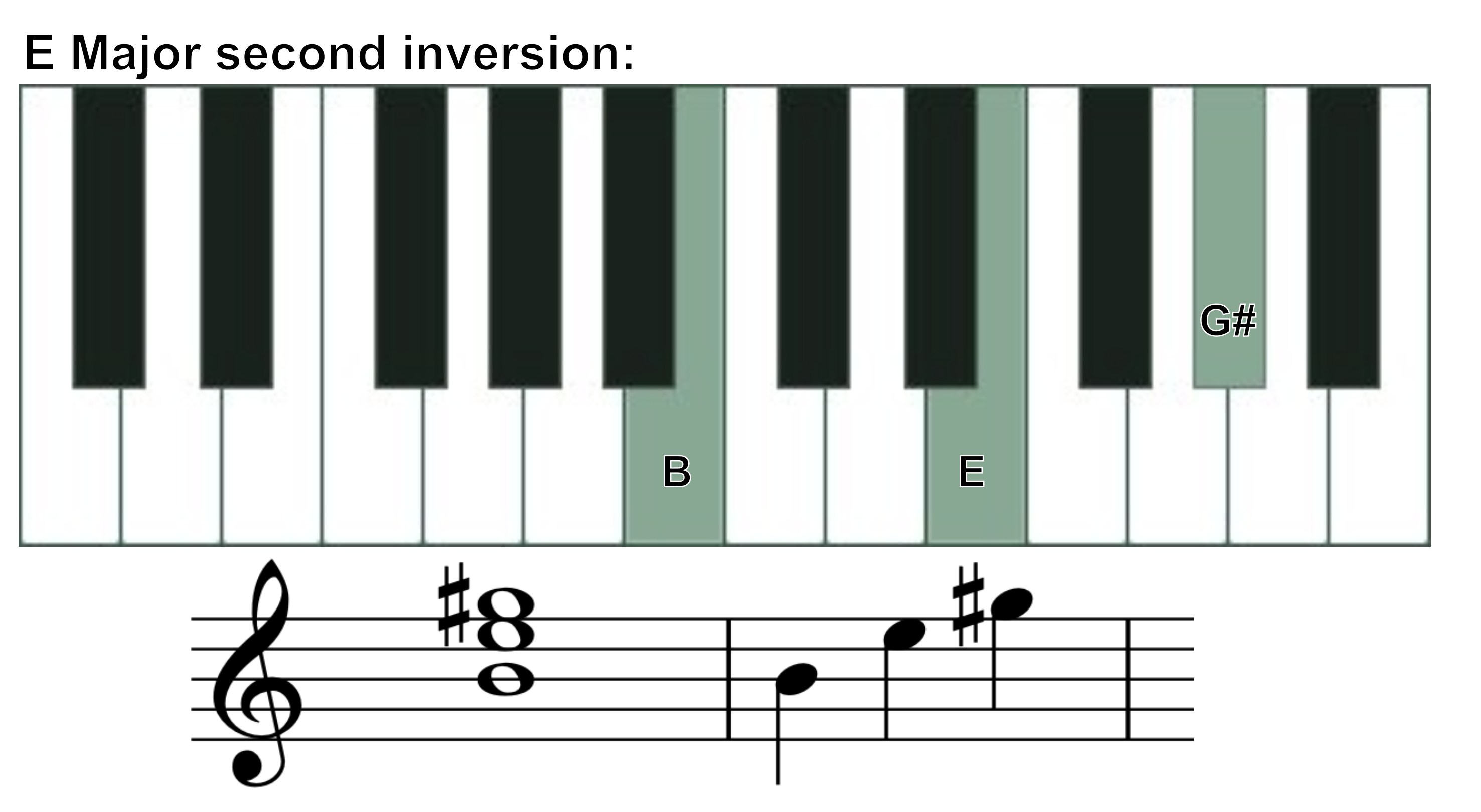
For the right hand, use these fingers:
- G# – Fifth finger (5)
- E – Middle finger (3)
- B – Thumb (1)
For the left hand, use these fingers:
- G# – Thumb (1)
- E – Second finger (2)
- B – Fifth finger (5)
The second inversion has a slightly unresolved, floating feeling that composers use to build tension before landing on a strong root-position chord.
E major chord progression
E major is a versatile key often paired with other simple chords like A major and B7 in many popular songs. Here are three common E major chord progressions you can try right now:
- Pop / ballad: E – C#m – A – B
- Minor-flavored: E – C#m – F#m – B
- Rock staple: E – A – B – C#m
When practicing these E major chord progressions on piano, use inversions to minimize hand movement. For example, if you move from E (root position) to A, play A in second inversion (E on the bottom) so your hand barely shifts at all.
These progressions are a great way to put your knowledge of piano chords to the test. To understand these chord symbols and how to play them, check out Skoove’s tailor-made beginner chord progression courses.
Piano chords generator
💡 If you are reading this from a mobile device, rotate it to display the tool in full width.
1. Click on “Chords”
2. Choose the “Root” of the chord
3. Choose the “Chord qualities” (major, minor, etc.)
4. Click “Display”
Popular songs to play with the E major piano chord
Have a go at some popular songs that are perfect for getting comfortable with this new chord and learning some new tunes as you go. Learning to play the E major chord is a great way to start if you want to learn chords and expand your ability to play a wide variety of songs.
Barry Manilow – “Copacabana”
This catchy classic makes excellent use of the E dominant 7 chord (E7). It’s a fun, low-pressure way to explore more colorful harmony.
“Bella Ciao”
A wonderful introduction to using the E major chord in a minor musical context, drawing on the harmonic minor scale for its distinctive sound.
Frank Sinatra – “All the Things you Are”
A beautiful jazz standard that puts chord extensions like Emaj7 to work in a real musical setting. A natural next step once you’re comfortable with the basic E chord.
Keep building with E major
You now have everything you need to play the E major chord on piano confidently, the notes, the fingering, the inversions, the variations and the progressions. Take your time exploring each of these and, most importantly, use them in real songs as quickly as you can. That’s where theory becomes music.
With Skoove, every step is guided ,you always know exactly what to do next. Try it free and start playing the songs you love.
Author of this blog post:
Susana Pérez Posada

With over seven years of piano education and a deep passion for music therapy, Susana brings a unique blend of expertise to Skoove. A graduate in Music Therapy from SRH Hochschule Heidelberg and an experienced classical pianist from Universidad EAFIT, she infuses her teaching with a holistic approach that transcends traditional piano lessons. Susana’s writings for Skoove combine her rich musical knowledge with engaging storytelling, enriching the learning experience for pianists of all levels. Away from the piano, she loves exploring new places and immersing herself in a good book, believing these diverse experiences enhance her creative teaching style.
Published by Lydia Ogn from the Skoove team