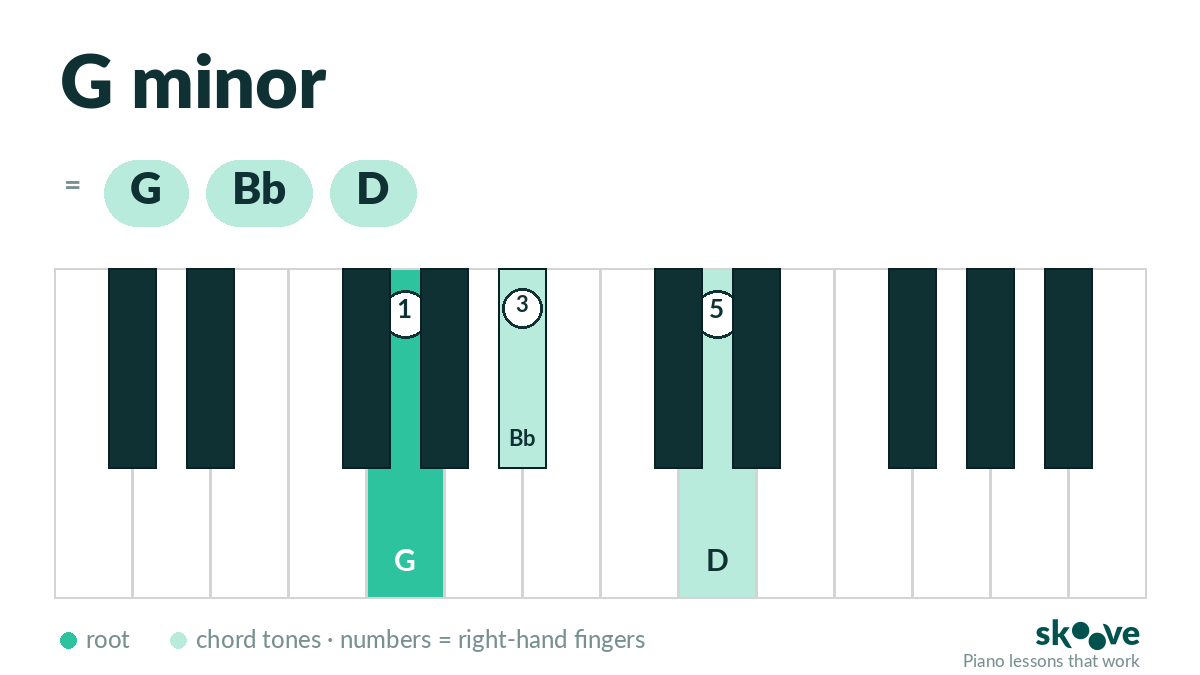
The G minor chord is a chord with a minor quality starting on the root note of G. It is made up of a G, Bb and a D. This chord is used across loads of styles of music, from classical to pop and film music, giving a dark, emotional sound that often stands out.
In this guide, you’ll learn how to play the G minor chord piano shape, including fingering, techniques and inversions. We will also review some chord progressions and some songs that use G minor so you put your newfound knowledge into action straight away. Mastering the Gm piano chord is an important addition to your piano repertoire and understanding of harmony. Let’s get going!
How to play the G minor chord on the piano?
To play any chord on piano you need to be able to find the notes in that chord. To play the G minor, you need to find three notes: G, Bb and D. G is the white key in between the first two of three black keys. Bb is the last of the three black keys. D is the white key in between the set of two black keys.
What is the fingering for a G minor chord?
To play piano chords with proper technique you must use the correct fingerings. Here’s a guide to which fingers press each key for the Gm piano chord in root position.
To play this chord in its root position (basic form) with your right hand, use these fingers:
- D – Fifth finger (5)
- Bb – Third finger (3)
- G – Thumb (1)
For the left hand, use the following fingers:
- D – Thumb (1)
- Bb – Third finger (3)
- G – Fifth finger (5)
When played together, these notes should make a beautiful melancholy minor sound.
What are the intervals in a G minor chord?
All minor chords follow a specific interval structure that creates their characteristic sound. Let’s see how this relates to the G minor chord. This is how the notes in the chord are labeled.
- G – Root
- Bb – Minor third
- D – Fifth
The interval from the root to the third (G to Bb) is 3 semitones, this is a minor third. From the third to the fifth (Bb to D) is 4 semitones, this is a major third. This creates a perfect fifth (7 semitones) between G and D.
Have a go at separating these notes out and play them one by one as a broken chord. This will give you a more of a feel of how these chords sound and work. You can try this with this root position chord and with the inversions we will look at later.
What are the inversions of a G minor chord?
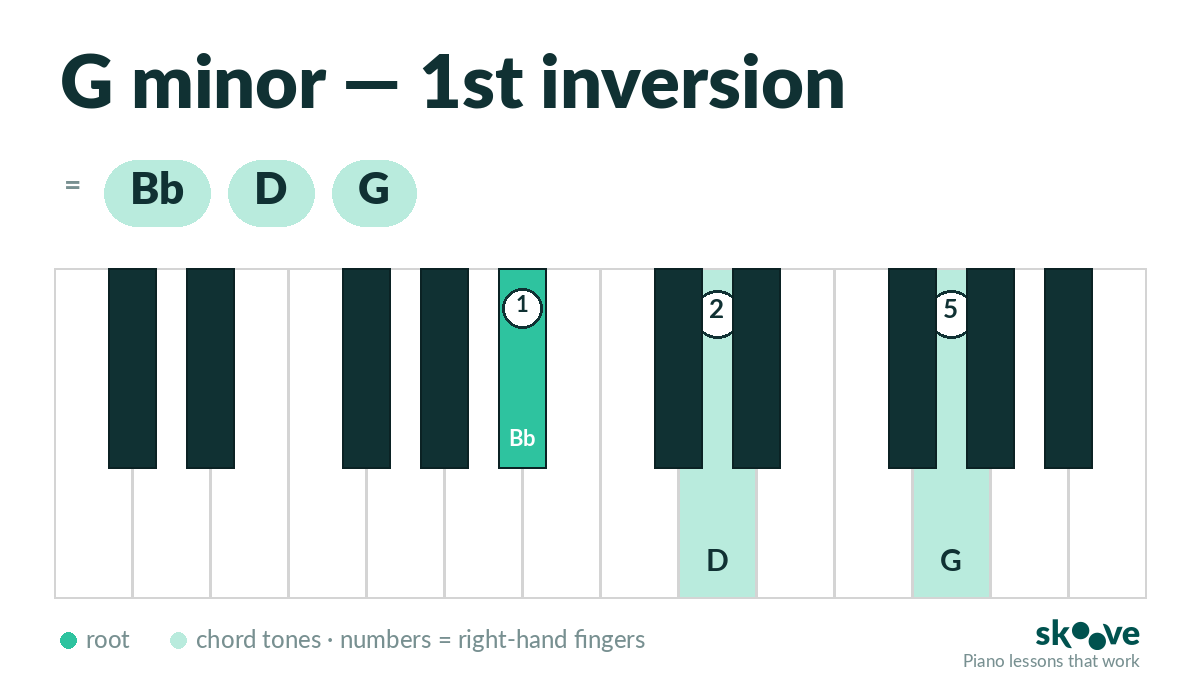
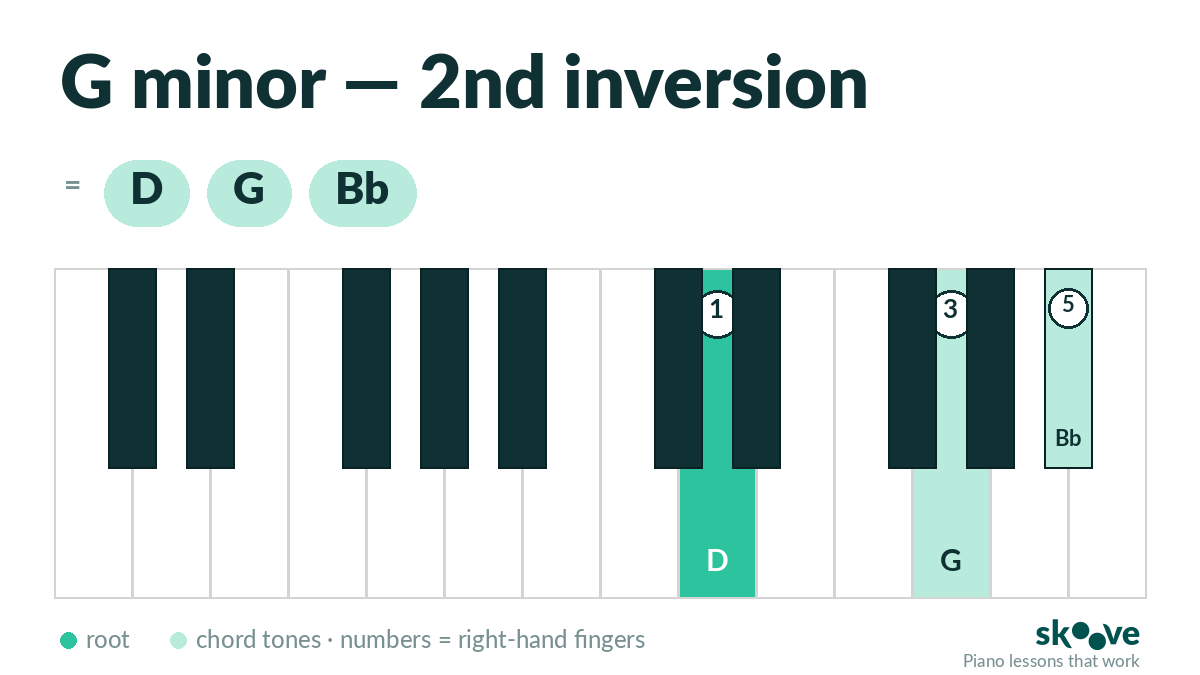
The G minor piano triad has two inversions, first and second. These chord inversions let you play the same chord with a small variation on the feeling it makes. First inversion moves G to the top, making Bb as the lowest note. Second inversion shifts both G and Bb to the top, making D the lowest note. Let’s take a look at how that works on piano.
How to play G minor first inversion?
To play the first inversion of the G minor, start with Bb as the bottom note. Then, add the D above it and the G as the highest note. This note switch up gives the chord a different sound that’s useful for transitions between chords.
For the right hand, use these fingers:
- G – Fifth finger (5)
- D – Middle finger (3)
- Bb – Thumb (1)
For the left hand, use these fingers:
- G – Thumb (1)
- D – Third finger (3)
- Bb – Fifth finger (5)
How to play G minor second inversion?
To play the second inversion of the G minor piano chord, make D as the lowest note. Then add a G above it and finally make Bb the top note. This inversion gives the chord a different sound. This inversion is often used to make chord variations and transitions more varied and interesting.
For the right hand, use these fingers:
- Bb – Fifth finger (5)
- G – Middle finger (3)
- D – Thumb (1)
For the left hand, use these fingers:
- Bb – Thumb (1)
- G – Second finger (2)
- D – Fifth finger (5)
Common G chord variations
There are a lot of other types of G chord that you will encounter on your piano playing journey. These are a selection of common variations for you to get familiar with in a handy table.
| Chord | Notes (root position) | 1st inversion | 2nd inversion | 3rd inversion | Character / use |
| G minor 7 chord | G – Bb – D – F | Bb – D – F – G | D – F – G – Bb | F – G – Bb – D | smooth, jazzy sound |
| G minor major 7 | G – Bb – D – F# | Bb – D – F# – G | D – F# – G – Bb | F# – G – Bb – D | dramatic, emotional |
| G sus2 | G – A – D | A – D – G | D – G – A | – | open, airy sound |
| G sus4 | G – C – D | C – D – G | D – G – C | – | suspended tension |
| G augmented | G – B – D# | B – D# – G | D# – G – B | – | unstable, tense |
| G diminished chord | G – Bb – Db | Bb – Db – G | Db – G – Bb | – | dark, dissonant |
Common chord progression in the key of G minor
Chord progressions in the key of G minor are used all over from rock and pop to jazz and much more. G minor chord progressions often make use of Gm, Bb, D and Eb and other diatonic chords. Here are some G minor chord progressions to start experimenting with:
- Gm – D – Bb – F
- Gm – Eb – Bb – D
- Gm – Eb – Dm – D
- Gm – D – Eb – F
To get comfortable with these chord symbols, take a look at Skoove’s tailor-made beginner chord progression courses. These sequences are a great way to put your newfound knowledge of piano chords to the test, be sure to take your time with them.
Piano chords generator
💡 If you are reading this from a mobile device, rotate it to display the tool in full width.
1. Click on “Chords”
2. Choose the “Root” of the chord
3. Choose the “Chord qualities” (major, minor, etc.)
4. Click “Display”
Final tips for practicing the G minor chord
Once you have gotten to grips with the G minor chord, a few simple practice tips can help you really lock it into your skillset.
- Start slow: Be sure to play the G minor chord piano shape slowly so each note sounds at the same time and volume.
- Keep your hands relaxed: Tension in your body makes your playing feel stiff. Stay loose so your chords sound free and easy.
- Memorize the G chord notes: Think G – Bb – D. Knowing the notes in the G minor chord helps you build other chords faster.
- Practice both hands separately first: This makes it easier to control your fingering before combining hands which is more complex.
- Use inversions to stay comfortable: Try moving between root position and inversions we looked at. This will help you to avoid jumping around the keyboard when playing chords in songs.
- Try simple progressions: Use the songs we will take a look at next to practice real music in context.
- Experiment with variations: Add a G minor 7 chord or a G sus chord, a G augmented chord or even a G diminished chord to hear how the sound changes with these variations.
Popular songs to play with the G minor piano chord
Let’s take a look at a few songs that make use of the G minor chord. Putting your newfound knowledge into practice is the best way to get Gm chord feeling natural.
Amy Winehouse – “Back to Black”
This soulful classic is a great way to get used to the inversions of a G minor chord in a steady repeating chord pattern.
Gilbert O’Sullivan – “Alone Again (Naturally)”
This soulful song is a great way to practice G minor as a broken chord pattern while working on your hand independence.
Aqua – “Barbie Girl”
This fun tune lets you introduce yourself to G minor in an easy way with a nice left hand bassline and right hand melody.
The next chord in your progression
Now we have gone through everything you need to know to fully understand G minor on the piano; root position, inversions and how the Gm chord fits into progressions. Before long you’ll start to recognize it in real music.
Keep going over the G minor chord in different contexts to keep improving your chord skills. With Skoove, you can learn step by step and start playing your favorite songs faster than you think. Keep up the good work and happy playing!
FAQ
Author of this blog post:
Matthew Dickman
With over a decade of experience in music education Matthew holds a BA in Music from Paul McCartney’s LIPA and an MA in Composition from the University of Salford. Mathew has developed a distinctive compositional voice and approach to music theory education through his research and work in the music industry. Matthew’s writing for Skoove combines experience from orchestral and media composition, and as a gigging jazz musician, to create a wholistic and accessible pedagogy for musicians of any level. Away from music, he enjoys reading and exploring nature to expand his horizons and knowledge contributing to his holistic teaching style.