




The great thing about the piano is its incredible range of notes. Standard keyboards have 88 keys. That gives us a lot of room to work with! Unfortunately, there are only 5 lines on the treble and bass staff. How can we use sheet music to represent really high or really low notes? The answer is simple. We use ledger lines. If you’re unsure about what ledger lines are, Skoove is here to help. This article will teach you everything you need to know from treble to bass clef ledger lines and how to get used to reading them on your own. Let’s dive in!.
What are ledger lines?
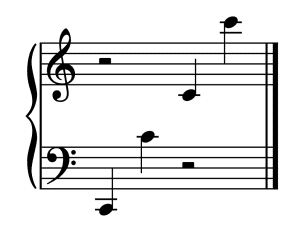
Ledger lines are the lines that represent the lines of the staff whenever notes need to be written above or below the five lines of a standard staff. As each clef only has five lines, we have to figure out a way to learn how to read piano notes names when they fall off the grand staff. These are an important part of learning to read piano sheet music.
How to read ledger lines
Let’s take a look at how to read and understand ledger lines. Remember each clef has five lines and four spaces and note names continue in order on the musical staff. This is true for both notes on the staff or ledger lines. We will start by looking at each stave individually.
How to read ledger lines on treble clef
Remember your treble clef notes? The top line of the treble is F, so logically, the next note that follows in the musical alphabet is G. The easy way here is to just continue counting letters, starting after F. The first line note is going to be A, since G is still touching the treble staff. Notice how these ledger lines still follow the same alphabetic sequence as the notes on the treble stave.

How to read ledger lines on bass clef
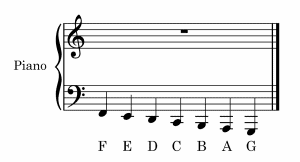
Just like the treble, we use bass ledger lines to play notes that fall outside the staff, most often below the staff in piano music. Our bottom line on the bass is G, so the bottom space below the clef would be F. This means our first ledger line is going to be the note E. Notice, as with treble clef, how bass clef ledger lines still follow the same alphabetic sequence as the notes on the bass clef stave.
Remember anchor notes are a great way to navigate note reading and keyboard music on across and between the grand staff.
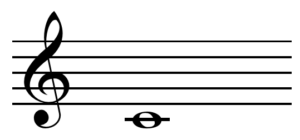
Middle C and C at other points on the staff lets us figure out any other note that is close to one of these Cs. Practicing this recognition makes ledger line note reading quite simple.
Figuring out line and space notes on ledger lines
Ledger line notes can fall on spaces or lines, just like notes on the staff. You don’t need to memorise these recognising the pattern and connecting it to the keyboard is far more effective.
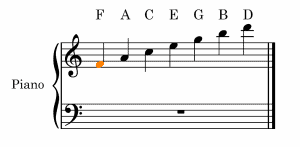
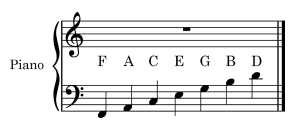
Space notes continue in the same letter order (F–A–C–E–G–B–D).
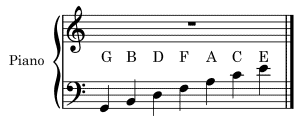
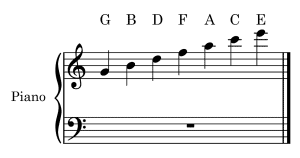
Line notes follow the same pattern in reverse (G–B–D–F–A–C–E).
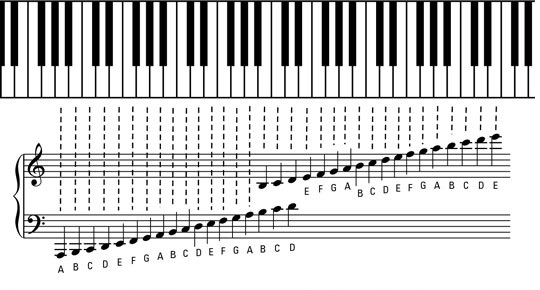
Take a look at this handy image and take a look at how staff and ledger line notes are laid out in alphabetical order. Try to recognise them with the handy tips we have already been through in this article.
Avoiding multiple ledger lines on the treble clef
The ledger lines could theoretically continue on and on, as the staff represents as many notes as your piano can play. When you take online piano lessons you will learn that in order to avoid too many ledger lines, many composers will skip writing ledger line notes. When reading music that is very high, often composers will just use an 8va, or “Ottava”, or “octave above” sign.
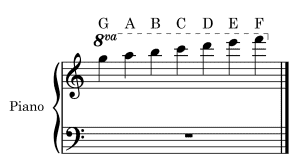
The notes are still the same, and musicians will recognize that they are the same notes as before, just one octave above. Remember to count your ledger lines when you are sight-reading notes on the treble clef.
Avoiding multiple ledger lines on the bass clef
As with the treble staff, we can play notes that are even too low out of the line. We can actually write a similar symbol to 8va for bass clef, we write 8ba which means play the notes an octave below.
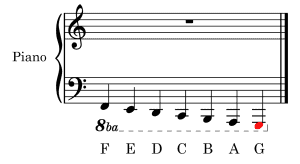
Using these 8ve and 8ba symbols is a good way to avoid vast amounts of ledger lines and makes sure music is easy to read.
How to remember notes on ledger lines
Ledger lines can feel confusing at first, but they follow the same simple rules as notes on the staff. With the right strategies, reading ledger lines in music quickly becomes second nature. Let’s recap and explore some of the best ways to get comfortable with ledger lines.
- Think in steps, not jumps
Notes on ledger lines continue the musical alphabet exactly as they do on the staff. If you know your treble clef notes or bass clef notes, simply count up or down one letter at a time. - Use anchor notes as reference points
Middle C and other C notes on ledger lines are powerful landmarks. Once you spot a C, it becomes much easier to identify nearby ledger line notes without counting every line. - Recognise line and space patterns
Ledger line notes still alternate between lines and spaces. Space notes follow the same order (F–A–C–E–G–B–D), while line notes follow the reverse pattern (G–B–D–F–A–C–E).
- Visualise the piano keyboard
Connecting notes on ledger lines to their physical location on the keyboard is one of the fastest ways to learn. This is especially helpful when reading piano ledger lines across both hands.
- Practise octave shifts
Take a familiar piece and play it one octave higher or lower. You’ll feel the same note patterns under your fingers, helping you recognise ledger lines without hesitation.
- Learn in small ranges
Start with just one or two ledger lines above or below the staff. Once those feel comfortable, gradually expand your range rather than trying to memorise everything at once.
- Watch for 8va and 8ba markings
These symbols reduce the need for multiple ledger lines and are commonly used in piano music. Understanding them makes reading ledger lines faster and cleaner.
With consistent practice, ledger line notes stop feeling like “extra lines” and start feeling like a natural extension of reading sheet music.
Ledger lines in music
The best way to get used to ledger lines is through regular playing. Explore music that gently pushes you above and below staff. This will help reinforce how ledger lines work in real pieces. Take a look at what we offer on Skoove and try a few examples to build your confidence and fluency with expert lessons and guidance.
In the hall of the mountain king – Edvard Grieg
Another one bites the dust – Queen
Feather – Sabrian Carpenter
Play more notes with ledger lines on the piano
Ledger lines extend the written staff so pianists can access the full range of the keyboard without overcomplicating notation. This system allows music to be clear, flexible and playable across styles and instruments. By reading this article and learning to read ledger lines you have unlocked more repertoire and gained a deeper understanding of how music works on the page. With guided practice and real musical examples, platforms like the Skoove make mastering ledger lines a natural part of your progress. Happy playing!
Author of this blog post:
Alvin Shipp

Alvin Shipp is a Multi-Instrumentalist Composer, Performer, Producer, and Educator from Portland, Oregon currently based in Berlin, Germany. He’s worked extensively in the USA and Germany, has released Over 15 Albums. He has been teaching upper-level students for over 15 years, and currently lives as a Freelance Composer, Mixing & Mastering Engineer and Teacher.
Published by the Skoove team