



Or why starting piano in January might be the worst time to begin
An analysis of 1.1 million users shows that those who start in May statistically stick with it much longer.
The psychology of the New Year
The psychological appeal of the “fresh start” is a well-documented driver of human behavior. “Temporal landmarks”, such as the New Year, birthdays, or even the start of a new week, are often perceived as powerful catalysts for change. These landmarks allow individuals to perform a “mental accounting” trick: they relegate past failures to a “former self” and approach the future with a clean slate.
Research, including a 2015 study published by the U.S. National Institutes of Health, confirms that people are significantly more likely to initiate life-altering habits, such as a new diet or a fitness regimen, on dates that feel like the beginning of a “new era.”
This impulse is culturally pervasive. As we entered 2026, more than one in three Germans reported making New Year’s resolutions for 2026, with Americans and Britons following close behind.
While health-related goals (exercise, nutrition, sleep) dominate the landscape, the New Year is also a primary driver for cognitive and creative skill acquisition, such as professional development or learning a new instrument.
However, there is a stark divergence between the symbolic act of beginning and the mechanical reality of persistence. While temporal landmarks are excellent at “triggering” an initial action, they may actually be poor predictors of long-term habit integration.
To investigate this, the piano learning app Skoove teamed up with Berlin-based data studio DataPulse Research to conduct a large-scale behavioral study.
Based on the enrollment data of over 1.1 million users between 2021 and 2024, the analysis provides an exclusive peek into the reality of long-term skill acquisition as observed through the behavior of piano learners.
Looking at the “Fresh Start Effect” through observed longitudinal behavior (and not through self-reported intentions or January 1st optimism), the data uncovers a fundamental paradox in skill acquisition: The periods of highest initial motivation often correlate with the lowest rates of sustained habit formation.
In other words: the “fresh start” of the New Year may actually be the worst time to ensure a new skill actually sticks.
Tracking the rhythm of retention
While the “Fresh Start Effect” explains why people begin, it does not guarantee they will continue. To understand this better, the researchers looked into where motivation converts into a lasting habit, and which months can dramatically improve the likelihood of building a lasting practice.
To measure this sustained commitment, they utilized a longitudinal dataset of 1,137,446 anonymized users who enrolled on the Skoove platform over a four-year period spanning 2021 to 2024.
As a first step, the researchers looked at when enrollment was the highest. As expected, the data confirms that the turn of the calendar year is a massive catalyst for action. Roughly one-quarter of all annual enrollments occur in the narrow window of December and January alone.

“The data shows that the turn of the year acts as a universal magnet for aspiration. It’s the moment when the ‘future self’ takes the lead; learning an instrument becomes more than just a hobby, it becomes a symbol of the person you intend to become.”
Why timing trumps New Year energy
Next, the researchers analyzed retention rates over six months, with users grouped into monthly cohorts based on their initial start date. This methodology allows for a precise comparison of how the time of year influences the likelihood of a student reaching the half-year milestone.
The analysis of the data reveals a striking inverse relationship between enrollment volume and long-term commitment. While the transition into the New Year triggers a massive surge in activity, it simultaneously marks the period of lowest retention.
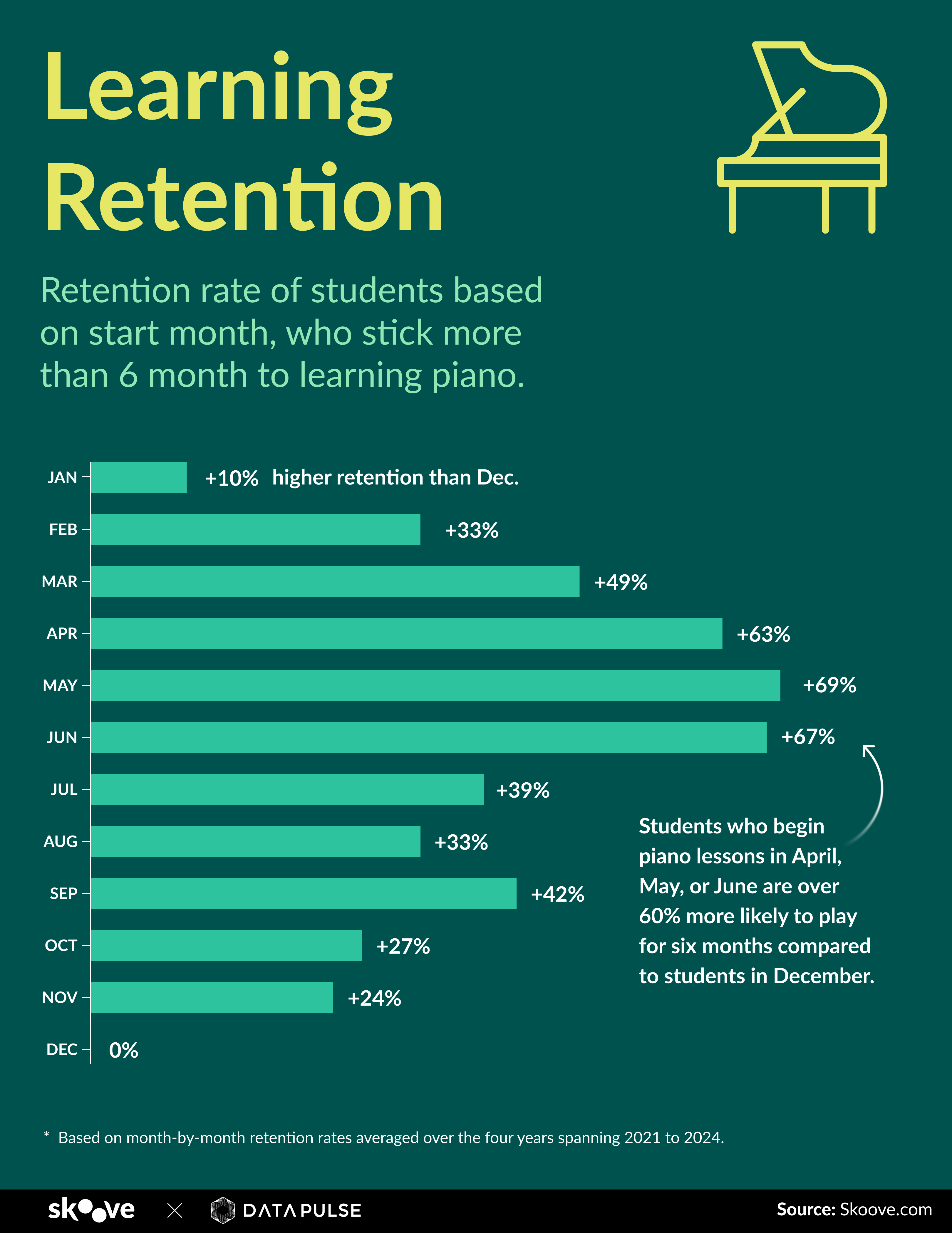
The heatmap below visualizes this six-month retention by start-month cohort. It shows that the highest retention rates occur in the second quarter of the year, with the best retention rates for learners who started in the month of May, followed by June and April.
Impulse vs. intentionality
This behavioral gap suggests that the “Fresh Start” impulse may actually be counterproductive to long-term skill acquisition. High-volume periods in December and January are often fueled by “aspirational identities”, the person we want to be on paper, which often lack a foundation in existing daily routines. Lumping a complex skill like piano (which requires frequent practice over long time periods) into a list of vague self-improvement goals creates a “Resolution Overload” that is difficult to sustain.
In contrast, learners who begin in late spring and early summer, particularly May, June, and July, demonstrate consistently stronger retention over the following six months. These cohorts are more likely to represent the power of Intentional Starts. These learners begin when cultural pressure is low and internal capacity is likely higher.
This suggests that for habit formation to take root, the internal capacity for consistency is far more critical than the symbolic weight of the starting date, which is clearly illustrated by the data:
- The cohorts driven by New Year’s resolutions demonstrate the lowest levels of sustained effort. Those who begin their journey in December show retention rates 28% below the cross-year average.
- January participants perform only marginally better at 21% below average, confirming that “New Year energy” is a volatile and short-lived fuel.
- In contrast, a “Persistence Peak” emerges in the second quarter of the year. Learners who bypass the seasonal noise of January and begin in April, May, or June exhibit significantly higher stability, with retention rates ranging from 18% to 23% above the average.
- The May cohort is the most successful, showing a 23% higher likelihood of reaching the six-month milestone compared to their counterparts in December.
“The data confirms a fundamental truth about learning: A New Year’s resolution is often an attempt to change your identity overnight, while long-term success comes from fitting the piano into the life you already have. In Q2, we see learners who aren’t chasing a ‘New Me’, they are simply making a conscious, quiet choice to practice, and that lack of external pressure is exactly what allows the habit to take root.”
The decay of New Year’s resolutions?
The Skoove dataset serves as a high-fidelity mirror for a broader cultural phenomenon: the collapse of New Year’s resolutions. The trend of high-volume drop-outs is corroborated by external research.
In 2024, data from Pew Research indicated that 41% of Americans had abandoned all or some of their resolutions by mid-January of that year. A similar YouGov poll in 2017 found that 22% of people in the United Kingdom who had made resolutions failed to keep to all of them just six days into the year.
Other longer-term surveys speak to the difficulty of sustaining resolutions. The 2017 YouGov survey found that only 27% of Britons kept their resolutions for the entirety of that year.
The conclusion is clear: the piano is not an outlier. Whether it is health, finance, or music, the “Fresh Start” provides the spark to begin, but the data suggests it rarely provides the stamina to finish.
Beyond the calendar: three pillars of a sustainable habit
A January start does not predestine a learner to quit. Rather, the data highlights a common failure to transition from a symbolic milestone to a functional routine. The challenge of acquiring a new skill, be it music, fitness, or a language, is systemic.
Fender CEO Andy Mooney noted in a 2019 interview that while approximately 50% of the company’s guitars are sold to first-time players, roughly 90% of those beginners abandon the instrument within the first 12 months.
This suggests that the “Beginner’s Wall” is a universal hurdle in skill building, where the technical difficulty of the early stages frequently outpaces the initial burst of motivation.
For those determined to make their 2026 resolutions stick, the study suggests three essential strategies to bridge the gap between intent and mastery:
- Practice music that is intrinsically enjoyable. Learning favorite songs will improve concentration and motivation.
- Set short, medium and long-term goals. This tactic helps students tackle just a few challenges at a time, allowing them to practice things that are difficult — but not too difficult.
- Focus on consistency. Small manageable practice sessions on a regular basis will yield better results than infrequent marathon sessions.”
Success in skill acquisition is tied less to the “Fresh Start” moment and more to the deliberate transition from aspirational intent to habit formation.
For any learner, regardless of their enrollment month, the primary indicator of longevity is not the day they begin, but the infrastructure they build to sustain progress once the “New Year energy” inevitably fades.
Methodology
The analysis is based on Skoove user retention data extracted from Mixpanel’s retention report. Users enrolled on the platform between January 2021 and December 2024 were analyzed in cohorts based on the month they began.
Retention was determined by tracking users over a period of six months. The retention rate for each cohort of users was calculated by dividing the number of users at month 1, 2, 3, etc. by the original number of users at month 0. A total of 1,137,446 users were analyzed across all cohorts.
To get the typical retention rate for each cohort, we averaged the four years’ retention rates. (For instance, the “January cohort” retention rate is the average of the retention rates of new users in January 2021, January 2022, January 2023, and January 2024.)
In order to compare each cohort against the others, we first found the lowest retention rate at month six (December cohort). We then calculated the percent difference between the December cohort and each of the other 11 cohorts.
Trends over time are based on the average retention rate for all users at each month in their progress. We found the percent difference between each cohort and the average user at one-month intervals (up to month six). For instance, to see if the December cohort is above or below average retention at the sixth month, we calculated the percent difference between December cohort retention (at month six) and all users’ average retention (at month six).
Study by: Skoove & DataPulse Research
Edited by: Susana Pérez Posada

With over seven years of piano education and a deep passion for music therapy, Susana brings a unique blend of expertise to Skoove. A graduate in Music Therapy from SRH Hochschule Heidelberg and an experienced classical pianist from Universidad EAFIT, she infuses her teaching with a holistic approach that transcends traditional piano lessons. Susana’s writings for Skoove combine her rich musical knowledge with engaging storytelling, enriching the learning experience for pianists of all levels. Away from the piano, she loves exploring new places and immersing herself in a good book, believing these diverse experiences enhance her creative teaching style.
Feel free to use this content
This content, including images and data visualizations, is licensed under a Creative Commons Attribution-ShareAlike 4.0 International License. You are free to share, copy, redistribute, adapt, remix, and transform the material for any purpose, even commercially, as long as you provide proper attribution. Please credit and link to: Skoove.com when using any part of this content.