


Pitch is one of the most fundamental concepts in music and the main way musicians categorize notes. Physics and music theory can be used to analyze and catagorise the sounds waves that make up pitch and let you transform them into musical melodies with the piano. Pitch in music is one of the most interesting concepts because it is a meeting point of physics and art, sound wave vibrations and musical notes. Skoove is here to walk you through this interesting musical concept step by step.
Read on to learn more about pitch in music!
What is pitch in music?
Every sound produces a vibrating air at one or multiple frequencies. These sound waves oscillate the air molecules making our ear drums vibrate, we then perceive this vibration as sound. This is basically how the human ear hears different pitches in music.

A frequency can have a slow or fast oscillation. A faster oscillation produces a higher pitch while a slower oscillation produces a lower pitch. Frequencies are measured in hertz (oscillations per second). When two sound waves share the same frequency, they share the same pitch.
How to describe pitch in music?
Hertz (Hz) is the unit of measure for frequency. How are the physics concepts of frequencies connected to the concept of musical pitch?
Pitch in music can be classified in a few different ways in this article we will look at:
- High pitch and low pitch
- Definite pitch and indefinite
Then, there are a handful of other pitch terms such as:
- Concert pitch and sounding pitch
- Absolute pitch and relative pitch
Let’s take a look at simple friendly Skoove definitions of these fun musical concepts.
Different types of pitch in music
High and Low: Understanding frequency
When we hear a note as high or low, we’re really hearing its frequency. As we now know frequency is measured in Hertz (Hz), which tells us how many times a sound wave vibrates per second. A low note vibrates slowly, while a high note vibrates much faster. For example, the note A above middle C vibrates at 440 Hz. Musical intervals are created by the relationship between two frequencies; simple ratios, like 2:1 for an octave sound stable while more complex ratios musical create tension known as dissonance.
Take a look at this musical frequency chart to see how it relates to the pitches you play on piano.
Note frequency chart
| Note | Octave 0 | Octave 1 | Octave 2 | Octave 3 | Octave 4 | Octave 5 | Octave 6 | Octave 7 | Octave 8 | Octave 9 | Octave 10 |
|---|---|---|---|---|---|---|---|---|---|---|---|
| C | 16.35 Hz | 32.70 Hz | 65.41 Hz | 130.81 Hz | 261.63 Hz | 523.25 Hz | 1046.50 Hz | 2093.00 Hz | 4186.01 Hz | 8372.02 Hz | 16744.04 Hz |
| C#/Db | 17.32 Hz | 34.65 Hz | 69.30 Hz | 138.59 Hz | 277.18 Hz | 554.37 Hz | 1108.73 Hz | 2217.46 Hz | 4434.92 Hz | 8869.84 Hz | 17739.69 Hz |
| D | 18.35 Hz | 36.71 Hz | 73.42 Hz | 146.83 Hz | 293.66 Hz | 587.33 Hz | 1174.66 Hz | 2349.32 Hz | 4698.63 Hz | 9397.27 Hz | 18794.55 Hz |
| D#/Eb | 19.45 Hz | 38.89 Hz | 77.78 Hz | 155.56 Hz | 311.13 Hz | 622.25 Hz | 1244.51 Hz | 2489.02 Hz | 4978.03 Hz | 9956.06 Hz | 19912.13 Hz |
| E | 20.60 Hz | 41.20 Hz | 82.41 Hz | 164.81 Hz | 329.63 Hz | 659.25 Hz | 1318.51 Hz | 2637.02 Hz | 5274.04 Hz | 10548.08 Hz | |
| F | 21.83 Hz | 43.65 Hz | 87.31 Hz | 174.61 Hz | 349.23 Hz | 698.46 Hz | 1396.91 Hz | 2793.83 Hz | 5587.65 Hz | 11175.30 Hz | |
| F#/Gb | 23.12 Hz | 46.25 Hz | 92.50 Hz | 185 Hz | 369.99 Hz | 739.99 Hz | 1479.98 Hz | 2959.96 Hz | 5919.91 Hz | 11839.82 Hz | |
| G | 24.50 Hz | 49 Hz | 98 Hz | 196 Hz | 392 Hz | 783.99 Hz | 1567.98 Hz | 3135.96 Hz | 6271.93 Hz | 12543.86 Hz | |
| G#/Ab | 25.96 Hz | 51.91 Hz | 103.83 Hz | 207.65 Hz | 415.30 Hz | 830.61 Hz | 1661.22 Hz | 3322.44 Hz | 6644.88 Hz | 13289.75 Hz | |
| A | 27.50 Hz | 55 Hz | 110 Hz | 220 Hz | 440 Hz | 880 Hz | 1760 Hz | 3520 Hz | 7040 Hz | 14080.00 Hz | |
| A#/Bb | 29.14 Hz | 58.27 Hz | 116.54 Hz | 233.08 Hz | 466.16 Hz | 932.33 Hz | 1864.66 Hz | 3729.31 Hz | 7458.62 Hz | 14917.24 Hz | |
| B | 30.87 Hz | 61.74 Hz | 123.47 Hz | 246.94 Hz | 493.88 Hz | 987.77 Hz | 1975.53 Hz | 3951.07 Hz | 7902.13 Hz | 15804.26 Hz |
Sharp and flat pitch
The terms sharp and flat don’t just refer to the accidentals and key signatures you see in written sheet music. They can also refer to tuning. If you are playing out of tune the note you are playing is not at the right frequency to match a tuner or another pitch you are playing with. This can happen with chords, a harmony or a unison/octave. If you are higher in pitch than intended you are sharp and if you are lower in frequency you are described as being flat.
What is a definite pitch?
Definite pitch refers to a sound that can be classified with standard music notation. Definite pitches can have a wide range of tones depending on the instrument that produces the sound, but each sound can be called a musical pitch letter name like C, D, E, F, etc. Definite pitches can be combined to develop melody in music.
For example, the notes of the C major scale, chromatic scale, and other piano scales are all definite pitches and can be played by a wide range of instruments.
Overtones and timbre
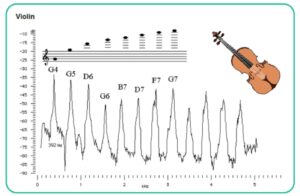
When you press a key, you don’t just hear one frequency. Alongside the main note (the fundamental), you also hear a collection of higher frequencies called overtones. These overtones follow a natural pattern known as the harmonic series. The relative volume and balance of these overtones is what gives an instrument its unique timbre, the reason a piano and a violin sound different even when playing the same note.
What is an indefinite pitch?
Sounds that can not be described with traditional musical note names are called indefinite pitches. Indefinite pitches have a duration and a timbre just like definite pitches. The only difference is they can not be notated with names like C, D, E, F, etc.
For example, the sound of a snare drum is an example of an indefinite pitch as there is no discernible pitch made by the snare drum as there are too many complex vibrational modes. The vibrations made by the striking of an indefinitely pitched object are instruments that are not perceived as having musical pitch by our ears due to this ununiform sound.
What is concert pitch?
Since we have such a wide range of instruments in western music and a huge range of possible pitches and timbres. Instruments like the trumpet and tenor saxophone are called transposing instruments. This means that the written music for those instruments is notated differently than music for the piano keyboard for example. When written in transposing pitch for the B flat trumpet, the C major scale actually begins with the sounding pitch D. This is because the music for the B flat trumpet is notated two half steps higher than it sounds. This is due to musical tradition and convention and so instrumentalists can switch instruments within families without needing to learn new fingerings. Concert pitch refers to standard non transposing musical notes and pitches.
Perfect pitch versus relative pitch
Perfect pitch in music refers to the ability to hear any note or harmony in music and name it without a reference pitch. This ability is rather rare and does not directly correlate to skill as a musician.
Relative pitch refers to the ability to hear and identify piano notes, chords, melodies etc. with the help of a reference pitch. For example, you can memorize a pitch like or hear middle C and then compare all other pitches you hear to this pitch. Anyone can learn to develop strong relative pitch by steady and consistent practice of interval and harmony recognition.
Pitch perfect
Now you know more about pitch works you have unlocked a much deeper understanding of how music really works and the sounds we hear are really made. You can become a master of all things relative to pitch with online piano lessons from Skoove. Develop your skills of recognizing, naming and reading pitches on the piano with Skoove’s friendly lessons. Have fun and enjoy the benefits of music education with a 7 day free trial of Skoove! Remember, it’s all just vibration!
Author of this blog post:
Edward Bond

Eddie Bond is a multi-instrumentalist performer, composer, and music instructor currently based in Seattle, Washington USA. He has performed extensively in the US, Canada, Argentina, and China, released over 40 albums, and has over a decade experience working with music students of all ages and ability levels.
Published by the Skoove team