




Did you know?
“Mad World” was originally written and recorded by Tears for Fears in 1982 as part of their debut album “The Hurting”. The Gary Jules version gained widespread popularity after being featured in the 2001 film Donnie Darko.
Mad World is one of the most haunting and emotional songs you can play on piano, and it’s much easier than it sounds. In this Mad World piano tutorial, we’ll show you how to play the Tears For Fears version step by step, even if you’re just starting out.
With Skoove, you don’t need to read complicated sheet music. We guide you through the Mad World piano keys and notes so you always know what to play next. Let’s get started!
Video tutorial
Check out this Mad World piano roll video to give you an idea of what you will get from learning this classic song. You can also experience this song inside our app with interactive lessons and real-time feedback. Try to simply follow along at first, no pressure to play just yet.
To find the full beginner arrangement of Mad World on piano. Start a free trial today!
”Mad World” piano chords and keys
”Mad World” is built around a beautiful melody and just a few simple chords, which makes it a great song for beginners. The song’s slow, haunting feel comes from the ”Mad World” piano chords that repeat throughout the entire track. Here’s a quick look at the ”Mad World” piano notes and the chords you’ll need to play:
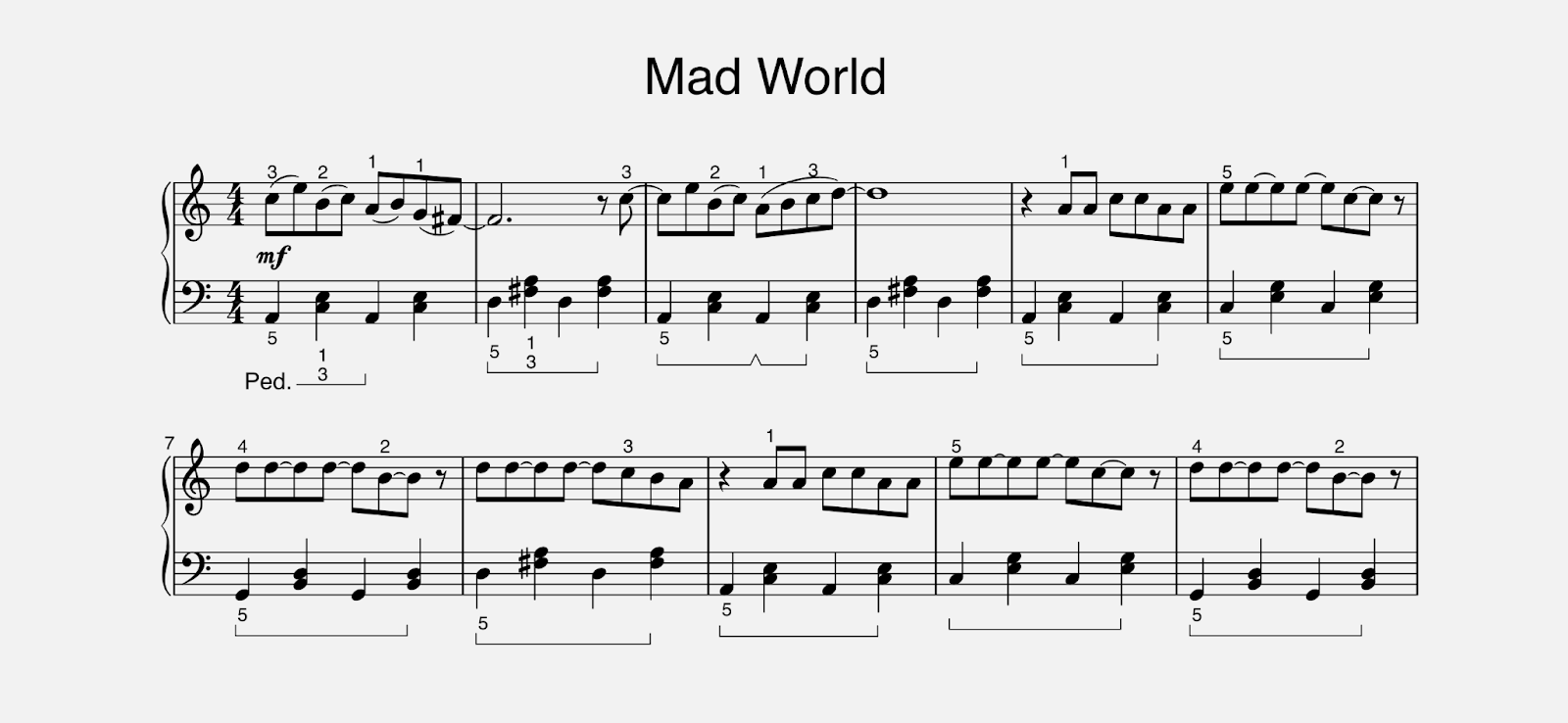
Start with the right-hand melody (notes first, then rhythm)
Your first goal is simple: play the melody smoothly, even if it’s slow.
- Find the melody line
- Play it alone, one hand only.
- Don’t worry about the pedal yet.
Fingerings
Notice how there are numbers above the notes. These numbers refer to the fingers you use to play the melody with proper flow and technique.
We’ll start on A. Place your right-hand fingers like this:
- 1 = thumb (A)
- 2 = index (B)
- 3 = middle (C)
- 4 = ring (D)
- 5 = pinky (E)
This hand position will set you in good stead for playing the melody well. Remember, keep your hand relaxed. Your fingers should feel curved, like you’re holding a small ball.
”Mad World” piano chords
These first chords are A minor (Am), D major (D), C major (C), and G major (G). You’ll play these chords with your left hand while your right hand plays the melody.
- A minor (Am): A – C – E
- D major (D): D – F# – A
- C major (C): C – E – G
- G major (G): G – B – D
Pay attention to the sheet music in the Skoove app this will show you how to properly alternate the chord notes to get the real ”Mad World” sound.
Piano tips for ”Mad World”
- Play with emotion: Don’t rush. Let the A minor chord set the tone, and let each chord breathe for an emotional, haunting sound. Be sure to practice the looping each chord pattern individually so it sits under your fingers well.
- Use the sustain pedal: Press the pedal for the duration of each chord to create smooth transitions. Lift it before changing chords to avoid muddiness.
- Slow down the melody: The melody is slow and expressive. Break it down into small sections and focus on playing it cleanly and with feeling. When you get comfortable, you can add some rubato and more expressiveness.
- Balance the hands: Keep the left-hand chords soft and steady, while letting the right-hand melody shine through. Be careful with your dynamics.
- Add dynamics in the chorus: Slightly increase volume during the chorus to add intensity, but maintain a soft overall tone.
Common beginner mistakes (and how to avoid them)
Playing too fast
- Mad World only works if it feels spacious and calm. Rushing kills the mood.
- Fix: Practice slower than you think you need. Let each note/chord ring before moving on.
Overusing the sustain pedal
- Holding the pedal too long can make the harmony sound muddy, especially with repeating chords.
- Fix: Change pedal with every chord change. Clean first, then add pedal.
Letting the left hand overpower the melody
- The left hand has a beautiful alternating pattern. However, the song loses its emotion if the chords are too loud.
- Fix: Play left-hand chords softly and keep the right-hand melody clearly on top.
Skipping hand-separate practice
- Trying to play hands together too soon leads to tension and mistakes.
- Fix: Get comfortable with the melody alone, then add the chords gradually.
Avoid these mistakes, and Mad World becomes far more enjoyable and much easier to learn.
Keep playing with Skoove
Well done! You’ve learned the Mad World piano chords and melody, and now you’re ready to bring this beautiful song to life. Want to keep improving? Head to Skoove to practice with real-time feedback and unlock even more piano tutorials. Whether you’re just starting or looking to perfect your skills, we’re here to guide you every step of the way. Happy playing!
Author of this blog post:
Susana Pérez Posada

With over seven years in piano education and a deep passion for music therapy, Susana brings a unique blend of expertise to Skoove. A graduate in Music Therapy from SRH Hochschule Heidelberg and an experienced classical pianist from Universidad EAFIT, she infuses her teaching with a holistic approach that transcends traditional piano lessons. In her writings for Skoove, Susana combines her rich musical knowledge with engaging storytelling, enriching the learning experience for pianists of all levels. Away from the piano, she loves exploring new places and immersing herself in a good book, believing these diverse experiences enhance her creative teaching style.
Published by the Skoove team