


If you play piano, chances are you’ve never needed to read tenor clef, which is exactly why it can feel like a foreign alphabet the first time you meet it in a cello duet, a bassoon part, or a music theory exam. Here’s the reassuring part: tenor clef follows the same logic as every other clef you already know. Once you know where middle C sits, the rest falls into place quickly.
In this guide, we’ll walk through what tenor clef is, why it exists, how to read every line and space, how it compares to alto, bass, and treble clef, and a few memory tricks to make it stick.
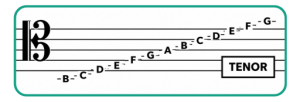
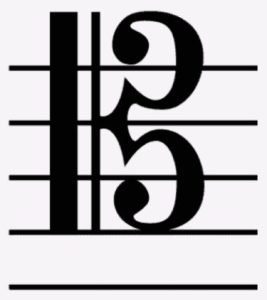
The tenor clef (C-clef) marks middle C on the fourth line from the bottom of the staff, used mainly for cello, bassoon, and trombone.
Its notes: D-F-A-C-E on the lines, E-G-B-D in the spaces, bottom to top.
F
A
C
E
G
B
D
Ledger lines extend the range up or down; tenor clef sits between alto and bass clef, letting mid-range instruments like cello and bassoon stay close to the staff with minimal ledger lines. Its key signatures use the same sharps and flats as every other clef, just placed on different lines and spaces.
What is the tenor clef?
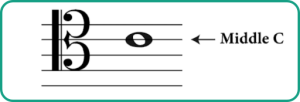
The tenor clef is an example of a C clef, the middle of the symbol always marks middle C, which sits on the fourth line up from the bottom of the staff. That placement gives instruments the flexibility to play notes above and below middle C without needing lots of ledger lines.
The tenor clef is seldom used in piano music, but learning how to read it is an important piece of music theory, since it’s commonly used in bassoon and cello sheet music. Just like the alto clef, it’s a C clef, for most musicians, the first clef they learn is the treble clef, soon followed by the bass clef.
Tenor Clef vs. Alto Clef (and Other Clefs)
Tenor and alto clef use the exact same symbo, it’s the placement that differs. Alto clef centers that symbol on the middle line (the third line), putting middle C there instead. Tenor clef shifts it one line higher, to the fourth line. That single line of difference is what lets tenor clef comfortably reach a higher range than alto clef can.
You’ll see alto clef used almost exclusively by violists, it’s their primary clef, while tenor clef belongs to cello, bassoon, and trombone parts. If you’re already comfortable reading one, the other isn’t a big leap; it’s the same skill, just shifted by one line.
Here’s how middle C lines up across every clef you’re likely to encounter:
| Clef | Middle C sits at |
| Treble clef | First ledger line below the staff |
| Alto clef | Third line (the middle line) |
| Tenor clef | Fourth line |
| Bass clef | First ledger line above the staff |
Notice the pattern: moving from treble down to bass, middle C’s position climbs steadily up the staff. That’s not a coincidence, it’s what lets each clef comfortably notate a different range without excessive ledger lines.
How to read tenor clef on the staff?
As with any clef, the fastest way in is to learn the lines and spaces as two small, separate sets, and lean on a mnemonic until they’re automatic.
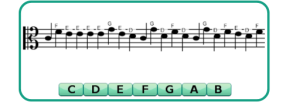
These are our helpful tips to help you remember all these notes on the tenor clef.
Line Notes: D–F–A–C–E
Reading bottom to top, the five lines of tenor clef spell out D, F, A, C, and E. A simple way to remember it: Dogs Fight All Cats Eagerly. If you already know treble clef’s F-A-C-E space notes, you’ve got a head start, tenor clef’s line notes are that same F-A-C-E pattern with a D tacked onto the front.
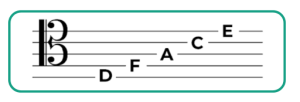
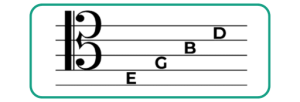
Space Notes: E–G–B–D
The four spaces, bottom to top, spell E, G, B, and D: Every Good Boy Dances. Feel free to swap in whatever acronym sticks best for you, plenty of players invent their own, and a slightly silly one is usually the one you actually remember.
Tenor clef notes chart
Here’s a tenor clef notes chart to help you quickly identify all tenor clef notes on piano:
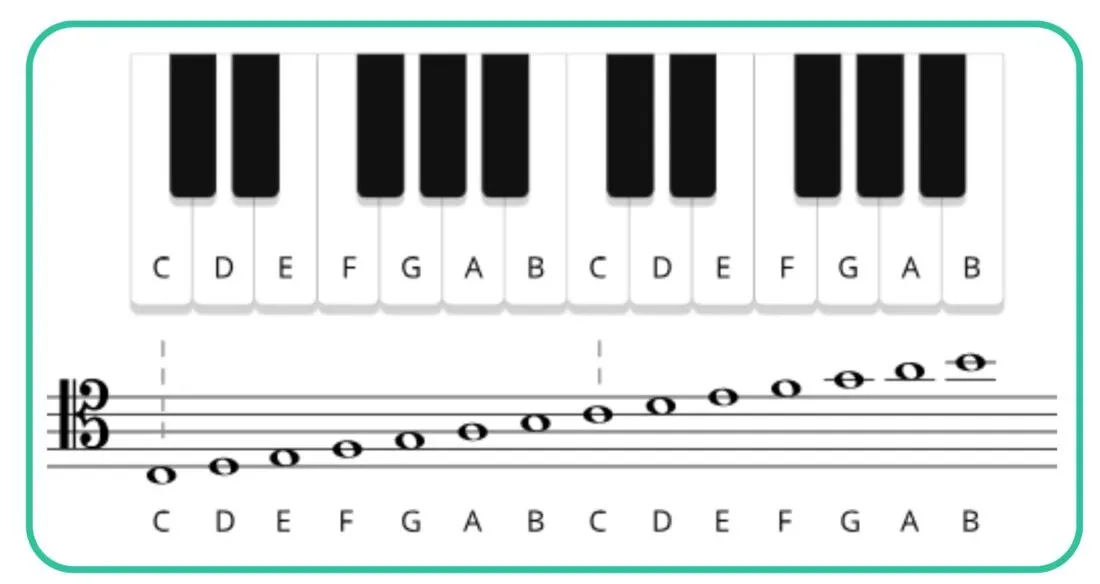
For quick reference, here’s the same mapping as text, every line and space, bottom to top:
- Lines: D – F – A – C – E
- Spaces: E – G – B – D
Tenor clef ledger lines & middle C
Middle C anchors the whole staff at the fourth line, so it’s worth memorizing that position first, everything else in tenor clef is just counting up or down from there.
Once you step outside the staff, the same stepwise pattern continues on the ledger lines. Just above the staff: F sits in the space right above the top line, then G lands on the first ledger line. Just below the staff: C sits in the space right below the bottom line, then B lands on the first ledger line. As with every clef, ledger-line notes simply keep climbing the musical alphabet in both directions.
The good news is you rarely need to go much further than that in real playing, most tenor clef parts stay close to the staff, since avoiding ledger lines is the entire reason tenor clef exists in the first place.
Converting Between Tenor, Bass, and Treble Clef
At some point you may need to work out what a tenor clef note would look like in treble or bass clef, maybe you’re arranging, or comparing a cello line to a piano part. The reliable method: find the note’s letter name and octave in tenor clef first, then locate that same pitch in the target clef using middle C as the shared reference point in both. The same logic works in reverse, starting from a bass or treble clef note and finding its tenor clef position.
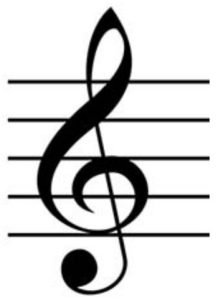 |
Treble clef | The treble clef is a G clef that marks where G is on the staff. |
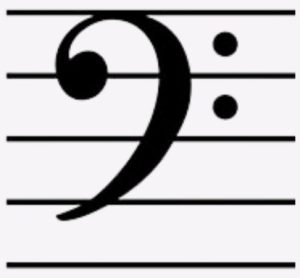 |
Bass clef | The bass clef is an F clef. The two dots mark the F note below middle C. The bass clef is mainly used for lower instruments like bass guitar, cello and left-hand piano parts. |
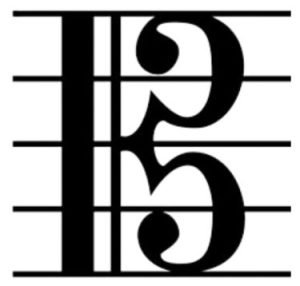 |
Alto clef | The alto clef places C on the middle line; it is used mainly for viola and trombone parts. |
 |
Tenor clef | The tenor clef places C one line higher and is used for cello, bassoon and trombone music. |
Here’s a concrete example. The top line of tenor clef is E, specifically the E just above middle C. That same E:
- Sits right on the bottom line in treble clef
- Sits on the second ledger line above the staff in bass clef
Same pitch, three different addresses, depending on which clef is doing the counting. This is naturally slower than reading a single clef at first, but it gets faster with repetition, most cellists and bassoonists build this skill gradually rather than memorizing a lookup table.
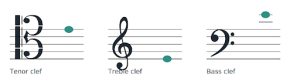
Same pitch, three different addresses, depending on which clef is doing the counting. This is naturally slower than reading a single clef at first, but it gets faster with repetition, most cellists and bassoonists build this skill gradually rather than memorizing a lookup table.
Key Signatures in Tenor Clef
If you’re wondering whether you need to relearn key signatures for tenor clef: you don’t. The order sharps and flats appear in is fixed no matter which clef you’re reading, F♯-C♯-G♯-D♯-A♯-E♯-B♯ for sharps, B♭-E♭-A♭-D♭-G♭-C♭-F♭ for flats. What changes between clefs is simply which line or space each symbol lands on, since the same line or space represents a different letter name in tenor clef than it does in treble or bass.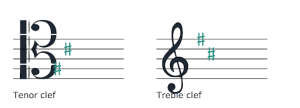
In practice, this means the key signature of a piece doesn’t change when an instrument switches into tenor clef mid-passage — only where it’s drawn on the staff. Your ear already knows what to expect; you’re just retraining your eye to find it in a new spot.
Tenor Clef Scale: C Major from Middle C
A scale is a good way to put everything above into practice, since it forces you to move through the staff — and past it — in order. Here’s a C major scale starting on middle C:
C4 (fourth line) – D4 (fourth space) – E4 (top line) – F4 (space just above the staff) – G4 (first ledger line above) – A4 (space above that), B4 (second ledger line above) – C5 (space above that)
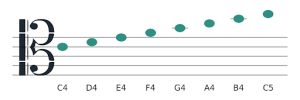
Notice how the first three notes sit comfortably inside the staff, and only the top half of the scale pushes into ledger-line territory, a good illustration of exactly why tenor clef exists in the first place.
Keep reading sheet music with Skoove
Now you know how to get by if you find yourself in a situation where you need to read the tenor clef. Learning the tenor clef helps develop your overall skills as a musician and gives you greater insights into concepts such as orchestration, instrument registers and pitch. There is no better way to learn music theory than to incorporate it into your playing. Online piano lessons with Skoove are the perfect place to do this with exercises, lessons and all of your favourite songs. Sign up for your free trial today!
FAQ
Explore all types of clefs
Author of this blog post:
Sam Girling

Sam Girling is a percussion and piano teacher, writer, an researcher based in Münster, Germany and Auckland, New Zealand. He has performed extensively in New Zealand and Europe, lectures on a variety of music history and theory topics, and has published several academic articles and musical scores. Sam has taught music in a variety of contexts, from primary schools through to university level.
Published by the Skoove team