





Knowing your piano intervals is one of the fastest ways to improve how you read, hear and play music. Instead of naming every single note, you learn to recognize the distance between notes. This makes sight-reading smoother and your hands more confident on the keyboard. With Skoove’s step-by-step lessons and guided practice, you will learn to hear and play intervals on the piano with real music. Let’s dive in!
What are piano intervals?
Piano intervals are the distance between two notes.
- They can be measured on the staff or on the keyboard or by ear.
- They describe how far apart notes are in pitch.
- They are the foundation of chords, keys, scales and harmony.
The simple answer is that intervals are the space between two notes, counted by letter name and categorized by sound and function. Intervals in piano music can be melodic, notes played one after another or harmonic, notes played simultaneously.
What are the types of intervals?
The types of intervals are major, minor, perfect, augmented and diminished. These qualities tell us about the sound function of these piano intervals.
A musical interval is defined by two things:
- Number
- Quality
For example an interval C to E is described as a ‘major third’. This definition tells the intervals quality as a major sound and the distance between the notes. Here are the basic rules for each type of interval.
Major intervals
Major intervals are found naturally in the major scale when counting from the root. 2nds, 3rds, 6ths, and 7ths can be major. For example C to E in a C major scale would be a major third.
Minor intervals
Minor intervals are one half-step smaller than a major interval and are also 2nds, 3rds, 6ths and 7ths can be minor. These intervals can be found by counting from the root of a minor scale. For example C to Eb would be a minor third. Notice how this is a semitone lower than a major third?
Perfect intervals
Only 4ths, 5ths, and octaves can be perfect. They are not major or minor. This is due to their stable quality as they do not change in a scale from major to minor. For example C major and C minor scales both have F G and an octave C.
Augmented intervals
Augmented intervals are usually ‘stretched’ major or perfect. Any interval can become augmented if the notes are altered enough without changing the written pitch names.
Diminished intervals
Diminished intervals usually ‘squashed’ minor or perfect intervals. However again any interval can be diminished if the notes are altered enough without changing the written pitch names.
Understanding all intervals piano players use helps you build chords, recognize patterns with just a bit of piano interval training.
Compound intervals
A compound interval is a musical interval that is bigger than an octave. It is formed by taking a simple interval (an octave or less) and adding one or more octaves to it. Common examples include 9ths and 10ths. These intervals can be described as compound 2nd and 3rds.
Counting semitones
There are lots of ways to figure out intervals. As a beginner people often find the counting semitones method the easiest. Let’s take a look at how we can use a bit of knowledge of semitones (half steps) to figure out intervals.
What is a semitone (half step)?
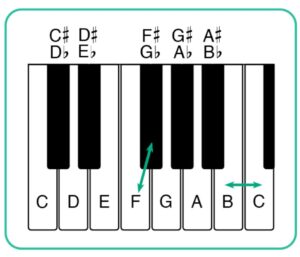
A half-step is the smallest distance between two notes on the keyboard. It is the distance from one key to the very next key black or white.
How to count semitones
- Start on the lower note.
- Do not count the starting note itself, only the steps between.
- Count every key (black and white) up to the top note.
For example:
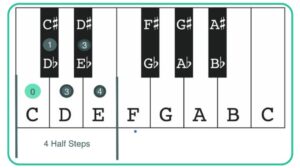
- C → E (major third)
- C to C♯ (1)
- C♯ to D (2)
- D to D♯ (3)
- D♯ to E (4)
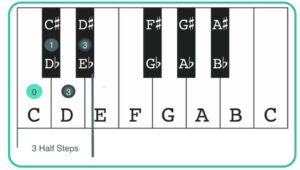
- C → E♭(minor third)
- C to C♯ (1)
- C♯ to D (2)
- D to E♭ (3)
This method works for intervals on a piano in any key. Let’s apply what we know about counting semitones and interval qualities to some real examples.
Identifying Intervals
When identifying intervals, always follow these two steps.
Step 1: The number (how many letter names?)
Count the letter names from the bottom note to the top note. For example:
- C → E = C (1), D (2), E (3)
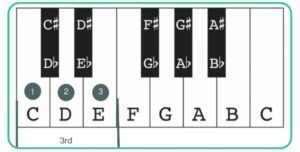
This is some kind of third. This tells you the number, but not the quality.
Step 2: The quality
Now count the half-steps. Compare your semitone count to the standard interval sizes on our handy table. For example:
- Major third = 4 half-steps
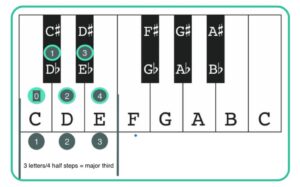
This basic method works for:
- Melodic intervals piano (played one after another)
- Harmonic intervals piano (played together)
With practice inside Skoove, you will quickly recognize basic intervals on the piano without counting every time. Pattern recognition replaces slow calculation. Have a look at the following basic piano intervals chart which lays out common intervals and their constituent semitones.
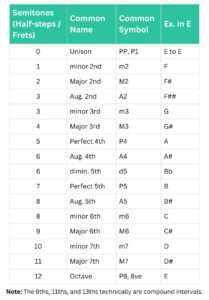
You can also learn to identify intervals by ear by associating them with musical concepts and well known songs to recognise the sound and feeling of each interval. This is a big part of being able to play music by ear.
Read music by intervals
Reading in intervals is a great way to become a more proficient sight reader of piano sheet music. The first step to reading musical intervals on piano is recognising whether notes move by a step or a jump and if it’s a jump, how big it is.
A step means moving to the very next note up or down For example, from middle C to the next note up is a step a major second and is naturally played with the next finger. These patterns go from lines to spaces or spaces to lines on the staff.
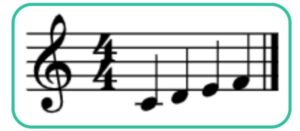
Thirds are a great interval to get used to on the staff as they go from a line to a line or a space just like this.
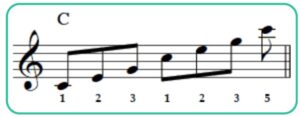
As you get more comfortable with reading intervals you will be able to recognize larger and more complicated leaps. Be sure to put your newfound skills to the test on the Skoove app with your favorite songs.
“Autumn Leaves” – Joseph Kosma
Unlock the power of intervals
Now it’s time to put your newfound knowledge into practice. You now have a greater understanding of how intervals work and their impact on music and music theory. Intervals also help you hear and spot patterns quickly, making sheet music easier to read and more intuitive to play. They’re the language of your fingers, building a natural physical connection to the keyboard. Keep exploring, keep listening, and keep playing and open the Skoove app and continue unlocking your interval skills today.
Author of this blog post:
Edward Bond

Eddie Bond is a multi-instrumentalist performer, composer, and music instructor currently based in Seattle, Washington USA. He has performed extensively in the US, Canada, Argentina, and China, released over 40 albums, and has over a decade experience working with music students of all ages and ability levels.
Published by the Skoove team