


Reading music may seem daunting at first however learning a few basic rhythm values can take you a long way. Music is often described as a language, with unique symbols that convey meaning. One essential part of this musical language is how it conveys the duration of each note. Musicians use specific note symbols to communicate these rhythmic values. In this article we will be covering whole, half and quarter notes and their variations. Let’s take a look at what these symbols are and how they are used when reading and writing music.
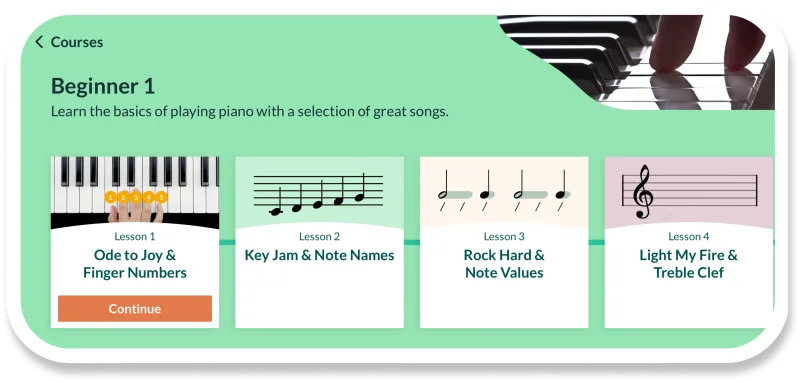
What are musical notes on piano?
In music notes convey two main things: pitch and duration. Piano notes higher up on the staff, the five lines and four spaces, are higher in pitch and notes that are lower on the staff sound lower. With help from time signature they also give us information about the duration of the pitches we will play in a given piece of music. Musicians use a combination of open and closed circles with and without lines attached to them to communicate these different durations.
Parts of a written note
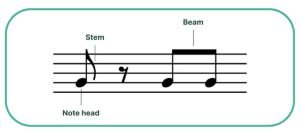
Understanding the parts that make up a note will help you identify them. These are the names for all of the parts of a musical note.

- Head: The round part of the note, which can be filled (for quarter notes and shorter) or open (for half notes and whole notes). The head shows the pitch when placed on the staff.
- Stem: The vertical line extending from the note head. The stem direction (up or down) doesn’t change the pitch but helps with readability in notation.
- Flag: The curved line that appears on the stem of notes shorter than a quarter note. Each flag halves the note’s duration (e.g. one flag for eighth notes, two for sixteenth notes). Flags become beams when multiple flagged notes are grouped together.
What are the basic note values in music?
Here are the basic note values we will be covering and how they look, notice how the flags and heads change to convey different values:
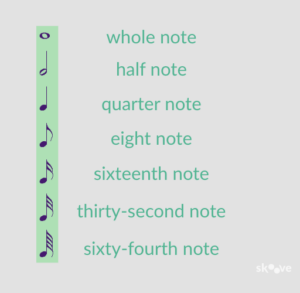
Now we understand what the parts of the note are, let’s take a closer note at each rhythmic value. .
What is a quarter note?
The quarter note lasts for one beat. Quarter notes, or crotchets, are probably the most common note type in music.
Quarter note symbol

As we see above, a quarter note symbol or crotchet consists of a closed note head (the black circle) with a stem.The stem will extend up if the note is below the third line of the staff. The stem will extend downwards from the left side if the note is on or above the third line of the staff. This distinction between the direction of the stem makes our music notation cleaner and easier to read.
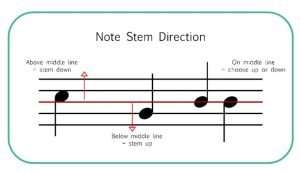
This is true for any note with a stem. Notes that are beamed follow this rule based on the position of the majority of the notes in the beam.
How many beats is a quarter note?
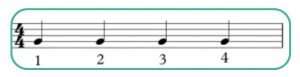
A quarter note is worth one beat. The diagram shows a bar of 4/4 time made up of four quarter notes. To further understand bars take a look at Skoove’s’ helpful guide on reading piano music.

What is a half note?
The half note symbol, or minim, lasts for 2 beats, twice as long as a quarter note
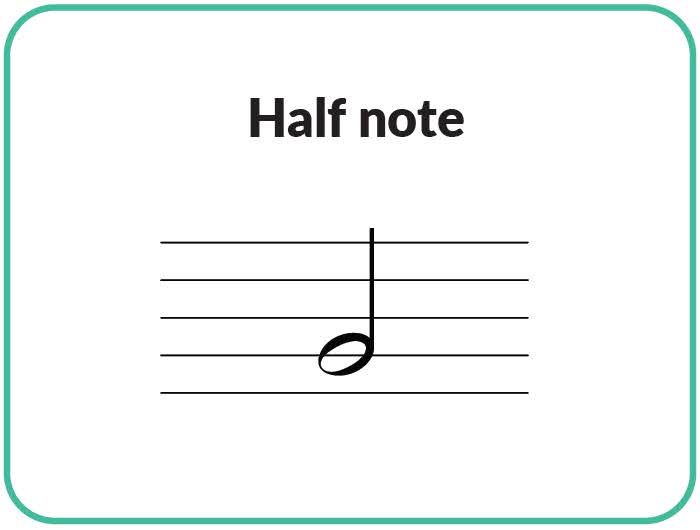
How many beats is a half note?
The half note lasts for two beats. Check out the diagram below to see a visual representation of counting half notes in a bar of 4/4.

Have a go at counting some quarter and half notes in this helpful exercise from Skoove.
Improve your note values technique, learn your favorite songs and more!
What is a whole note?
A whole note symbol consists of an open note head with no stem. It is simple and easy to read.
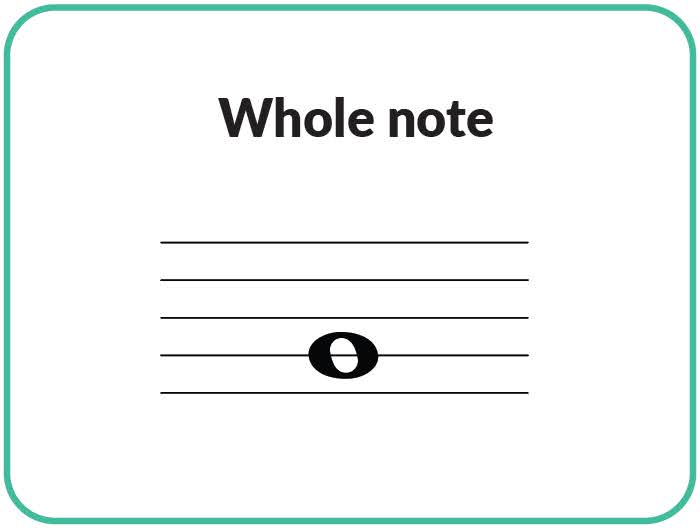
How many beats is a whole note?
The whole note lasts the same time as four quarter notes. Check out the diagram below for a visual representation of this note in a bar of four four.

Comparing quarter, half, and whole notes
Let’s compare how all of these notes fit together
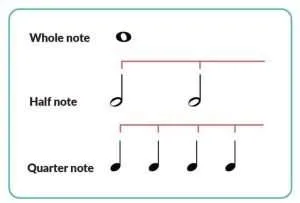
Knowing how all of these notions work together and how they relate to each other will make understanding rhythm a lot easier. Use this helpful video to see how they are counted in real time.
How to count quarter, half and whole notes?
Feeling more confident with these different notes values on a piano? Great! Now let’s learn to put them into practice.
This first example involves playing 4 quarter notes one after the other. Play each quarter note correctly and in time, you are going to count from 1 up to 4. Press the G key on each beat. Once you can play and count comfortably, move around to different keys as you see fit! Be sure not to cut the fourth beat short and play it for its full duration.
How was that? Let’s try another. This next example combines quarter notes and half notes.
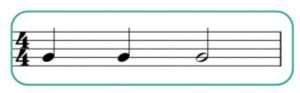
Just like the example before, play the first two quarter notes counting 1 on the first and 2 on the second. Then, count the half note over beats 3 and 4. Keep looping this with a steady pulse of 1, 2, 3, 4 and once you feel more comfortable, move on to different notes.
Tied notes, dotted notes and rests
Music, like any language, has a lot of meaning to convey. This means there is a necessity for rhythm to go beyond simple whole, half and quarter notes.Tied notes connect two notes together, making them sound like one longer note. Dotted notes extend a note’s length by adding half of its original value. There are musical rests which mark moments of silence which are just as important as the notes themselves. Let’s take a closer look!
What are tied notes?
Ties look like a curved line that connects two notes like this.

The whole note lasts for four beats. If we have two whole notes tied together, this means that the note values are equal to eight beats. Practice playing a note and counting a steady pulse and holding the note for two bars.
Here is another example. As you can see the tie combines two half notes. They take up the 3rd and 4th beat of the first bar and the 1st and 2nd and the next. Have a go at playing this bar. Be sure to keep a steady pulse as before.

What is a dotted note?
A dotted note adds half of its original value to its duration. This means a dotted half note lasts for three beats and a dotted quarter note lasts for one and a half beats. Let’s break this down:

For example, a standard half note is worth two beats. The dot adds half of this duration onto the note (one beat). This means a dotted half note will be worth three beats.
A standard quarter note is worth one beat. As before the dot adds half the value to the note (half a beat). This means a dotted quarter note is worth one and a half beats. This principle applies to any note value or rest in music.
What is a rest?
A rest is a symbol that musicians use to indicate silence for a specific duration. Just like notes, rests come in different values.
The quarter note rest, or crotchet rests, are equivalent in duration to quarter notes. This rest notates a rest for a whole beat. A quarter/crotchet rest looks like this:

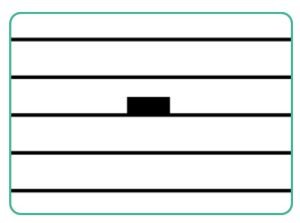
A half rest or minim rest has the same duration of two whole beats and looks like this:
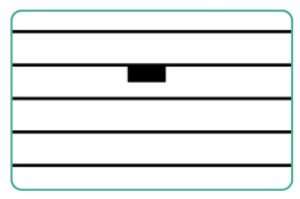
The whole note rest is shown by use of a rectangular musical symbol. This rest hangs from the fourth line of the staff. It looks similar to the half-rest symbol so make sure you don’t get the two confused. It looks like this:
These rests are just as rhythmically important as normal pitched frequencies of note. Take care to count them and keep them as in time as you would any piano notes you’re reading on a sheet of music.
How to use dotted notes and rests in music?
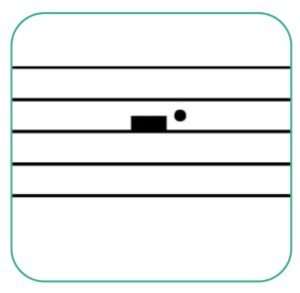
Dotted rests work just in the same way as dotted pitch notation. The dot adds half of the notes value onto itself. For instance, a dotted half note would be worth three beats. The dot adds half the value, one beat, to the minim rests standard two beats.
Once you feel comfortable, try putting this into practice with a friendly Skoove lesson.
Music note values chart
This music note values chart shows the different note symbols and how long each one is held in a piece of music. It’s a simple guide to help you understand rhythm and note duration.

Put these musical notes into practice!
Let’s put these concepts into practice with some easy to follow Skoove lessons.
Queen – “We Will Rock You”
With the Skoove app open, try to play the chorus from We Will Rock You by Queen. Have a look out for quarter notes and eighth note values. You will also come across whole and crotchet rests. Make sure you count the rest symbols properly.
Practice counting along with the music before you try to play it on the piano so that you ensure you understand the rhythm.
Learn how to play ‘We Will Rock You’ by Queen. Start a 7 day trial today – no card details required!
How was that? Let’s play one more song!
Don Mclean – “American Pie”

Now open up the app to play American Pie. What do you see when you sight read the music? In this song you will see examples of the quarter note, half note and whole note. Again, it will be helpful to count through the rhythm before trying to practice the piece on piano. Make sure to keep the rest in time too!
Learn how to play ‘American Pie’ on piano. Start a 7 day trial today – no card details required!
You’ve got the rhythm!
Well done, you’ve built an understanding of basic rhythms, you’re ready to expand your skills. You can keep up your progress by exploring songs from the Skoove Piano Beginner 1 Course to practice what you’ve learned. Working with simple songs will strengthen your rhythmic foundation allowing you to approach more complex pieces later on. Remember, rhythm is key to all music and each new piece you practice will bring you closer to mastering it. Well done and happy rhythm reading!