


Cadences are fundamental elements in music theory. They serve as markers that punctuate the end of a musical phrase or section. The importance of cadence in music extends beyond just concluding a phrase; cadences also establish the tonal framework of a piece. By defining the start and end points of musical sections, they help in creating a sense of resolution and completeness. This is crucial in maintaining the listener’s engagement and understanding of the music’s flow and tonal centre. Skoove is here to help you understand this music fundamental with simple step by step guidance. Let’s take a look.
What is a cadence in music?
Cadences are the harmonic punctuation of music and dictate whether a phrase or piece sounds finished, unfinished or anywhere in between. In practical terms, cadences are essential for musicians and composers. They provide a clear framework within which to innovate and express, guiding the emotional journey of the piece.
Types of cadences
Let’s examine the nuances of these musical endings to better understand their impact on composition and listening.
Perfect cadence
A perfect cadence moves from chord V (dominant) to chord I (tonic) (for example, G major to C major in the key of C). It sounds final and resolved. In a minor key this would be a V chord to a i (minor tonic) chord. This would be making use of the harmonic minor scale to get a major V chord to create a full sense of resolution. You will also come across the use of a minor v but this is less common as it sounds less complete.
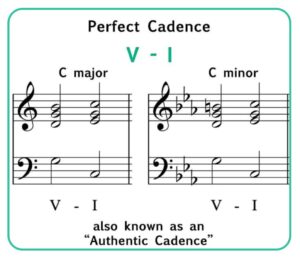
You can think of this cadence like a full stop at the end of a sentence.
Imperfect cadence
An imperfect cadence ends on chord V. Instead of sounding finished, it creates expectation as the V chord wants to end on a one chord. This can also be achieved in a natural minor scale with a minor v chord to keep a minor sound. However this does not carry the same sense of anticipation. This lack of resolution is what creates the unfinished sound.
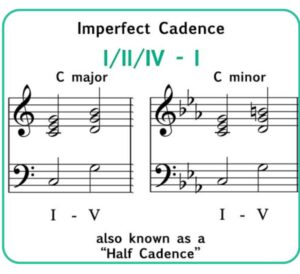
This cadence feels like a pause or question in a conversation with lots of anticipation suggesting something is still to come. Composers use imperfect cadences to keep the music moving forward and create anticipation or longing.
Plagal cadence
A plagal cadence moves from chord IV to chord I or iv to i in a minor key. It has a softer, more gentle resolution than a perfect cadence.
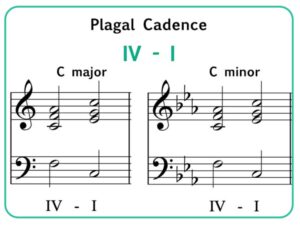
Often called the ‘Amen’ cadence, it’s commonly heard at the end of hymns. It feels warm and settled rather than dramatic, a bit like a comma in a sentence, a brief respite of flow in a phrase.
Interrupted (deceptive) cadence
An interrupted or deceptive cadence begins like a perfect cadence (V or v). This creates a sense of tension. However, instead of resolving to I or i, it moves somewhere unexpected, usually chord VI or iv. This creates a surprise. Just when your ear expects a strong resolution to the tonic, the music shifts direction.
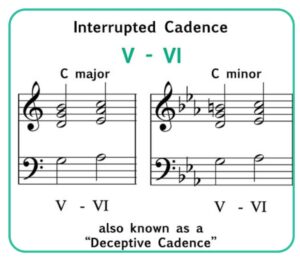
This cadence is a powerful tool for adding emotion, tension, or drama to a piece.
The picardy cadence
A picardy cadence, also known as picardy thirds, is characterized by the sudden change from a minor key to a major key at the cadence with the use of a major tonic chord in place of a minor. Typically, this occurs at the end of a piece in a minor key, where the final chord is unexpectedly played in major. This shift can create a bright, uplifting resolution that contrasts with the preceding minor tonality.
Practice your cadences
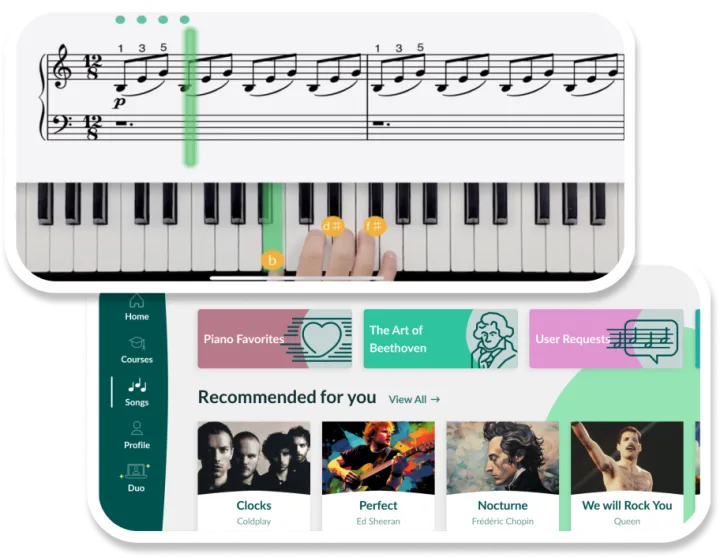
Let’s take a look at a few examples of cadences in music with the help of the Skoove app.
“1812 Overture” – Pyotr Ilyich Tchaikovsky
“Danse Macabre” – Camille Saint-Saëns
“All The Things You Are” – Frank Sinatra
“Cheek To Cheek” – Irving Berlin
A symphony of cadences
Well done you now understand all of the common cadences in music. As we have seen, cadences are crucial for crafting impactful and emotionally resonant music. For budding piano players, awareness of these cadences opens new dimensions in appreciating the depth and complexity of musical compositions.
Cadences are the punctuation marks of music, defining its flow and articulation. By exploring the art of cadences with the help of the Skoove app you can gain a deeper insight into the language of music, enhancing your connection with the piano. Keep up the good work!
Author of this blog post:
Susana Pérez Posada

Susana Pérez Posada, Master in Music Therapy, Skoove Piano Educator With over seven years in piano education and a deep passion for music therapy, Susana brings a unique blend of expertise to Skoove. A graduate in Music Therapy from SRH Hochschule Heidelberg and an experienced classical pianist from Universidad EAFIT, she infuses her teaching with a holistic approach that transcends traditional piano lessons. In her writings for Skoove, Susana combines her rich musical knowledge with engaging storytelling, enriching the learning experience for pianists of all levels. Away from the piano, she loves exploring new places and immersing herself in a good book, believing these diverse experiences enhance her creative teaching style.
Published by the Skoove team