E minor chord on piano
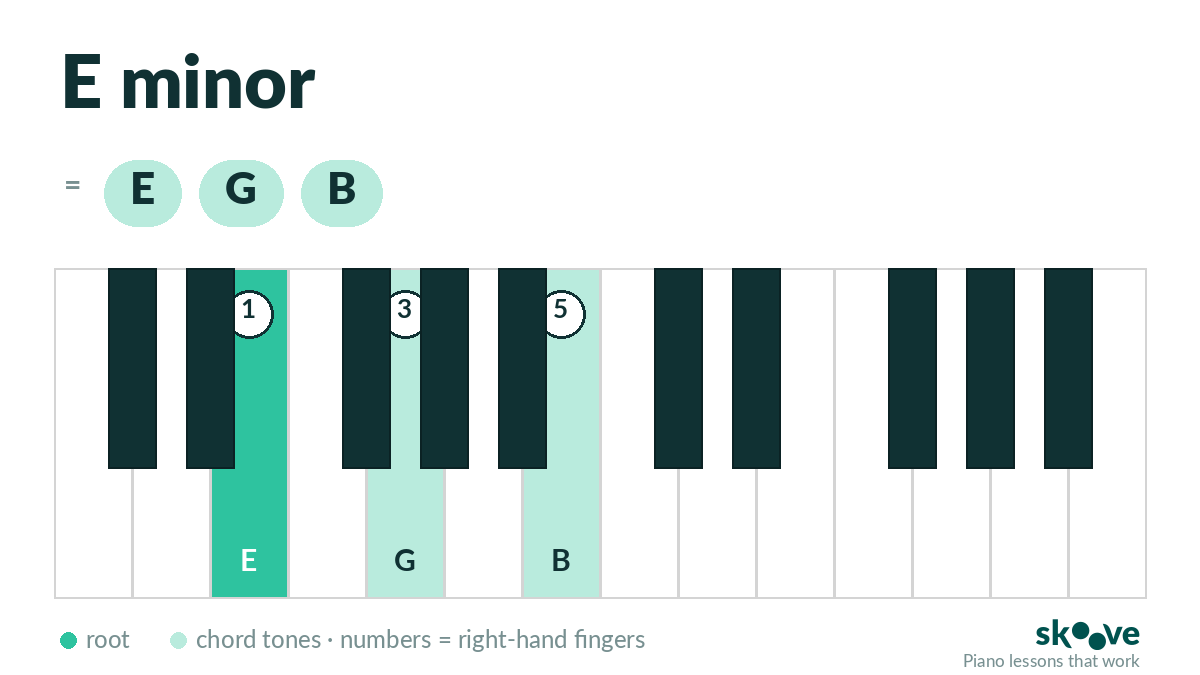
The E minor chord is E–G–B. Tap the keys below to hear it.
EmE · G · B
Tap the keys to hear them
E minor anchors a huge number of pop and rock songs. It has a brooding minor sound. As E minor is the relative minor of G major, it sits at the centre of countless three-chord songs.
You've heard it in "Adventure of a Lifetime" by Coldplay.
How the E minor chord is built
Fingerings & inversions
Standard fingerings use the thumb (1), the little finger (5), and either the index (2) or middle finger (3). Hand size and musical context change what feels natural. Switch Fingers on above to see 1-3-5 land for Em.
| Position | Notes (bottom → top) | Right hand | Left hand |
|---|---|---|---|
| Root position | E – G – B | 1-3-5 | 5-3-1 |
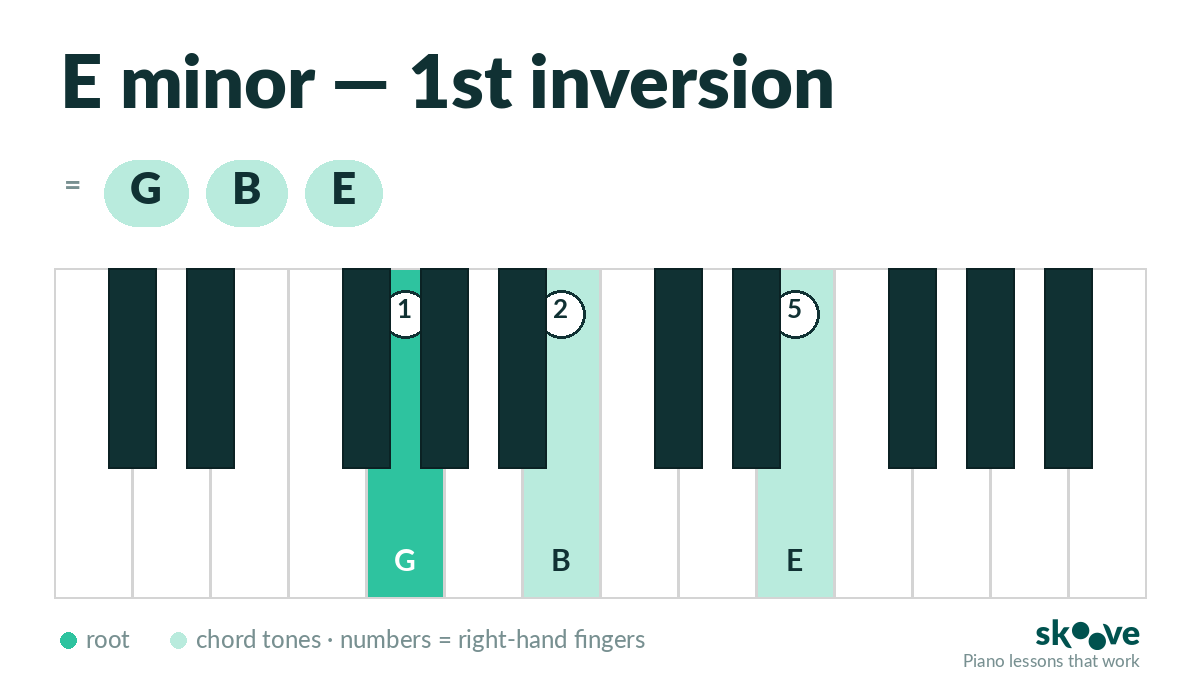
| 1st inversion | G – B – E | 1-2-5 | 5-3-1 |
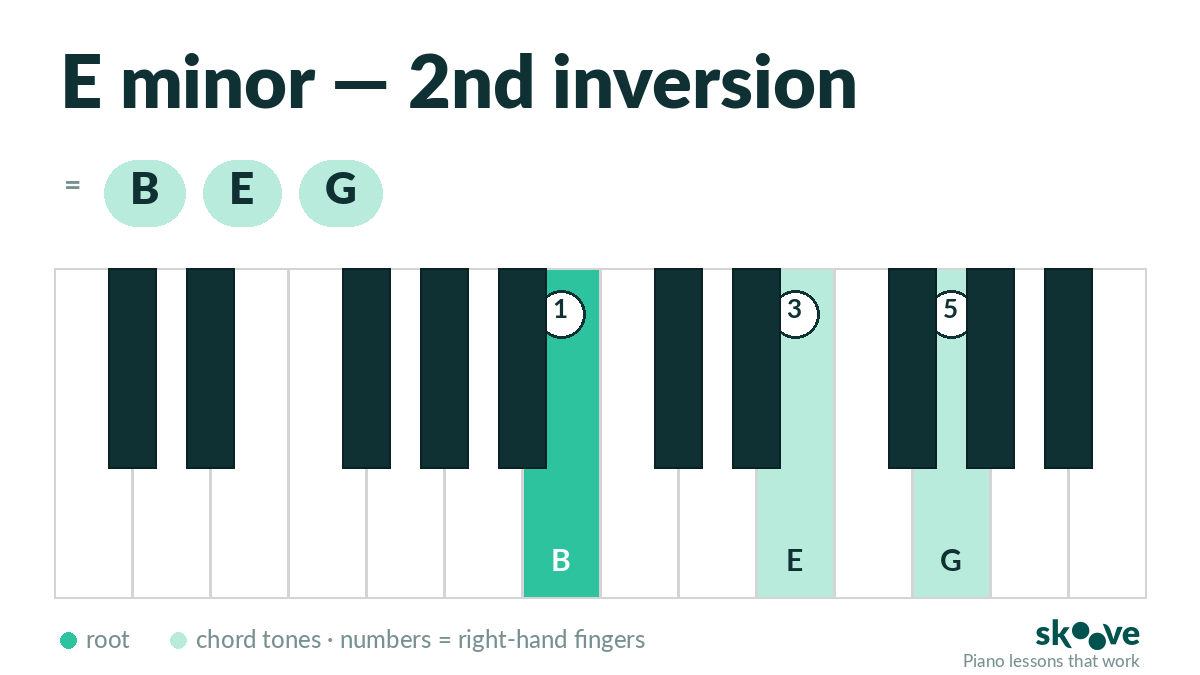
| 2nd inversion | B – E – G | 1-3-5 | 5-2-1 |
Inversion diagrams
The inversion buttons above play all 3 shapes of Em.
Popular songs to play with the Em piano chord
- Adventure of a Lifetime by Coldplay
Songs are where chords start making sense. Skoove takes you from Em to full songs, step by step.
Start a piano lesson for freeWhere Em shows up
E minor is the relative minor of G major: the E minor scale is built from the same notes as the G major scale. This means that the key of E minor has one sharp. E minor also works as the ii in D and the iii in C, two roles that keep it busy in pop and jazz progressions alike.
Its most famous setting is the Em–C–G–D loop, the minor-led progression behind countless pop hits.
Common questions
What notes are in the E minor chord?
The E minor chord is made up of E, G, B. All white keys: start on E, skip a key to G, skip another to B, and the shape is under your hand.
What fingers should I use to play Em on piano?
In root position, the standard fingering is 1-3-5 in the right hand and 5-3-1 in the left hand (1 = thumb, 5 = little finger). E, G, B are all white keys; find E just right of the pair of black keys, and the rest of the shape follows.
Why does E minor sound sad?
Compared with E major, the third (middle note) is lowered by a half step: G# becomes G, a minor third. This makes it sound sad. The E minor scale shares its notes with G major, its relative major, which is why the two chords often appear in the same songs.
What chords are in the key of E minor?
E minor shares its key signature with G major, so it uses the same seven diatonic chords: G major, A minor, B minor, C major, D major, E minor, F# diminished, starting from E minor as the home chord.
What are the notes in the E natural minor scale?
The E natural minor scale is E – F# – G – A – B – C – D, the same notes as the G major scale. The Em chord is built from its 1st, 3rd and 5th degrees.
More E chords

Reviewed by
Composer, arranger and music educator. BA Music (LIPA), MA Composition (University of Salford).
Last updated 2026-09-24