Hear any piano chord. See how it's built.
Every chord, note by note
Each chord below has its own page with the exact keys, fingerings, inversions, audio, and songs that use it. Prefer something printable? Download the Skoove chord chart (PDF).
Major chords
Bright and stable, the chords most songs are built on.
Minor chords
Darker and more reflective, the other half of most progressions.
Seventh chords & extensions
Dominant 7ths, m7 and maj7: the colour chords of blues, jazz and soul.
What's actually happening when you play a chord
Piano chords are formed by playing two, three or more notes together. The combination of notes within a chord defines its character, and combinations of chords, known as chord progressions, can define the character of a song. Pretty much every song you know is built from triads and their close cousins (seventh chords, ninth chords, suspended chords) layered into progressions.
The Chord Finder above lets you build any of the most common chord shapes from scratch. Pick a root note (the note the chord is named after; "C major" is built on C), pick a type (major, minor, and so on), and we'll light up the keys, play the chord on a real piano, and tell you what intervals are stacked inside it.
How to read the keyboard above
When you pick a chord, three things happen on the piano:
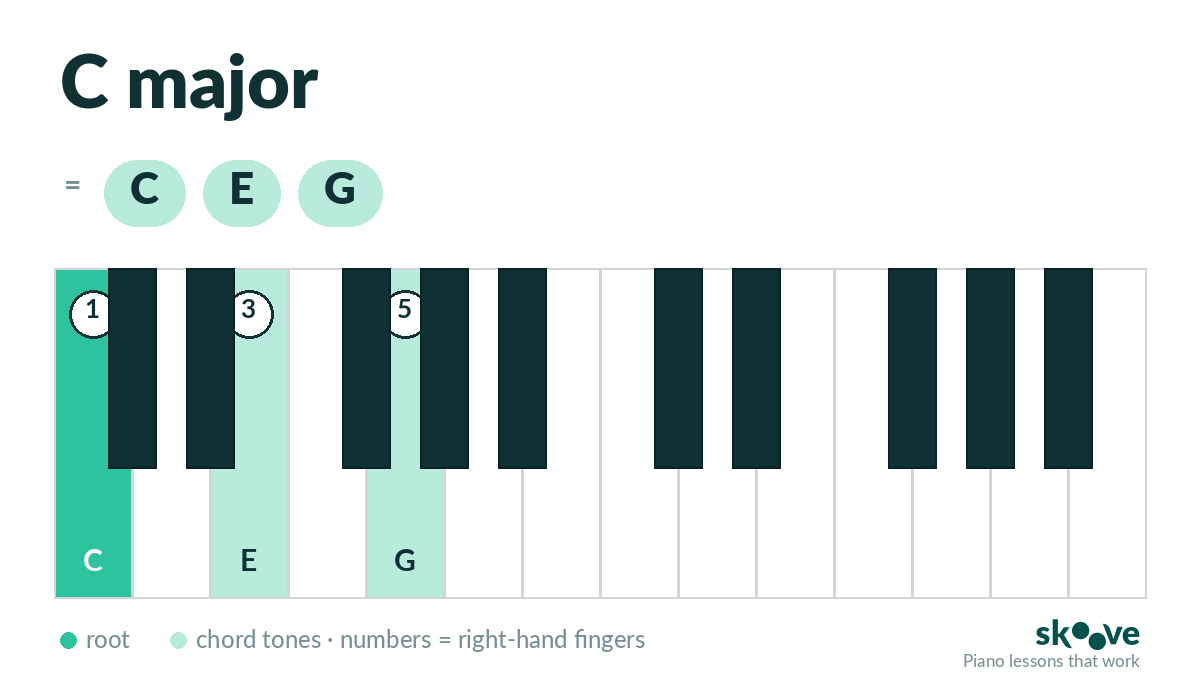
- The root note (the chord's namesake) lights up in solid Skoove green.
- The other chord tones light up in pale green: the third and the fifth in a triad, plus the seventh if it's a 7th chord.
- Everything else stays white. You can tap any unlit key to play it anyway. It's a handy way of hearing how a note that isn't in the chord clashes against the ones that are.
The two big buttons let you hear the chord two ways. Play chord sounds all the notes simultaneously, the way a pianist usually plays it. Arpeggiate plays them one at a time, bottom to top, so you can hear how the individual notes stack into a single colour.
Inversions: same chord, different shape
Inversions are created by changing the order the notes of a chord are stacked. They let you play the same chord with a different feel, and change how you hear each note. C-E-G, E-G-C, and G-C-E are all "C major", but each has a different structure. The flavour changes a bit (root-position chords sound the most stable; inversions feel a little more in motion), but the chord is the same.
The inversion toggle above the piano lets you cycle through these shapes. For triads you'll see Root, 1st inversion, and 2nd inversion. For 7th chords you also get a 3rd inversion. Pianists use inversions to make smooth voice-leading between chords, keeping the same notes near each other so the music doesn't lurch around the keyboard.
The chord types you'll meet most often
There are dozens of chord types. Here are the ones you'll see in 95% of pop, rock, and folk songs:
- Major is the bright, "happy" sound. It stacks a major third (four half steps) and then a minor third (three half steps) on the root, so C major is C-E-G. The default chord most songs return to.
- Minor sounds darker and more reflective. The two intervals swap: a minor third first, then a major third on top, which lowers the middle note by a half step. C minor is C-E♭-G.
- Dominant 7th (just called "7") is a major chord with a flat 7th added on top. C7 is C-E-G-B♭. It sounds restless, like it wants to resolve down a fifth to F. It powers blues, gospel, and any cadence that lifts and lands.
- Major 7th ("maj7") is a major chord with a major 7th. Cmaj7 is C-E-G-B. The 7th sits a half step under the root above it, and that gentle rub is the chord's warmth. Common in bossa nova and modern pop ballads.
- Minor 7th("m7") is a minor chord with a flat 7th on top. Smooth and contemplative. The chord of soul, R&B, and countless verses.
- Sus2 / Sus4 are the "suspended" chords: the third is taken out, so they are neither major nor minor. Sus2 puts a major 2nd in its place (Csus2 is C-D-G) and sounds open and airy. Sus4 uses a perfect 4th instead (Csus4 is C-F-G), and that 4th leans so hard toward the third that the chord almost always resolves back to the major or minor chord on the same root. Songwriters use both to create motion without leaving the chord.
- Diminished is a minor chord with the fifth lowered a half step. Cdim is C-E♭-G♭. Tense and unstable, it is used as a passing chord rather than a resolution.
- Augmented is a major chord with the fifth raised a half step. Caug is C-E-G#. It sounds bright, and is usually used as a pivot chord or a substitute for a dominant.
- 6 / Minor 6 add a major 6th on top of a major or minor triad. C6 is C-E-G-A. The 6 sounds vintage and sweet; the m6 is melancholic with a lift.
- Add9 stacks a major 9th on a bare triad, with no 7th. Cadd9 is C-E-G-D. Shimmery and modern, a staple of pop ballads.
Where chords come from: the key
In the key of C major (a key is the set of notes a song is built from), the chords that naturally fit are C, Dm, Em, F, G, Am, and B°. These are called diatonic chords, and they're labelled with Roman numerals (I, ii, iii, IV, V, vi, vii°) so you can talk about them independently of the key.
That's where the "Try next" suggestions come from. When you're looking at C major, the V (G major) is what most songs go to next; it pulls back to C beautifully. The relative minor (Am) shifts the mood without changing the notes you're playing on. The IV (F major) is the other foundational chord of three-chord pop. Try the suggestions. They're not random.
Building progressions from this tool
A chord progression is just a sequence of chords. Some of the most loved progressions in pop music are remarkably short:
- I – V – vi – IV, the "axis of awesome" progression. In C major: C, G, Am, F. Powers thousands of pop songs.
- ii – V – I, the cornerstone of jazz. In C major: Dm7, G7, Cmaj7. Minor keys have their own version, ii° – V – i; in A minor that's Bm7♭5, E7, Am.
- I – IV – V, the three-chord backbone of folk, blues, and early rock. In C major: C, F, G. These are the three major chords the key contains, a twelve-bar blues is built from nothing else, and early rock 'n' roll ran on them for a decade.
Pick a starting chord above, follow the "Try next" suggestions for a few hops, and you'll have built one of these progressions without trying. That's not a coincidence; those suggestions are curated from how chord families actually behave.
Common questions
What are the most common piano chords?
Major and minor triads carry most songs: C, G, D, F, A, E major and A, E, D, B minor cover the bulk of pop, rock and folk. Add the dominant 7th chords (G7, C7, D7) and you can play thousands of songs.
What piano chords should I learn first?
Start with C major, G major, F major and A minor. All four sit mostly on white keys, and together they already cover progressions used in thousands of songs. Once those feel comfortable, add D major, E minor and G7.
How do I read a piano chord chart?
A chord chart shows which keys to press: the root note (the chord's name) plus the other chord tones. On our diagrams the root is marked in solid green and the remaining chord tones in pale green. Press them together and you're playing the chord.
How many piano chords are there?
Each of the 12 root notes can carry every chord type, so the common types alone (major, minor, 7ths, sus, diminished, augmented, 6ths, add9) give you well over a hundred chords, before counting inversions. In practice, a few dozen do almost all the work: this page covers the ones you'll actually meet in songs.
What's the difference between Cmaj7 and C7?
Cmaj7 has a major 7th (B) on top, warm and stable. C7 has a minor 7th (Bb), restless and pulling toward F. Same triad underneath, but the seventh changes the whole flavour.
What does 'sus' mean in sus2 and sus4?
"Sus" is short for suspended. The third of the chord is replaced with either a 2nd (Csus2 = C-D-G) or a 4th (Csus4 = C-F-G). Suspended chords sound open and unresolved; sus4 usually resolves back to the major or minor chord on the same root.
Why do diminished and augmented chords sound so strange?
Diminished chords have a flat fifth, a tritone: the most dissonant interval in tonal music. Augmented chords have a raised fifth. Both are used as passing chords rather than resolutions.
Are inversions hard to play?
Not particularly. You're playing the same three notes, just with a different one at the bottom. The benefit is in how chord changes sound when you use them: notes don't have to leap across the keyboard between chords.
Where do chord names like Cm7b5 or Cdim7 come from?
Those are more specific chord types layered on top of the triads above. Cm7b5, the half-diminished chord, is a diminished triad with a minor 7th; Cdim7, fully diminished, stacks another minor third on top. Both are in the chord player above, behind More chords. Ninth, eleventh and thirteenth chords extend the same stacking idea further and are the usual next step after these.

Reviewed by
Composer, arranger and music educator. BA Music (LIPA), MA Composition (University of Salford).
Last updated 2026-09-24