



The grand staff is made of two five-line staves joined together by a brace, usually with a treble clef on top and a bass clef on the bottom. Piano music is written, usually, with the right hand playing the treble part and the left playing the bass. Understanding the grand staff helps you read music more confidently and connect the keyboard to written notation. In this guide, we will break down the grand staff definition, how grand staff notes are organized, how the treble and bass clefs work together and where middle C sits on the piano grand staff. By the end of this article, you’ll be able to read basic grand staff music and navigate both staves with ease. Let’s get going!
What is a grand staff ?
A grand staff is a musical notation system combining a treble clef staff and a bass clef staff, connected by a brace. This allows notes for both hands to be read together. Middle C acts as an anchor point between the two staves.
The treble clef is usually played with the right hand and the music in the bass clef is played with the left hand. It is an effective way to divide what the left and right hand play. It is an important concept to understand when you learn to read music. It is especially important to know if you need to sight read or compose music.
Grand staff: Structure and layout
The lines and spaces of the grand staff show musicians what pitches to play. These five lines for each clef of the grand staff are called the staves with four spaces between them that help show each note’s letter names in order through the musical alphabet.
The top staff
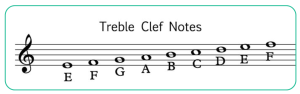
The top staff uses the treble clef and is designed for higher-pitched notes, usually the right hand. This makes it ideal for melodies and higher harmonies.
The bottom staff
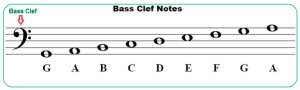
The bottom staff uses the bass clef and is used for lower-pitched notes. It is usually played by the left hand, providing bass lines, chords and harmonic support.
The Brace
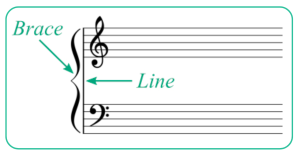
The connecting brace is the vertical line and curved bracket on the far left that joins the treble and bass staves. It shows that both staves belong together as a grand staff and are read and played as one musical system.
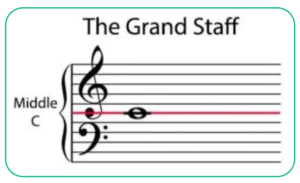
Middle C
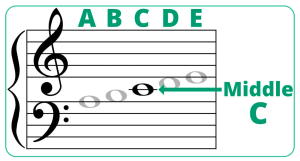
The below diagram shows middle C. It is called middle C because it is in the middle of the grand staff. When we combine the two clefs together into the grand staff, two C notes of the same pitch overlap in the exact same position, one ledger line above bass clef and one below treble.
How to read music on the grand staff
Reading the grand staff means matching each note’s position on the treble or bass staff to its pitch, using landmarks like Middle C to orient yourself, while reading both staves together to coordinate your two hands.
Treble clef
The notes on grand staff include both the treble and bass clefs. The notes of the treble staff are simple to memorize if you use mnemonic devices. The treble clef notes are:
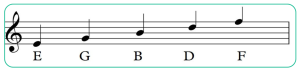
Use a helpful mnemonic like ‘Every Good Boy Deserves Football’ to commit these note positions to memory.
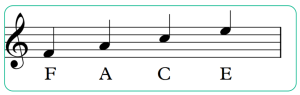
You can simply remember the phrase “FACE in the space” to remember these note positions on treble clef.
Bass clef
As with treble clef the lines and spaces of bass clef are likewise quite easy to memorize if you use a mnemonic device. Here are the bass clef notes:

For the lines you can remember “Good Burritos Don’t Fall Apart”.

For the spaces you can remember “All Cows Eat Grass”.
Grand staff notes chart
When we combine both the notes of the treble staff and the staff notes in bass clef, quarter notes on grand staff look like this:
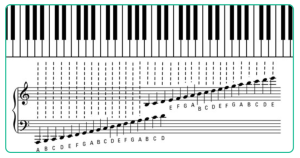
These notes can come in any form including eighth notes, dotted notes, ties and as passing notes with varying articulation.
The grand staff and ledger lines
Ledger lines are additional lines added to the grand staff to show the notes that extend beyond the piano grand staff. Knowing what these notes are is especially useful when reading piano notes that fall above or below the typical range.
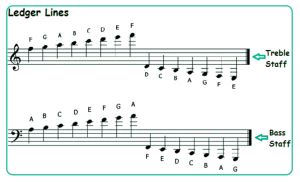
In the case of ledger lines below the treble clef, we usually notate these pitches in the bass clef and in the case of ledger lines above the bass clef, we could notate these pitches in the treble clef. Notation and use of clefs and ledger lines are heavily dependent on musical context and ease of reading grand staff in music.
Top tips for practicing the grand staff
Reading grand staff notes becomes much easier when you focus on a few key practice points. Here are our tips to help you build confidence and improve your reading speed.
- Learn middle C: Middle C connects the treble and bass clefs and helps you orient yourself on the grand staff.
- Use mnemonics: Knowing the note names in each clef will help you recognize patterns. Use our helpful phrases we looked at to speed up learning.
- Read in intervals: Rather than trying to read every note individually, learn to recognize steps, skips and common chord shapes.
- Learn your ledger lines: Notes above and below the grand staff use ledger lines to extend the range of the staff. Knowing these before they appear in a piece will be very handy.
- Read both staves together: See the grand staff as one connected system rather than two separate clefs.
- Practice reading regularly: Just a few minutes a day can improve your ability to identify notes on the grand staff.
With consistent practice, reading grand staff music will become more natural and you’ll spend less time thinking about note names and more time focusing on musical expression.
Put the grand staff into practice
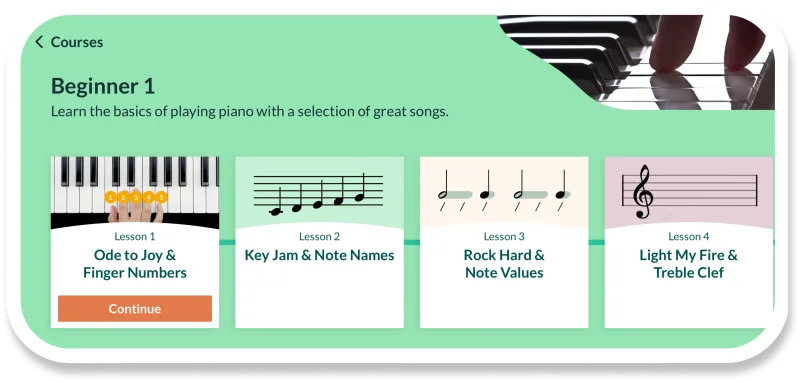
The best way to internalise the grand staff is through hands-on practice with Skoove. Once you understand how the treble and bass clefs work together, it’s time to apply that knowledge to real music. The following examples will help you identify grand staff notes, locate middle C, and develop confidence reading both staves at the same time.
Simon and Garfunkel – “Mrs Robinson”
Have a go at our helpful lesson Mrs Robinson III and Sight Reading from our piano course. It’s a great introduction into reading on the Grand staff.
Billie Eilish – “Birds of a Feather”
This fun Billie Eilish tune is an approachable way to work on your timing and interaction between your hands and reading on the grad staff.
A grand way to read music
The grand staff is the foundation of piano notation. Understanding how these two staves work together, where middle C sits, and how notes are organized will make it much easier to read and play piano music. As you continue practicing, focus on recognizing note patterns, intervals, and common shapes rather than reading every note individually. With regular practice, identifying grand staff notes will become more automatic and you’ll be able to spend less time decoding notation and more time focusing on musical expression.
Ready to put your skills into action? Skoove’s interactive lessons help you apply your understanding of the grand staff through guided exercises, sight-reading activities and songs designed to build confidence at every stage of your piano journey. Happy practicing!
FAQs
Author of this blog post

Eddie Bond is a multi-instrumentalist performer, composer, and music instructor currently based in Seattle, Washington USA. He has performed extensively in the US, Canada, Argentina, and China, released over 40 albums, and has over a decade experience working with music students of all ages and ability levels.
Published by the Skoove team