
Have you ever frozen mid-song because of a curved line above or between notes? You’re not alone. One of the most common challenges for beginner musicians is figuring out whether that curved line is a tie or a slur. Ties and slurs look very similar on the page, yet they serve completely different purposes.
Understanding both symbols will help you read rhythms more accurately, interpret musical phrasing correctly and avoid common mistakes when performing. In this article, we will learn how to identify, read and play ties. We will also cover how they differ from slurs and when composers use each one in music notation. Let’s get started!
What is a tie in music?
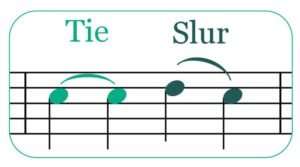
Ties are notated with a curved line linking two notes of the same pitch. A tie in music is a way of increasing the length of a rhythmic value by combining two notes. They are used when a single note value conflicts with rhythmic grouping or isn’t possible due to bar lines.
A tie music symbol is very similar to the slur symbol in music. Ties and slurs in music differ as slurs connect notes of different pitches.
In this first example, we see how a tie between two quarter notes works. A quarter note is worth one beat. However, when a tie links two quarter notes across the bar line, it is worth two beats (beat four + beat one).
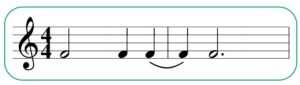
Ties were used in this situation as a half note (minim) would not have been able to fit in the bar or cross the bar line so a tie was used to achieve the desired rhythm.
How to play tied notes on piano?
The best way to get used to playing tied notes is by looking at examples of tied notes and how to recognise them.
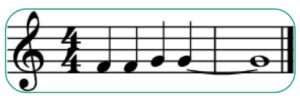
In the following example of two tied notes, the tie links the quarter note (crotchet) on beat four to the whole note (semibreve) in the next bar, creating a note that lasts for the duration of the fourth beat (one beat) and the next bar (four beats). The key stays down while you count through both note values. A common beginner mistake is re-striking the second note, resist that urge.
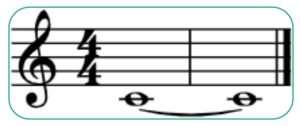
In the next example, the first note is a whole note tied across the bar line into the second measure to another whole note. This makes the note worth two bars total (four beats + four beats).
Take a look at this example of how to count tied notes and how they relate to the beats of the bar.
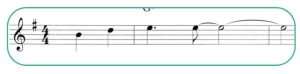 In this example we see an eighth note (quaver) tied to a half note. So why use a tie for the E? The answer is proper rhythmic grouping. In a bar of four four the strong third beat needs to be visible when more intricate notation is used.
What is a slur in music?
As we have briefly discussed, a slur instructs you to play two or more notes smoothly. This articulation gives you a smoother phrase as you move from one note to the next without a break in the sound. The Italian term for this is “legato”.
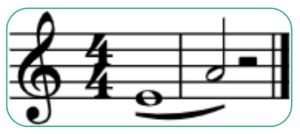
Notice how the slur connects two notes of different frequencies while music ties connect two notes of the same pitch. Just like ties, slurs can extend across multiple different notes or bars, or even over ties. 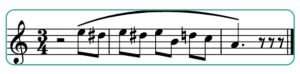
This is the beginning of Beethoven’s Fur Elise, one of the most popular piano songs of all time. In order to make it sound smooth and expressive, we use a slur to instruct the player to use legato technique and connect these piano notes.
How to play slurs on piano
When playing a slur on the piano, the notes should blend naturally into one another without noticeable gaps or accents. Many pianists describe this feeling as ‘singing through the keyboard’ with the hand moving smoothly from note to note.
While the sustain pedal can help create a connected sound, it should not be relied upon to perform a slur. True legato playing comes from careful finger technique, not the pedal. A good test is whether you can maintain a smooth connection between notes without using the pedal at all.
When a slur extends over a longer phrase, think of it as a musical sentence rather than a series of individual notes. This is a phrase marking. Instead of focusing on each note separately, shape the entire phrase as one connected musical idea. One of the most common beginner mistakes is not paying attention to finger technique and relying too much on the pedal. Be sure to practice slowly and listening carefully for any gaps between notes will help you develop smooth, expressive phrasing. Try this out with a friendly lesson form Skoove tailored to help you with your articulation.
What’s the Difference Between Ties and Slurs?
This handy table should help you recap what we have learned and get to grips with it.
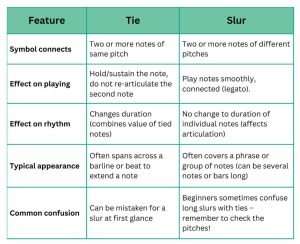
Now you understand the differences between a slur vs tie you will be able to more confidently read sheet music.
Practice playing ties and slurs
A good starting point for learning to identify ties and slurs correctly is with Skoove. Have a go at this lesson and use it to get comfortable with your newfound knowledge.
When learning this song, be sure to internalize the duration of tied notes. While practicing the song, make sure to hold the tied notes to their full value. At the same time pay attention to the slurs between different pitches. You can also try adding in some basic piano chords with the melody.
Ties and Slurs – Know the difference
Understanding ties and slurs is an important step in becoming a confident music reader. Although these symbols look similar, they serve very different purposes. Ties connect notes of the same pitch to create a longer rhythmic value, while slurs connect notes of different pitches to indicate smooth, flowing phrasing. Learning to recognize the difference between ties and slurs will help you interpret sheet music more accurately and perform with greater musicality. The more you practice reading and playing ties and slurs, the more natural they will become. Be sure to keep practicing and use Skoove for expert guidance and help. Happy practicing!
FAQs
Author of this blog post:
Georgina St George

Georgina St George has been playing piano most of her life. She has a thriving piano school on the south coast of England. She loves to infuse her students with her passion for music, composing and performing. Her music has been featured on over 100 TV shows and her musicals have been performed in New York and London’s West End.
Published by Lydia Ogn from the Skoove team