


Every musical note has a specific frequency measured in Hertz (Hz). The frequency of a note determines how high or low we hear it. Understanding note frequencies can help piano players better understand tuning, pitch and the relationship between music and sound. In this friendly guide we will look at what note frequency means, how piano notes correspond to specific frequencies and how to use a note frequency chart to find the frequency of any piano key. Let’s get going!
What is a frequency?
In simple terms, a note frequency is the number of times a sound wave vibrates per second. Hertz (Hz) and note frequency are the way we measure the wobbly air made by musical instruments and musical sounds. The vibrations in the air create the pitches we hear in music, the faster the vibrations, the higher the pitch and the slower the vibrations, the lower the pitch.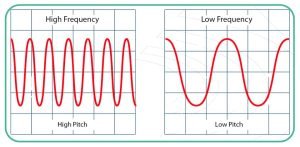
A note frequency chart will show the frequency of each musical note, making it easy to see how pitch relates to sound. For example, the note A4 has a frequency of 440 Hz, meaning its sound wave vibrates 440 times per second. Every musical note has its own unique frequency, our ability to hear these differences allows us to distinguish between high and low notes.
Piano note frequency chart
The music note frequency chart below shows the frequencies of piano keys, from low C to the high B. This range represents the frequency span of a standard piano, covering both its lowest and highest notes. You can use this piano note frequency chart to quickly find the frequency of any key, compare pitches across octaves and better understand how musical notes relate to sound frequencies and keys on the keyboard.
| Note | Octave 0 | Octave 1 | Octave 2 | Octave 3 | Octave 4 | Octave 5 | Octave 6 | Octave 7 | Octave 8 |
|---|---|---|---|---|---|---|---|---|---|
| C | 16.35 Hz | 32.70 Hz | 65.41 Hz | 130.81 Hz | 261.63 Hz | 523.25 Hz | 1046.50 Hz | 2093.00 Hz | 4186.01 Hz |
| C#/Db | 17.32 Hz | 34.65 Hz | 69.30 Hz | 138.59 Hz | 277.18 Hz | 554.37 Hz | 1108.73 Hz | 2217.46 Hz | 4434.92 Hz |
| D | 18.35 Hz | 36.71 Hz | 73.42 Hz | 146.83 Hz | 293.66 Hz | 587.33 Hz | 1174.66 Hz | 2349.32 Hz | 4698.63 Hz |
| D#/Eb | 19.45 Hz | 38.89 Hz | 77.78 Hz | 155.56 Hz | 311.13 Hz | 622.25 Hz | 1244.51 Hz | 2489.02 Hz | 4978.03 Hz |
| E | 20.60 Hz | 41.20 Hz | 82.41 Hz | 164.81 Hz | 329.63 Hz | 659.25 Hz | 1318.51 Hz | 2637.02 Hz | 5274.04 Hz |
| F | 21.83 Hz | 43.65 Hz | 87.31 Hz | 174.61 Hz | 349.23 Hz | 698.46 Hz | 1396.91 Hz | 2793.83 Hz | 5587.65 Hz |
| F#/Gb | 23.12 Hz | 46.25 Hz | 92.50 Hz | 185 Hz | 369.99 Hz | 739.99 Hz | 1479.98 Hz | 2959.96 Hz | 5919.91 Hz |
| G | 24.50 Hz | 49 Hz | 98 Hz | 196 Hz | 392 Hz | 783.99 Hz | 1567.98 Hz | 3135.96 Hz | 6271.93 Hz |
| G#/Ab | 25.96 Hz | 51.91 Hz | 103.83 Hz | 207.65 Hz | 415.30 Hz | 830.61 Hz | 1661.22 Hz | 3322.44 Hz | 6644.88 Hz |
| A | 27.50 Hz | 55 Hz | 110 Hz | 220 Hz | 440 Hz | 880 Hz | 1760 Hz | 3520 Hz | 7040 Hz |
| A#/Bb | 29.14 Hz | 58.27 Hz | 116.54 Hz | 233.08 Hz | 466.16 Hz | 932.33 Hz | 1864.66 Hz | 3729.31 Hz | 7458.62 Hz |
| B | 30.87 Hz | 61.74 Hz | 123.47 Hz | 246.94 Hz | 493.88 Hz | 987.77 Hz | 1975.53 Hz | 3951.07 Hz | 7902.13 Hz |
Common piano note frequencies
Here are some common frequencies that may come up in musical conversations. Knowing these will help you, sight read, understand the theory behind piano and musical frequencies better.
Middle C
Middle C (C4) has a frequency of approximately 261.63 Hz. Located near the center of the piano keyboard, it serves as an important reference point for reading music and understanding pitch relationships.
A = 440 Hz
A4 has a frequency of 440 Hz and is the standard tuning reference used by most modern instruments. Before a performance, musicians often tune their instruments to this pitch so they can play together in tune. The A4 = 440 Hz standard was internationally adopted in the 20th century, along with twelve tone equal temperament and remains the most widely used tuning system today.
A = 432 Hz
Some musicians and listeners prefer tuning A4 to 432 Hz instead of the standard 440 Hz. They often describe 432 Hz tuning as sounding warmer, softer or being ‘more natural’. However, these preferences are largely subjective. Scientific studies have not found conclusive evidence that 432 Hz provides unique physical, healing or psychological benefits compared to 440 Hz. The difference is the slightly lower and possibly comparatively ‘warmer’ pitch of tunings compared to A=440Hz.
How frequencies relate to piano keys
Every piano note corresponds to a specific frequency. As we have learned so far these frequencies determine the pitch you hear when the key is played. As you move from left to right on the keyboard, the frequencies increase, creating progressively higher notes, just like going up on the grand staff. Each key is assigned a note name, such as C, D or E. Take a look at this piano frequency chart to see how this connects to the layout of the keyboard.
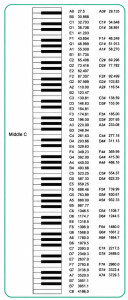
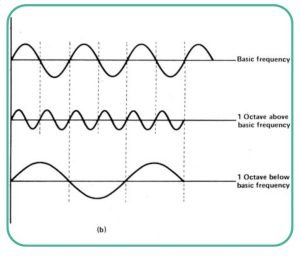
As you can see notes with the same name in different octaves share the same musical note name but have different frequencies. For example, C5 has a frequency that is exactly double that of C4 (middle C), making it sound higher while still being recognized as the same note, just in a different octave.
What is a note frequency calculator?
A note frequency calculator is a tool that converts a musical note into its corresponding frequency. For example, entering A4 will return 440 Hz, while entering 440 Hz will return A4. Piano players can use a note-to-frequency calculator when tuning their instrument, checking pitch accuracy, training their ear or learning how notes relate to sound frequencies.
Bringing note frequencies into practice
Understanding note frequency is a simple way to deepen your understanding of the music you love. As we have learned every note you hear has a specific frequency and these frequencies and their relationships are what create the pitches that form melodies, chords and songs. By using a note frequency chart, you can see how musical notes are organized, how pitch changes across octaves and how frequencies relate to the sounds and music we hear every day.
Having a basic understanding of note frequencies can make concepts like tuning, pitch recognition and music theory much easier to understand. If you’re ready to put these ideas into practice, Skoove’s interactive piano lessons can help you develop your ear, build confidence at the keyboard and turn music theory into real musical skills.
FAQ
Author of this blog post:
Susana Pérez Posada

With over seven years of piano education and a deep passion for music therapy, Susana brings a unique blend of expertise to Skoove. A graduate in Music Therapy from SRH Hochschule Heidelberg and an experienced classical pianist from Universidad EAFIT, she infuses her teaching with a holistic approach that transcends traditional piano lessons. Susana’s writings for Skoove combine her rich musical knowledge with engaging storytelling, enriching the learning experience for pianists of all levels. Away from the piano, she loves exploring new places and immersing herself in a good book, believing these diverse experiences enhance her creative teaching style.
Published by the Skoove team