




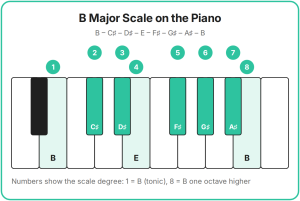
The B major scale uses the notes B, C♯, D♯, E, F♯, G♯ and A♯, and its key signature has five sharps. On the piano, that means every black key plus just two white keys: B and E.
Five sharps can look intimidating on paper. Under your fingers, though, B major is one of the most natural scales you can play, which is exactly why Chopin had his students learn it early.
Below you’ll find the notes, fingering for both hands, the key signature, chords, famous songs in B major and a quick quiz to test yourself.
B major scale notes
The notes of the B major scale are B – C♯ – D♯ – E – F♯ – G♯ – A♯ – B. The scale starts on B, climbs through seven different notes and lands on B again one octave higher.
B major scale formula: W-W-H-W-W-W-H
Every major scale follows the same pattern of whole steps (W) and half steps (H): W-W-H-W-W-W-H. A half step is the distance to the very next key, black or white. A whole step skips one key.
Start on B and follow the pattern: a whole step to C♯, a whole step to D♯, a half step to E, then whole steps to F♯, G♯ and A♯, and a final half step back to B. If this pattern is new to you, start with piano scales for beginners, which explains how every major and minor scale is built.
B major scale degrees, from tonic to leading tone
Each note in the scale has a number and a name. These names describe the job each note does, and they matter once you start working with scale degrees in music and chords.
| Degree | Name | Note | Interval from B |
|---|---|---|---|
| 1 | Tonic | B | Unison |
| 2 | Supertonic | C♯ | Major 2nd |
| 3 | Mediant | D♯ | Major 3rd |
| 4 | Subdominant | E | Perfect 4th |
| 5 | Dominant | F♯ | Perfect 5th |
| 6 | Submediant | G♯ | Major 6th |
| 7 | Leading tone | A♯ | Major 7th |
| 8 | Tonic (octave) | B | Octave |
The leading tone in the B major scale is A♯. It sits just a half step below B and pulls strongly back home to it.
B major scale on the piano keyboard
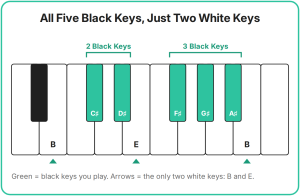
Look at the black keys on any piano and you’ll see them in groups of two and three. The B major scale uses both groups completely: C♯ and D♯ from the group of two, and F♯, G♯ and A♯ from the group of three.
The only white keys you need are B and E, the white keys sitting just to the right of each black-key group: E after the group of two, B after the group of three. Once you see the scale this way, you no longer have to think about five separate sharps. You just play “B, the two black keys, E, the three black keys, B”.
B major scale fingering for piano
The fingering numbers are the same for every pianist: 1 is your thumb, 2 your index finger, 3 your middle finger, 4 your ring finger and 5 your pinky. In B major, your thumbs only ever land on the white keys, which keeps your hand in a relaxed, natural shape.
B major scale right hand fingering
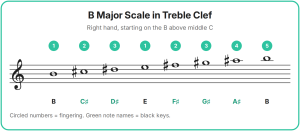
Right hand fingering for the B major scale is 1-2-3-1-2-3-4-5. Put your thumb on B, play C♯ and D♯ with fingers 2 and 3, then tuck your thumb under to play E. Fingers 2, 3 and 4 take F♯, G♯ and A♯, and your pinky finishes on the top B.
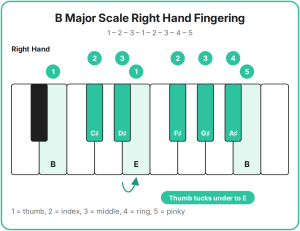
Coming back down, reverse it: 5-4-3-2-1-3-2-1. Cross finger 3 over your thumb onto D♯ after you play E.
B major scale left hand fingering
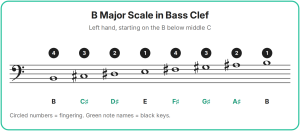
Left hand fingering for the B major scale is 4-3-2-1-4-3-2-1. Start with your ring finger on B, play C♯ and D♯ with fingers 3 and 2, and land your thumb on E. Then cross finger 4 over your thumb onto F♯, and finish with 3, 2 and 1 on G♯, A♯ and B.
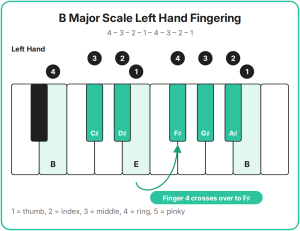
Notice that the left hand starts on finger 4, not your pinky. This is standard for B major and makes the crossover onto the black key much smoother.
Both hands together: thumbs meet on E
Here’s a detail most guides miss. When you play the B major scale hands together, both thumbs land on E at the same moment. That shared landmark makes coordinating your hands much easier than in most other keys.
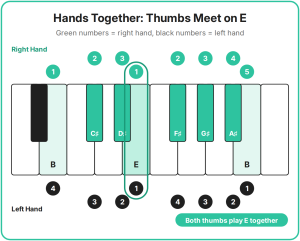
Practice tip
Say “thumbs on E” out loud the first few times you play hands together. Once that moment feels secure, the rest of the scale usually falls into place.
B major scale two-octave fingering
When you’re comfortable with one octave, extend the scale to two. The pattern repeats, with one change at the turnaround.
| Hand | Two-octave fingering (ascending) |
|---|---|
| Right hand | 1-2-3-1-2-3-4 – 1-2-3-1-2-3-4-5 |
| Left hand | 4-3-2-1-4-3-2-1 – 3-2-1-4-3-2-1 |
In two octaves, your thumbs meet three times: on the first E, the middle B and the second E.
Chopin’s first scale: why B major is easier than it looks
Most beginners learn the C major scale first because it has no sharps or flats. Frédéric Chopin, one of the greatest piano teachers of his time, reportedly did the opposite. According to his students’ accounts, he started pupils on scales full of black keys, such as B major, and left C major until later.
His reasoning was about the shape of the hand. Your long middle fingers naturally reach further forward than your thumb and pinky. In B major, those long fingers rest on the raised black keys while your short thumb sits on the white keys. In C major, every finger lies flat on white keys, and playing evenly is actually harder.
So if you’ve already learned the G major scale and felt ready for something new, don’t let five sharps put you off. B major may feel more comfortable in your hands than you expect.
B major key signature: 5 sharps
The B major key signature has five sharps: F♯, C♯, G♯, D♯ and A♯. They sit at the start of every line of music, so you don’t have to write a sharp next to each note. If you’d like key signatures explained from scratch, start with the basics before reading music in B major.
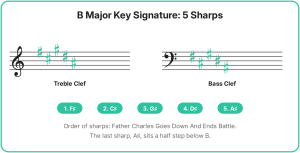
Order of sharps in B major
Sharps always appear in the same order: F♯, C♯, G♯, D♯, A♯, E♯, B♯. A popular way to remember it is “Father Charles Goes Down And Ends Battle”. B major uses the first five.
There’s a quick trick for naming any sharp key: go up a half step from the last sharp. The last sharp in B major is A♯, and a half step above A♯ is B. On the circle of fifths, B sits five steps clockwise from C, one sharp added at each step.
B major scale in treble clef
In treble clef, the right hand usually plays the B major scale starting on the B in the middle of the staff. The top two notes, A♯ and B, sit on and above the first ledger line. If any of these positions feel unfamiliar, brush up on your treble clef notes.
B major scale in bass clef
In bass clef, the left hand starts on the B on the second line of the staff and climbs to the B just above the top line. Reading these notes quickly gets easier with practice of bass clef notes on piano.
B major scale chords
Build a chord on every note of the B major scale, using only notes from the scale, and you get seven chords. Three are major, three are minor and one is diminished, the same pattern as every major key. Learn more about how these sound in major and minor chords.
The 7 diatonic triads in B major
A triad is a three-note chord built by stacking every other note of the scale. Start on any note of the B major scale, skip one, play the next, skip one and play the next. Starting on B gives you B – D♯ – F♯, the B major chord. Do the same from each of the seven notes and you have every basic chord in the key.
Chords are numbered with Roman numerals that show both their position and their quality. Uppercase numerals (I, IV, V) are major chords and sound bright. Lowercase numerals (ii, iii, vi) are minor and sound softer or sadder. The small circle on vii° marks the one diminished chord, which sounds tense and wants to resolve.
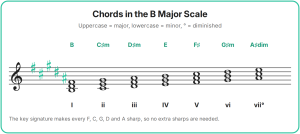
The pattern is always major, minor, minor, major, major, minor, diminished. It is the same in every major key, so once you know it in B major, you know it everywhere.
A triad is a three-note chord made by stacking two thirds. Start on any note of the B major scale, skip the next note, play the one after it, skip again and play one more. Do this on each of the seven scale notes and you get the seven diatonic triads: the chords that naturally belong to the key of B major.
Their qualities follow the same pattern in every major key: major, minor, minor, major, major, minor, diminished. Roman numerals show this at a glance. Uppercase numerals (I, IV, V) are major chords, lowercase numerals (ii, iii, vi) are minor chords, and the small circle in vii° marks the diminished chord.
| Numeral | Chord | Notes | Quality |
|---|---|---|---|
| I | B | B – D♯ – F♯ | Major |
| ii | C♯m | C♯ – E – G♯ | Minor |
| iii | D♯m | D♯ – F♯ – A♯ | Minor |
| IV | E | E – G♯ – B | Major |
| V | F♯ | F♯ – A♯ – C♯ | Major |
| vi | G♯m | G♯ – B – D♯ | Minor |
| vii° | A♯dim | A♯ – C♯ – E | Diminished |
The three you’ll use most are I, IV and V: B, E and F♯. Together they contain every note of the B major scale, which is why so many songs in B major are built on them alone.
Hand-shape tip
Two of these chords use black keys only: D♯m (D♯ – F♯ – A♯) and F♯ (F♯ – A♯ – C♯). Your hand can rest on top of the black keys for both, which makes them some of the easiest chords in the key to find without looking.
The three major chords, B, E and F♯, are the backbone of the key. Many simple songs in B major use only these three, so they’re the best place to start.
On the keyboard, each triad mixes black and white keys in its own way. D♯m and F♯ use only black keys, E major is the only chord with two white keys (E and B), and every other chord has just one white key. Noticing these shapes makes the chords much quicker to find.
A♯dim is the odd one out. Its outer notes are a diminished fifth apart, which gives it a tense, unsettled sound that wants to resolve straight back to B.
Practice tip
Walk up the key one chord at a time: play each triad with right-hand fingers 1, 3 and 5, from B all the way to A♯dim and back to B. You’ll hear the major, minor and diminished pattern as you go.
Easy chord progression in B major: I–V–vi–IV
The I–V–vi–IV progression powers countless pop songs. In B major it becomes B – F♯ – G♯m – E. These are the same four chords Jason Mraz uses in “I’m Yours”, so you can play along as soon as the shapes feel comfortable.
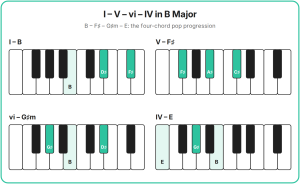
Try it with your left hand holding the root note and your right hand playing the three-note chord. When that works, explore more chord progressions on piano in the same key.
B major relative minor: G♯ minor
The relative minor of B major is G♯ minor. Both keys share the same five sharps and the same seven notes. The difference is the home note: G♯ minor starts and ends on G♯, the 6th note of the B major scale, which gives it a darker sound.
G♯ minor’s notes are G♯, A♯, B, C♯, D♯, E and F♯. In the harmonic minor version, the 7th note is raised to F double sharp, which you play on the G key. The parallel minor, B minor, shares B major’s starting note but has only two sharps. To see how these pairs work across every key, read about relative major and minor scales.
B major and C♭ major: same keys, different names
Yes, B major and C♭ major sound exactly the same and use exactly the same piano keys. They are enharmonic equivalents: the same pitches, spelled with different note names. B major is written with five sharps, while C♭ major needs seven flats.
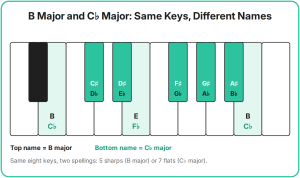
Because five sharps are easier to read than seven flats, composers almost always choose Bmajor. You’ll mainly see C♭ major in music that moves into it from a nearby flat key.
B major pentatonic scale on piano
The B major pentatonic scale keeps five notes from the major scale: B, C♯, D♯, F♯ and G♯. It drops the 4th (E) and the 7th (A♯), which leaves a bright, open sound that’s perfect for improvising.
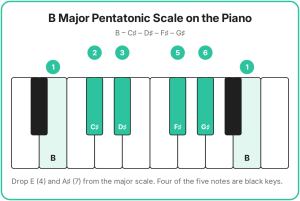
Four of its five notes are black keys, so you can improvise freely with very few wrong notes. That black-key shortcut is one of the easiest ways into the pentatonic scale on piano.
The sound and character of B major
B major sounds bright and radiant, with a slightly brilliant edge compared to the warmer sound of flat keys. Of course, every piano is tuned the same way today, so this “character” comes mostly from how composers have used the key over time.
Some musicians in the past took key character very seriously. The German poet and musician Christian Schubart, writing in the late 1700s, described B major as strongly coloured and full of wild passions. It’s a subjective view, but it’s fun to listen for when you play.
Is B major a rare key? Not on piano or guitar, where it sits comfortably under the hands. It’s less common in orchestral music, where five sharps are awkward for many string and wind instruments.
Famous songs and pieces in B major
Hearing a key in real music is the best way to remember its sound. These pieces are all written in B major.
| Song or piece | Composer or artist | Style |
|---|---|---|
| I’m Yours | Jason Mraz | Pop |
| Wicked Game | Chris Isaak | Rock |
| Don’t Worry, Be Happy | Bobby McFerrin | Pop |
| Sir Duke | Stevie Wonder | Soul |
| Nocturne Op. 9 No. 3 | Frédéric Chopin | Classical |
| Nocturne Op. 32 No. 1 | Frédéric Chopin | Classical |
| Piano Trio No. 1, Op. 8 | Johannes Brahms | Classical |
Chopin’s Nocturne Op. 9 No. 3 is the sister piece of the much more famous Nocturne Op. 9 No. 2. Learn one, and the other is a natural next step.
Common B major scale mistakes and how to fix them
| Mistake | How to fix it |
|---|---|
| Starting the left hand on finger 5 | Start on finger 4. Your pinky isn’t needed in B major and makes the crossover awkward. |
| A bump when the right thumb tucks under to E | Move your thumb toward E while you play D♯, so it’s already in place. |
| The left hand’s 4th finger lands late on F♯ | Keep your wrist level and lift finger 4 over your thumb in one smooth arc. |
| Black keys sound louder than white keys | Play close to the edge of the black keys and listen for an even volume on every note. |
| Rushing the black-key groups | Practice with a metronome and give every note exactly the same length. |
B major scale practice exercises
Work through these steps in order and only move on when you can play the current one cleanly five times in a row.
| Step | Exercise |
|---|---|
| 1 | Play the black-key groups as blocks: C♯ + D♯ together, then F♯ + G♯ + A♯ together. This maps the scale into your hand. |
| 2 | Right hand alone, one octave, up and down at a slow, steady tempo. |
| 3 | Left hand alone, one octave, up and down at the same tempo. |
| 4 | Hands together, one octave, saying “thumbs on E” as you go. |
| 5 | Two octaves, hands separately, then hands together. |
| 6 | Raise your metronome a few beats per minute each day, but only when the previous tempo feels easy. |
To hear the scale and check your fingering as you go, open the Piano Scales tool.
The B major scale looks busy on paper but sits beautifully under your fingers: five black keys, two white keys and thumbs that only ever touch B and E. Learn the right hand 1-2-3-1-2-3-4-5, the left hand 4-3-2-1-4-3-2-1, and remember that both thumbs meet on E.
From there, the chords, the relative minor and songs like “I’m Yours” are all within reach. If you’re still building the basics of how to play piano, Skoove’s interactive lessons guide you step by step, with real-time feedback as you play.
Author of this blog post:
Susana Pérez Posada

Susana Pérez Posada, Master in Music Therapy, Skoove Piano Educator With over seven years in piano education and a deep passion for music therapy, Susana brings a unique blend of expertise to Skoove. A graduate in Music Therapy from SRH Hochschule Heidelberg and an experienced classical pianist from Universidad EAFIT, she infuses her teaching with a holistic approach that transcends traditional piano lessons. In her writings for Skoove, Susana combines her rich musical knowledge with engaging storytelling, enriching the learning experience for pianists of all levels. Away from the piano, she loves exploring new places and immersing herself in a good book, believing these diverse experiences enhance her creative teaching style.