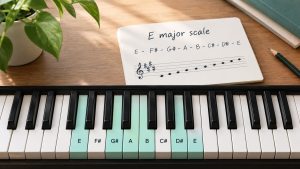




D major is a scale with two sharps, F♯ and C♯. Its notes are D, E, F♯, G, A, B, C♯ and D. D major is well worth learning as a beginner, because so many favorite tunes are written in this key. It’s a natural next step after C major and G major, as it steadily introduces the black keys. In this article, we’ll cover the notes, fingerings, chords in the key of D major and some helpful songs to get you started. Let’s get into it.
What is the D major scale?
As with other major scales, D major is made up of seven consecutive notes of the musical alphabet, beginning and ending on D. Major scales have a bright, happy sound. The D major scale follows the same pattern of whole and half steps as every other major scale, and we’ll look at this in more detail below. A solid understanding of piano scales for beginners will help you grasp both the theory and the practical side of all your scales.
D major scale notes
The D major scale is made up of D, E, F♯, G, A, B, C♯ and D. F♯ and C♯ are the only black keys you need; all the other notes are white. 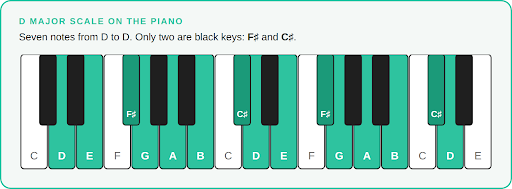 Both black keys are easy to find on the keyboard. F♯ is the leftmost key in the group of three black keys, and C♯ is the left key of the pair of black keys.
The D major scale formula: whole and half steps
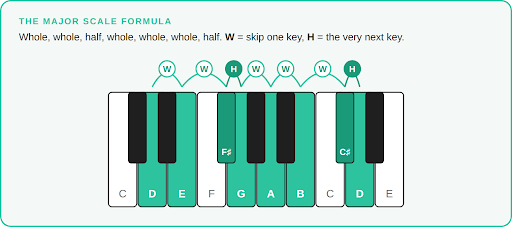
All major scales are built from the same pattern of whole and half steps:
W – W – H – W – W – W – H
Whole and half steps are easy to find on the keyboard. A half step is the smallest possible distance between two keys on the piano, for example C to C♯. A whole step is two half steps combined, for example C to D.
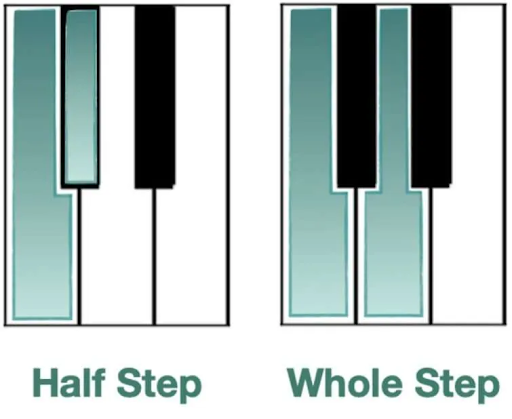
Take a look at this diagram of the D major scale to see how the pattern works in practice.
Scale degrees in D major
Musicians use a handy system to label the notes in a scale. The simplest way is to label each note in the major scale from one to 7 however scale degrees are much more useful in understanding the scale. This system gives each note in the scale a name based on its function.
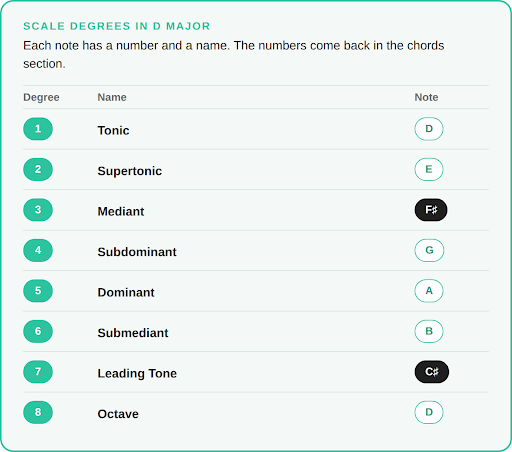
This labelling of the scale will make chords and melodies easier to follow as a beginner musician.
How to play the D major scale on piano
Finger numbers tell you which finger to use when you are playing the scale. 1 is your thumb, 2 is your index finger, 3 is your middle finger, 4 is your ring finger and 5 is your pinky finger.
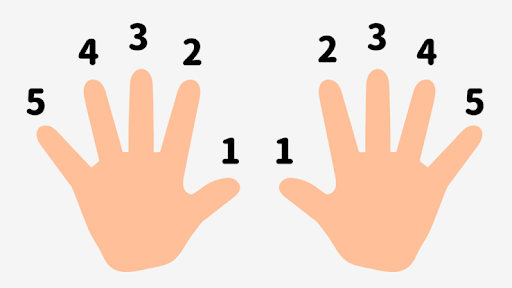
You should start by practising each hand separately, making sure every note sounds clear before trying hands together. D major uses the same fingering shape as C major and G major. If you already know those scales, your hands are familiar with the pattern.
Right-hand fingering
The fingering pattern is:
D (1) – E (2) – F♯ (3) – G (1) – A (2) – B (3) – C♯ (4) – D (5)
When playing the scale with your right hand start with your right-hand thumb (finger 1) on D, then play E with finger 2 and F♯ with finger 3. Next, tuck your thumb underneath your middle finger to reach G, then continue with A using finger 2, B using finger 3, C♯ using finger 4, and the top D using finger 5.
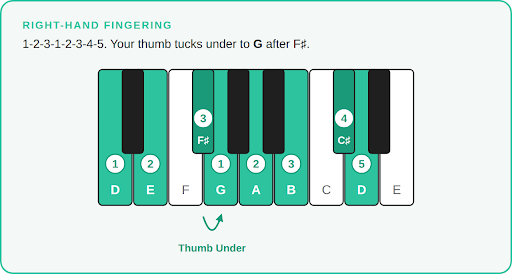
Pay special attention to the thumb tuck after F♯. Keep your wrist level and relaxed, and let only your thumb move underneath your hand to reach G. Try not to twist your wrist or move your whole arm. When coming back down, reverse the movement while keeping good piano posture and technique.
Left-hand fingering
The fingering pattern is:
D (5) – E (4) – F♯ (3) – G (2) – A (1) – B (3) – C♯ (2) – D (1)
Starting with your left-hand little finger (finger 5) on D, then play E with finger 4, F♯ with finger 3, G with finger 2, and A with your thumb (finger 1). Next, cross your middle finger (finger 3) over your thumb to play B, then play C♯ with finger 2 and the top D with your thumb (finger 1).
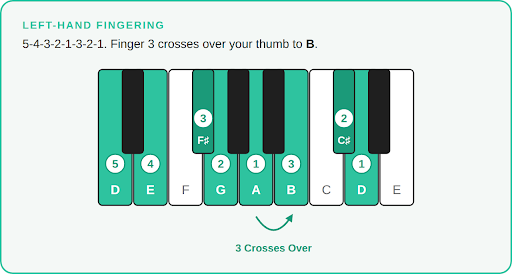
Notice that the left-hand crossover happens at a different place from the right-hand crossover. This is one of the most common stumbling points when learning the D major scale. In the left hand, you cross your middle finger over your thumb after playing A to reach B. Practice this movement slowly, keeping your wrist relaxed and avoiding any twisting of your hand. The black keys, F♯ and C♯, fall naturally under your middle fingers. This makes the fingering feel comfortable and helps your hand move smoothly across the keyboard.
Two-octave fingering
To play the D major scale over two octaves, continue the same fingering pattern into the next octave. For the right hand use: 1-2-3-1-2-3-4-1-2-3-1-2-3-4-5 For the left hand use: 5-4-3-2-1-3-2-1-4-3-2-1-3-2-1 Take your time learning where each thumb tuck and finger crossover occurs as you move between octaves. A metronome can help you develop consistent timing. Set it to a slow tempo, around 60 beats per minute and play one note per beat. Focus on making every note sound equally clear and even. Only increase the tempo when you can play the entire scale smoothly and confidently several times in a row. 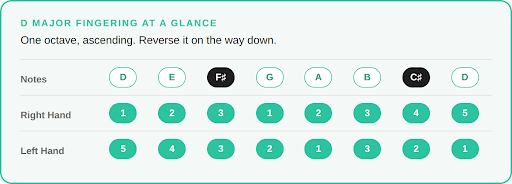
Hands together and two octaves
Once each hand feels comfortable on its own, begin playing the D major scale with both hands together. Start slowly and listen carefully to how the notes line up. The most challenging part is coordinating the thumb movements, because the thumbs move at different times in each hand, just the same as when you play one octave. In the right hand, the thumb tucks under after F♯ to play G, while in the left hand, the middle finger crosses over the thumb after A to play B.
D major key signature: how many sharps?
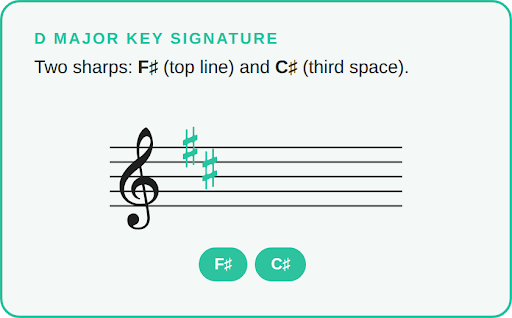
As we know D Major has two sharps F# and C#. This is the key signature for D major. composers use key signatures when writing sheet music to reduce the amount of accidentals needed in a piece to keep melodies and chords in a key.
These shops follow a strict order:
F♯, C♯, G♯, D♯, A♯, E♯, B♯.
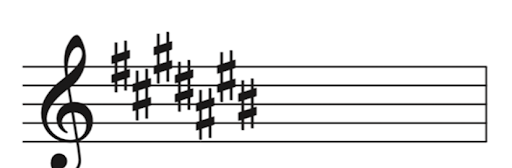
There’s a simple pneumonic trick to remember this order:
Father Charles Goes Down And Ends Battle
For sharp keys, the last sharp in the key signature is a semitone below the key note. This works for D major: C♯ is a half step, or semitone, below D.
The D major scale in treble and bass clef
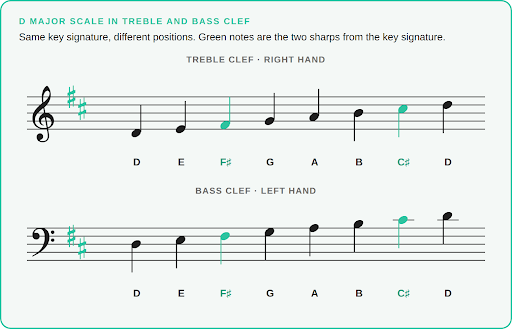
When learning the D major scale on piano, it helps to learn the notes in treble and bass clef. The right hand usually plays in treble clef, while the left hand reads bass clef. The D major key signature has two sharps: F♯ and C♯ make sure you follow this as you play the scale in either clef. In treble clef, F♯ sits on the top line and C♯ in the third space. In bass clef, F♯ sits on the fourth line and C♯ in the second space but they alter all of the F and C notes wherever clef or they come of the staff. Try saying each note aloud as you read the D major scale notes on the staff.
The D major chord on piano
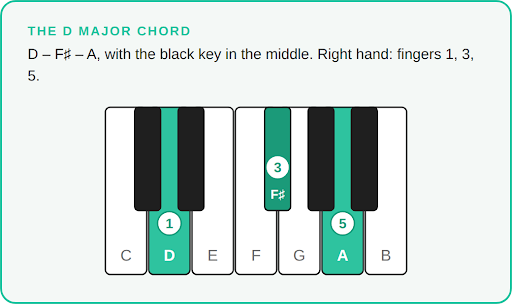
The D major chord piano shape uses three notes: D, F♯ and A, three note chords like this are known as traids. Play these three notes together using fingers 1, 3 and 5 in the right hand, or 5, 3 and 1 in the left hand. The black key, F♯, sits between two white keys, making this chord easy to recognise by touch.
Chords in the key of D major
You can build a triad on every note of the D major scale by stacking every other note. Using diatonic notes from D major gives you seven chords:
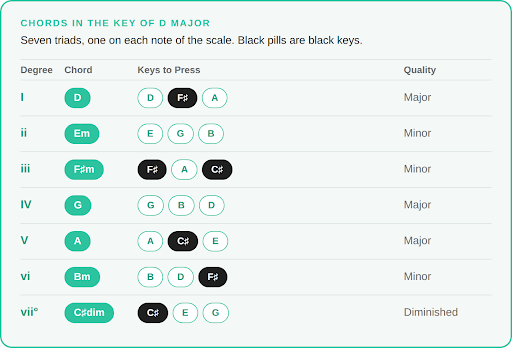
These Roman numerals help you identify each chord type. Capital means major, while lowercase means minor chord, a ‘°’ means the chord is diminished. Start by practicing with D, G and A, these three major chords are enough to play countless songs in the key of D major.
Common chord progressions in D major
A chord progression combines chords to create the foundation of a song. Try these three D major chord progressions with your left hand while playing notes from the scale with your right: 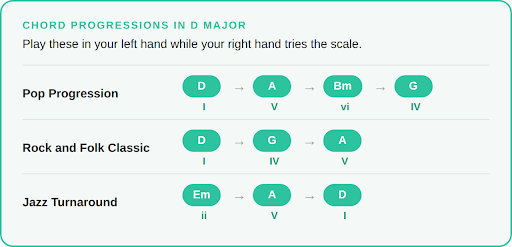 Start by playing these progressions slowly and focus on smooth chord changes. As your confidence grows, experiment with different rhythms and chord inversions and play around with the D major piano scale over each progression.
The relative minor of D major: B minor
The relative minor of D major is B minor. These relative keys share the same seven notes and two sharps, F♯ and C♯. However, B minor starts on B and has a darker minor sound. You can find the relative minor of any major key by counting to the sixth note of the D major scale or moving three semitones down from D. 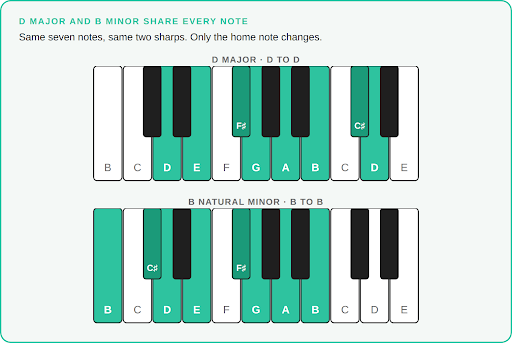 Play these two scales back to back to hear the difference. You can also use the piano scales tool to select B as the root and natural minor as the scale type, then compare both patterns on the keyboard.
D major pentatonic scale
The D major pentatonic scale uses five notes from the full scale: D, E, F♯, A and B. The formula for any major pentatonic scale is the 1st 2nd 3rd 5th and 6th degrees of the scale. In D this leaves out the crunchy notes G and C♯, creating a simple, versatile pattern that’s great for improvisation. 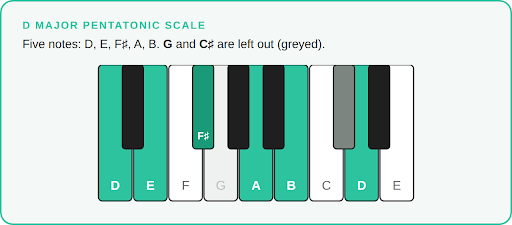 Have a go at holding a D major chord in your left hand while playing around with these five notes in your right and you will see how the pentatonic is an easy way to get into improvisation.
Songs in D major to practice
Once the D major scale on piano feels comfortable, it’s time to try it with some real music. Playing familiar pieces will help you recognise the notes, practise chord patterns and develop coordination between both hands.
Africa by Toto
This classic pop tune has a fun melody and a simple half note left hand accompaniment. The stepwise melody makes it a perfect place to put your newfound D major knowledge into practice.
Gymnopédie No. 1 by Erik Satie
This piece has a gentle, spacious sound and is originally in D major. Its slow pace makes it useful for developing control, listening closely to harmony and practising smooth chord changes.
Practice tips for the D major scale
A few minutes of daily practice can help you master the D major scale on piano. Use these tips to build accuracy, improve finger coordination and play with confidence.
- Play slowly with a metronome: Start at a comfortable tempo that you can play the scale at easily and increase the speed gradually as your accuracy improves.
- Start hands separately: Practise the right hand and left hand on their own before playing together. Focus on correct notes and smooth movement.
- Check the two sharps: Remember that the D major scale notes include F♯ and C♯. Watch out for C♯, especially when moving up the scale.
- Practise your fingering: Work on a smooth thumb tuck in the right hand and a well-timed crossover in the left. Avoid rushing between notes.
- Build up to two octaves: Once you can play one octave comfortably, try the D major scale piano 2 octaves pattern, keeping your rhythm steady.
- Mix up your practice: Play the scale staccato, alternate between loud and soft, or try contrary motion by moving both hands in opposite directions from middle D.
- Connect scales to songs: Learning scales is one part of learning to play piano. Combine your practice with reading sheet music and playing familiar songs to develop your overall musicianship.
Ready to play the D major scale?
Great work, now you know how to play the D major scale on piano. It’s time to put your skills into practice. Start slowly, focus on your fingering and remember the two sharps, F♯ and C♯. With regular practice, you’ll build confidence and find it easier to play songs in D major.
Ready to take the next step? Learn to play your favourite songs with Skoove’s interactive piano lessons. Practise at your own pace, improve your technique and discover how much fun learning piano can be!
Author of this blog post:
Matthew Dickman

With over a decade of experience in music education Matthew holds a BA in Music from Paul McCartney’s LIPA and an MA in Composition from the University of Salford. Mathew has developed a distinctive compositional voice and approach to music theory education through his research and work in the music industry. Matthew’s writing for Skoove combines experience from orchestral and media composition, and as a gigging jazz musician, to create a wholistic and accessible pedagogy for musicians of any level. Away from music, he enjoys reading and exploring nature to expand his horizons and knowledge contributing to his holistic teaching style.