



The A flat major scale (also written A♭ major or Ab major) is made up of the notes A♭, B♭, C, D♭, E♭, F and G. It has four flats in its key signature, and it starts on a black key, which is usually the moment beginners decide it must be difficult.
It isn’t. A♭ major is one of the most hand-friendly scales on the piano. Your long fingers rest on the black keys, your thumbs only ever land on white keys, and both hands share the same finger on half the notes. It’s no accident that Beethoven, Chopin, Schubert and Liszt chose this key for some of their most lyrical music, or that two of the most popular modern love songs are written in it.
In this guide you’ll find the notes and where they sit on the keyboard, how the scale is built from two matching halves, a quick way to remember the key signature, fingering for both hands going up and down, the chords in the key, and the music you can play once the scale is under your fingers.
A flat major scale notes
The notes of the A flat major scale are A♭ – B♭ – C – D♭ – E♭ – F – G – A♭. On the piano that’s four black keys (A♭, B♭, D♭ and E♭) and three white keys (C, F and G).
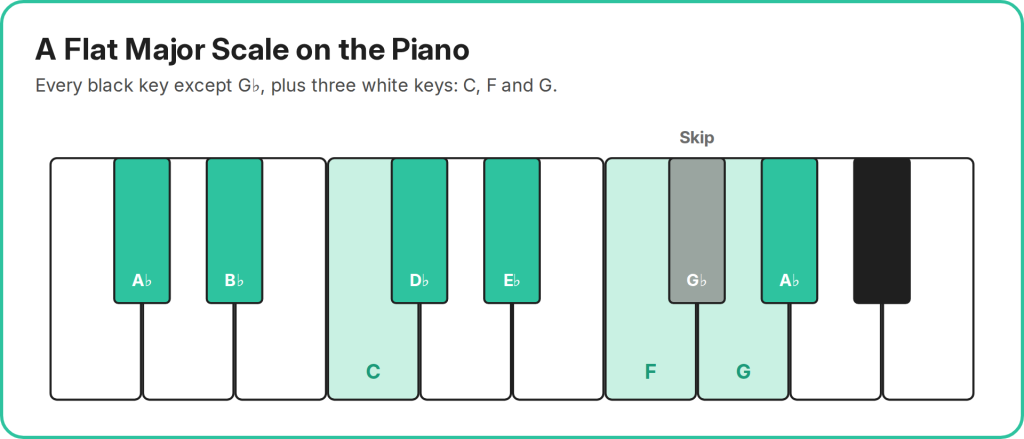
Each note has a number that describes its position in the key. These are the scale degrees in music, and they make it much easier to talk about chords and melodies in any key.
| Degree | 1 | 2 | 3 | 4 | 5 | 6 | 7 | 8 |
|---|---|---|---|---|---|---|---|---|
| Note | A♭ | B♭ | C | D♭ | E♭ | F | G | A♭ |
| Key | Black | Black | White | Black | Black | White | White | Black |
How to find A flat on the piano
Find any group of three black keys. A♭ is the middle one of the three, sitting between G and A. Because the pattern of piano keys repeats every 12 keys, every group of three black keys has its own A♭, so you can start the scale anywhere along the keyboard. The A♭ just below middle C is a comfortable starting point for the left hand, and the one just above middle C works well for the right hand.
GOOD TO KNOW
The same black key is also called G♯. Which name you use depends on the key you’re in. In A♭ major it’s always A♭, and you’ll see why further down.
How the A flat major scale is built: two matching halves
Every major scale follows the same pattern of whole steps (W) and half steps (H): W – W – H – W – W – W – H. A whole step skips one key and a half step goes to the very next key. Both are piano intervals, and they’re all you need to build A♭ major from scratch.
Start on A♭ and follow the pattern: a whole step up to B♭, a whole step to C, a half step to D♭, a whole step to E♭, a whole step to F, a whole step to G and a half step back to A♭.
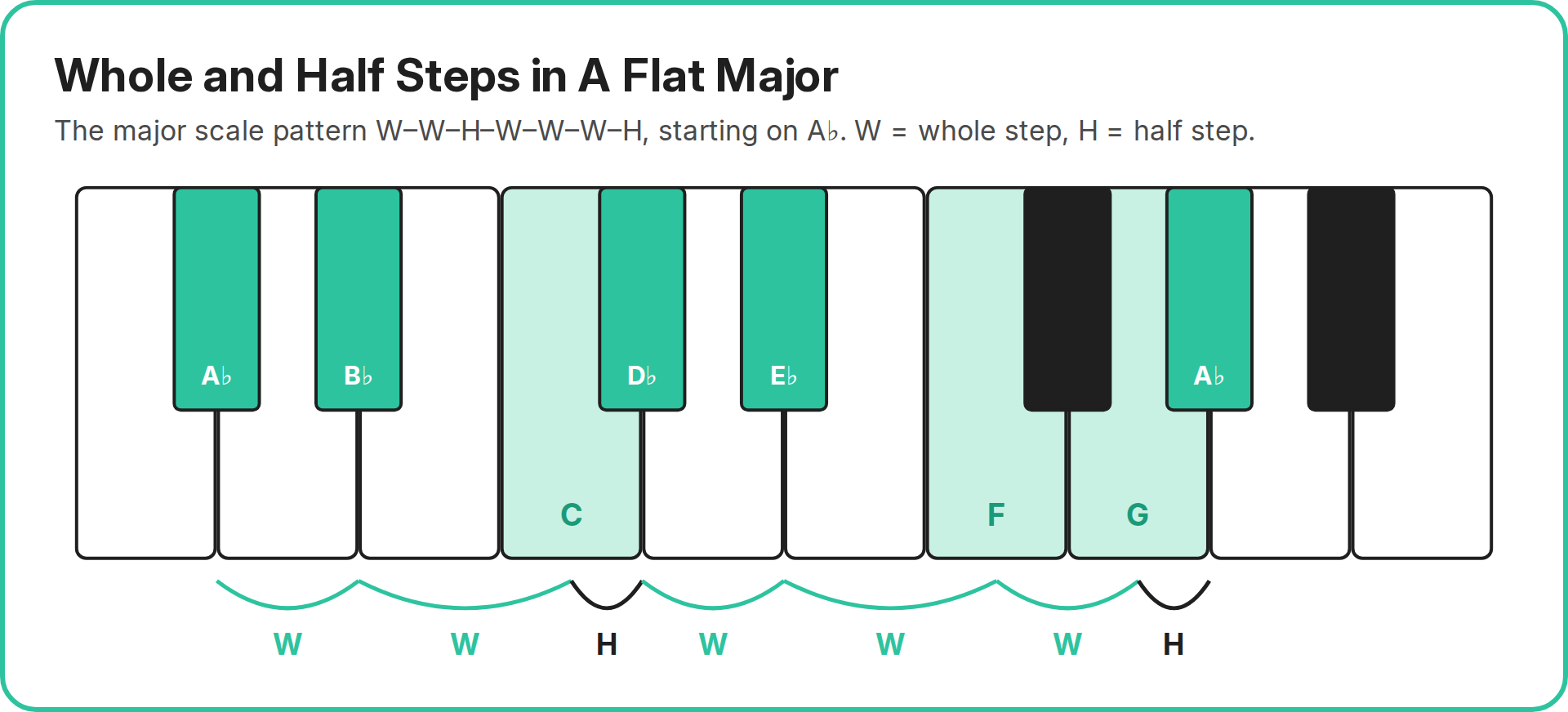
Look closely and the scale splits into two halves with exactly the same shape. A♭ – B♭ – C – D♭ is whole, whole, half. E♭ – F – G – A♭ is also whole, whole, half. A single whole step from D♭ to E♭ joins them together. If you learn the first four notes, you already know the shape of the second four.
The halves are shared with neighboring keys, too. E♭ – F – G – A♭ is the first half of E♭ major, and A♭ – B♭ – C – D♭ is the second half of D♭ major. That overlap is why the flat keys feel so connected once you’ve learned a couple of them.
A flat major key signature: 4 flats that spell BEAD
The A flat major key signature has four flats: B♭, E♭, A♭ and D♭, always written in that order. Read the letters on their own and they spell BEAD, which makes this one of the easiest key signatures to remember.
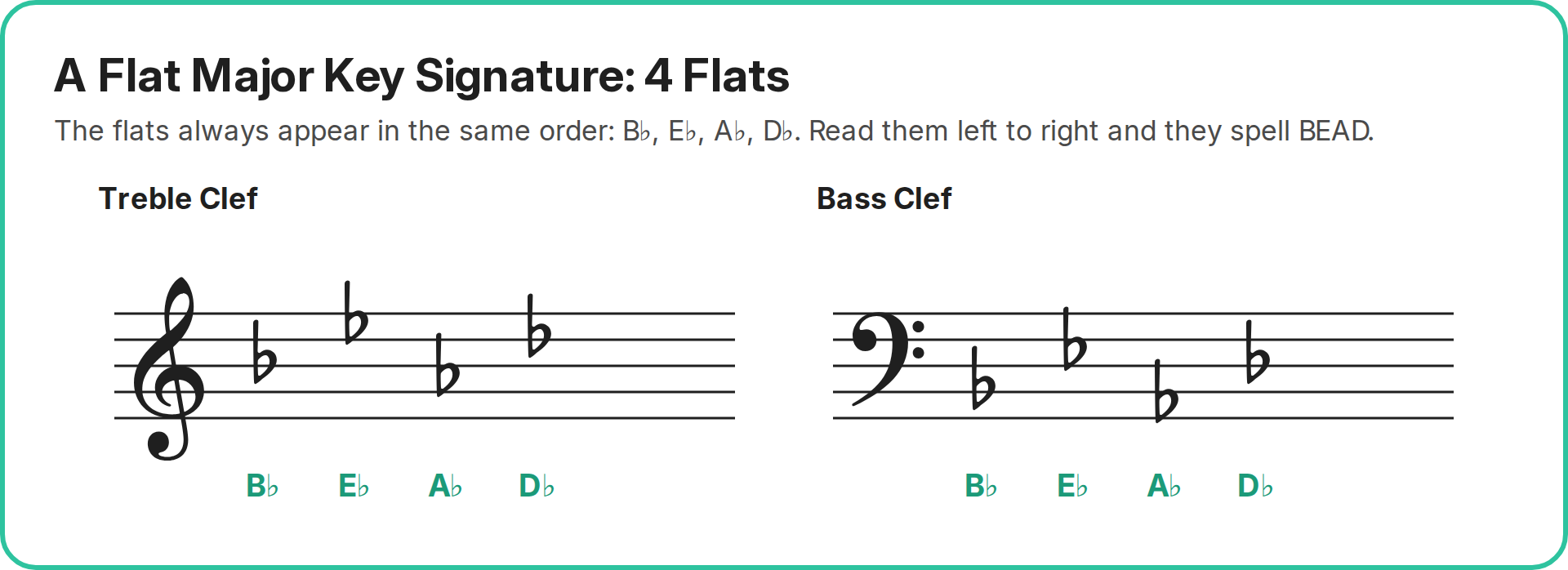
So if you’re asking which scale has 4 flats, the answer is A♭ major, along with its relative minor, F minor. For flat keys there’s also a reliable shortcut: the second-to-last flat in the signature names the key. Here the flats are B♭, E♭, A♭, D♭, and the second-to-last one is A♭. You’ll find the full method for every key in key signatures explained.
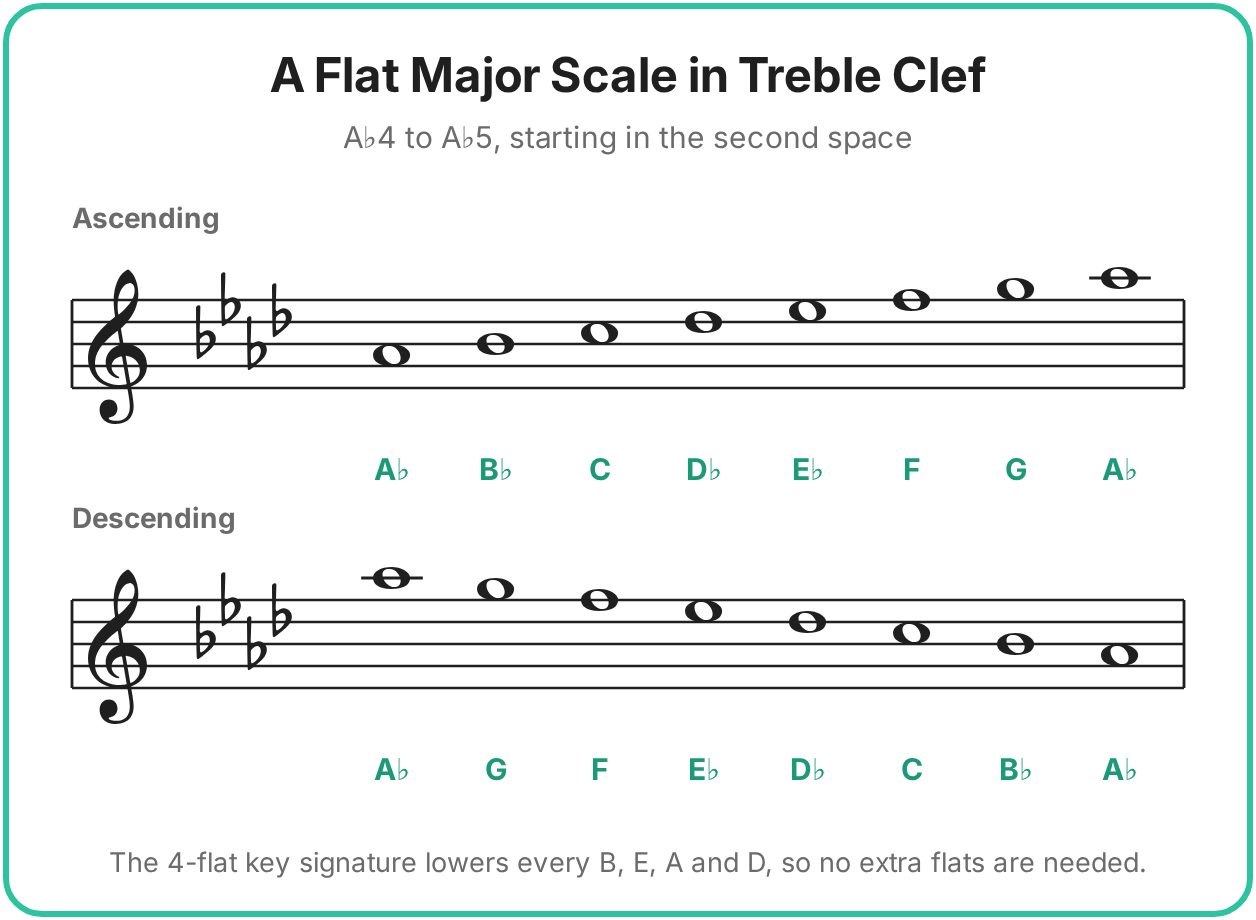
Because the key signature already lowers every B, E, A and D, the notes in the music don’t need their own flat signs. You only see extra piano accidentals when a piece briefly borrows a note from outside the key, such as a D natural or an E natural.
A flat major scale in treble clef
In treble clef, the right hand usually starts on A♭ in the second space of the staff and climbs to the A♭ on the first ledger line above it. Read it like any other treble clef notes: the second space is A, and the key signature turns it into A♭ for you.
A flat major scale in bass clef
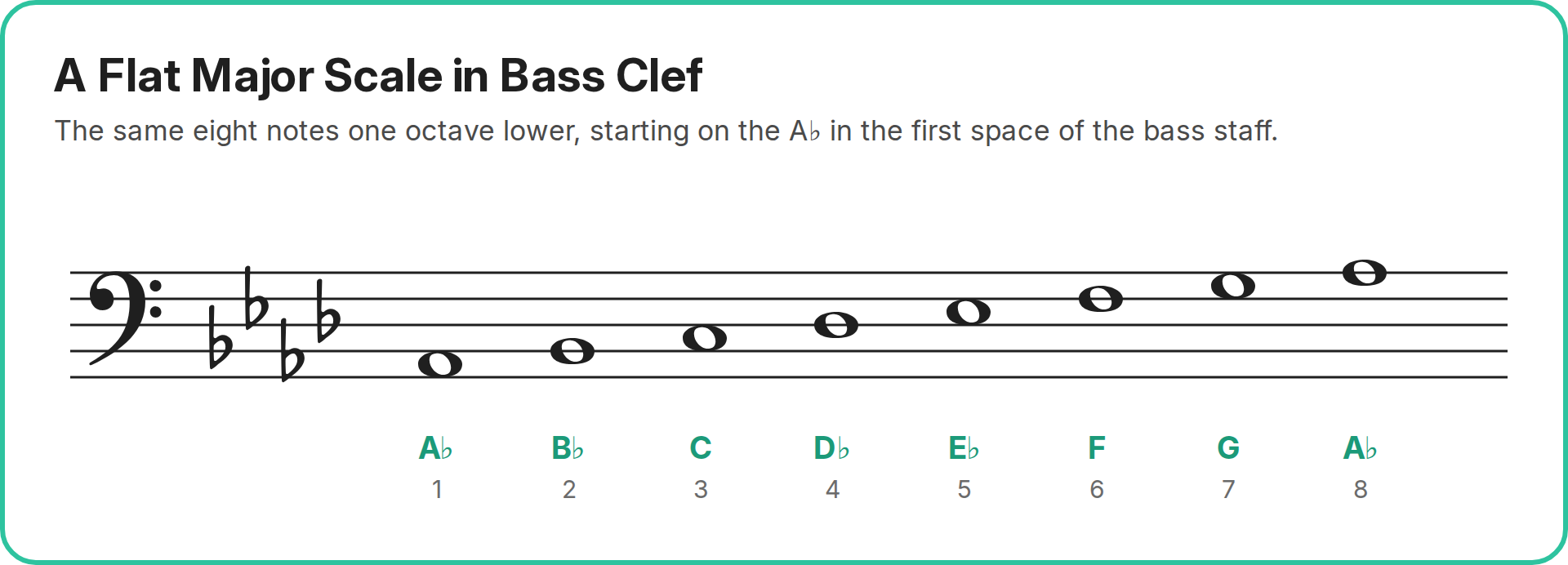
In bass clef, the left hand fits the scale entirely inside the staff. It starts on A♭ in the bottom space and ends on A♭ on the top line, with no ledger lines at all. If you’re still building speed with bass clef notes on piano, this is a good scale to practice reading, because every note stays on the five lines.
A flat major scale fingering on piano
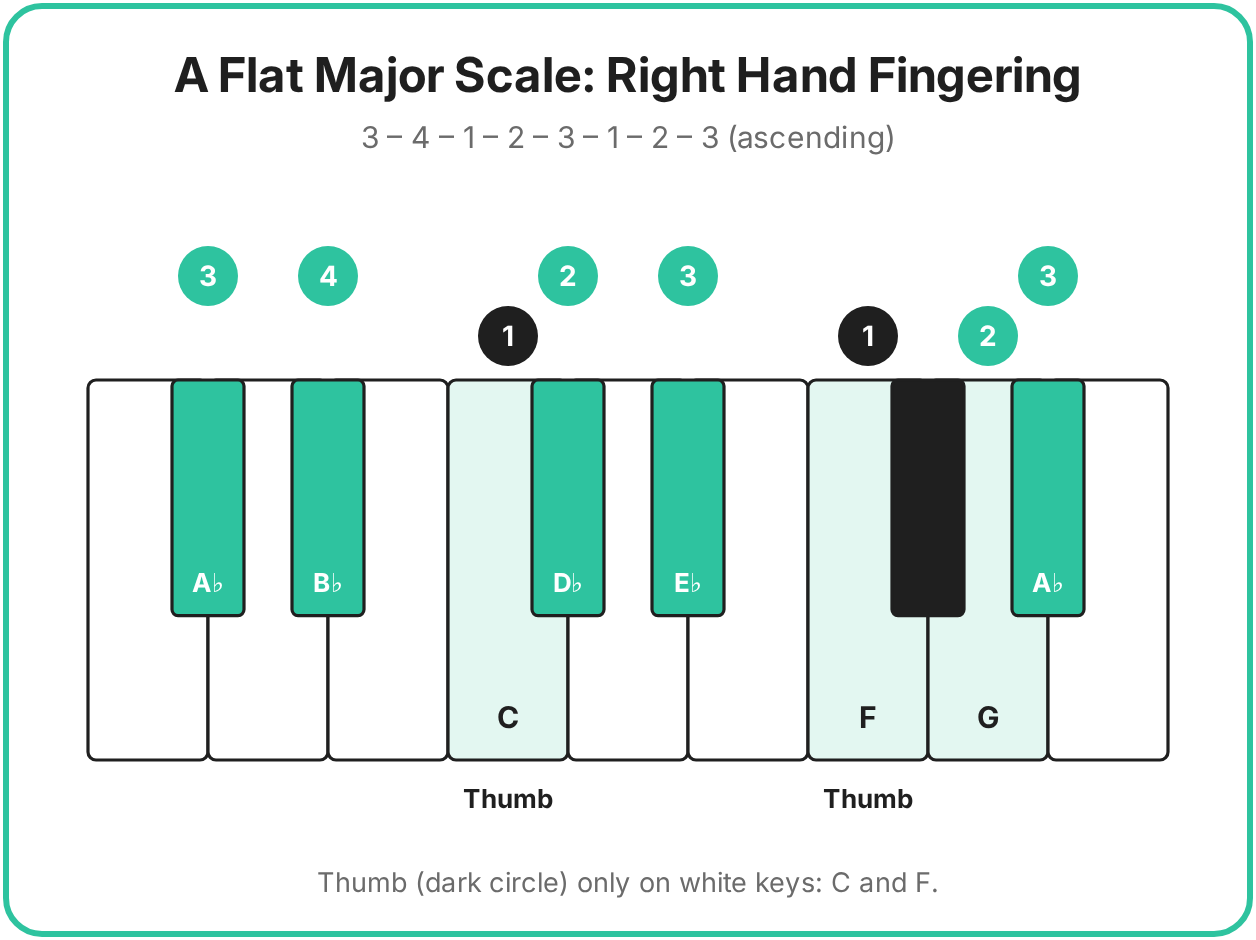
Most piano scales for beginners start with the thumb on the first note, so the A flat major fingering can look strange at first. It follows one simple rule: the thumb never plays a black key. A short thumb on a black key forces your whole hand forward and makes the next crossing awkward. In A♭ major the thumbs only play the white keys, and the longer fingers take care of the black keys.
Right hand fingering: 3 – 4 – 1 – 2 – 3 – 1 – 2 – 3
Start with finger 3 on A♭ and finger 4 on B♭. Tuck your thumb under to play C, then play D♭ and E♭ with fingers 2 and 3. Tuck the thumb under again for F, play G with finger 2 and finish on A♭ with finger 3.
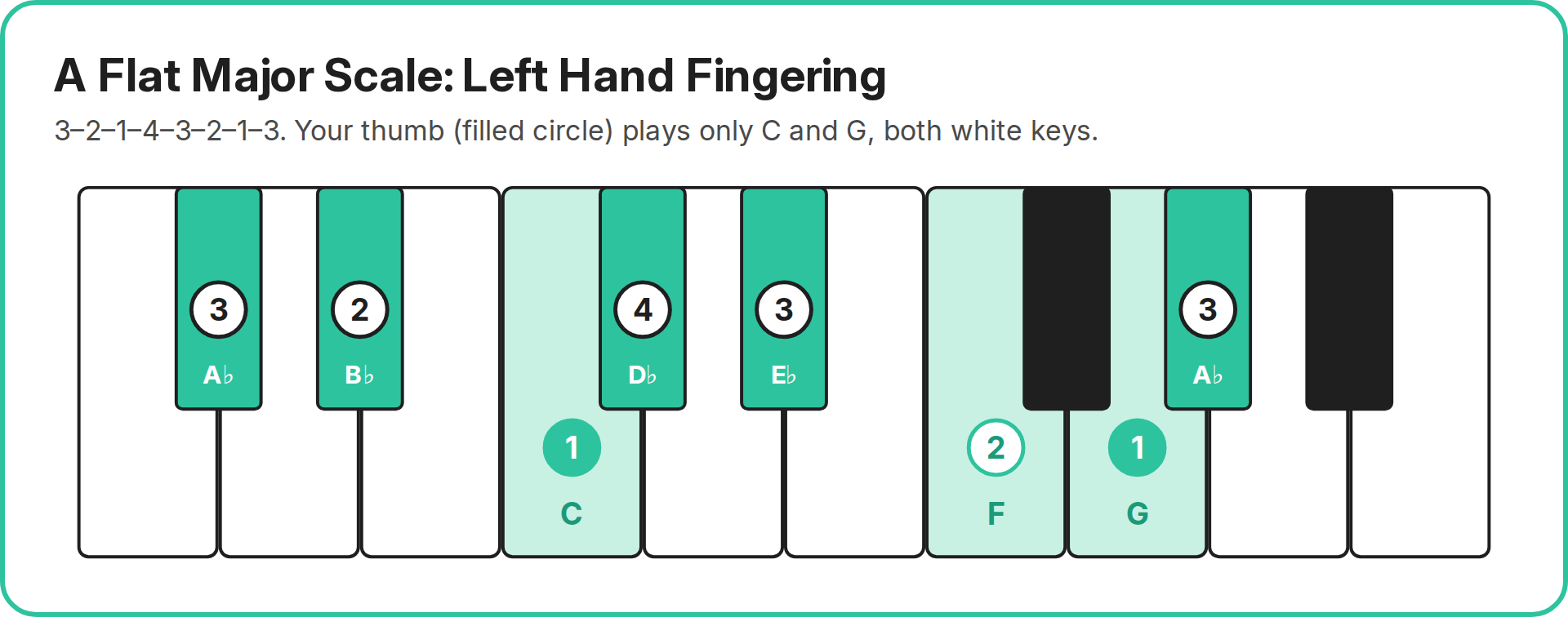
Left hand fingering: 3 – 2 – 1 – 4 – 3 – 2 – 1 – 3
Start with finger 3 on A♭, finger 2 on B♭ and your thumb on C. Cross finger 4 over the thumb to reach D♭, then play E♭ and F with fingers 3 and 2. Your thumb plays G, and finger 3 crosses over to finish on A♭.
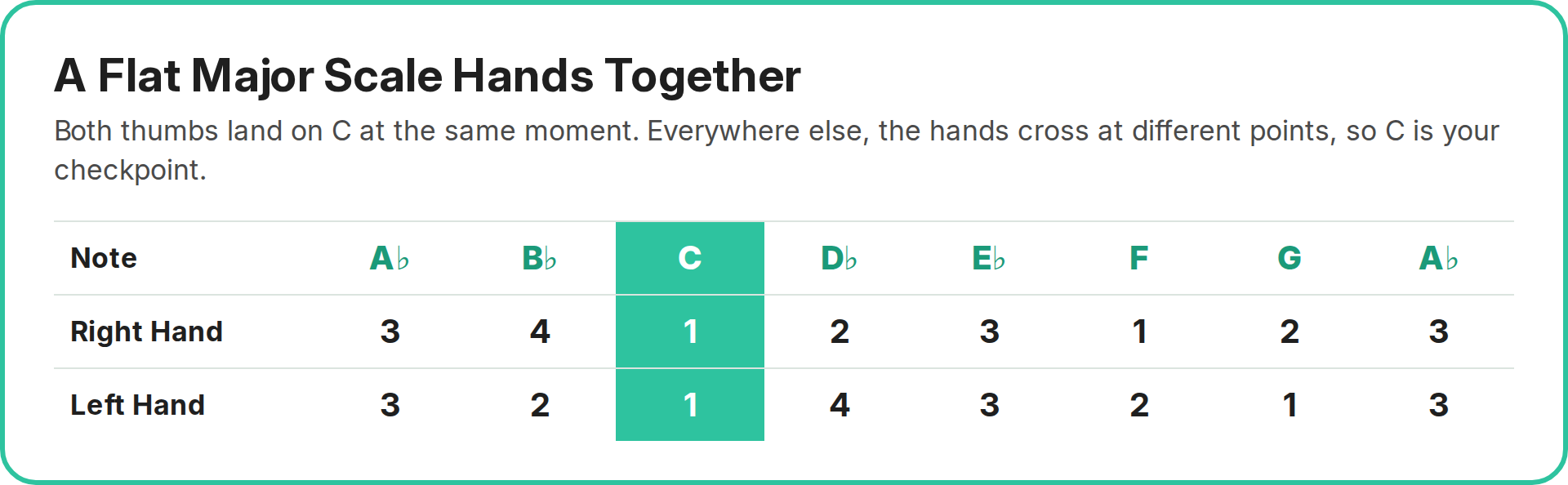
Hands together: four notes where your fingers match
Here are both hands side by side. Going down, simply read each column from the bottom up.
| Note | Right hand | Left hand |
|---|---|---|
| A♭ | 3 | 3 |
| B♭ | 4 | 2 |
| C | 1 | 1 |
| D♭ | 2 | 4 |
| E♭ | 3 | 3 |
| F | 1 | 2 |
| G | 2 | 1 |
| A♭ | 3 | 3 |
On four notes, both hands use the same finger: finger 3 on A♭, both thumbs on C, finger 3 on E♭ and finger 3 on the top A♭. Those four notes are A♭ – C – E♭ – A♭, which is the A♭ major chord. When you play hands together, use them as checkpoints. If your fingers don’t match on those notes, one hand has slipped.
Descending A flat major scale and two octaves
Coming down, reverse each pattern. The right hand plays 3 – 2 – 1 – 3 – 2 – 1 – 4 – 3, crossing finger 3 over the thumb from F to E♭ and finger 4 over the thumb from C to B♭. The left hand plays 3 – 1 – 2 – 3 – 4 – 1 – 2 – 3, tucking the thumb under onto G and onto C.
For two octaves, the pattern simply continues. The right hand plays 3 – 4 – 1 – 2 – 3 – 1 – 2 – 3 – 4 – 1 – 2 – 3 – 1 – 2 – 3, and the left hand plays 3 – 2 – 1 – 4 – 3 – 2 – 1 – 3 – 2 – 1 – 4 – 3 – 2 – 1 – 3. In the middle of the scale, the right hand plays A♭ with finger 3 and carries on with 4 on B♭, so it never needs to reset.
Chords in A flat major
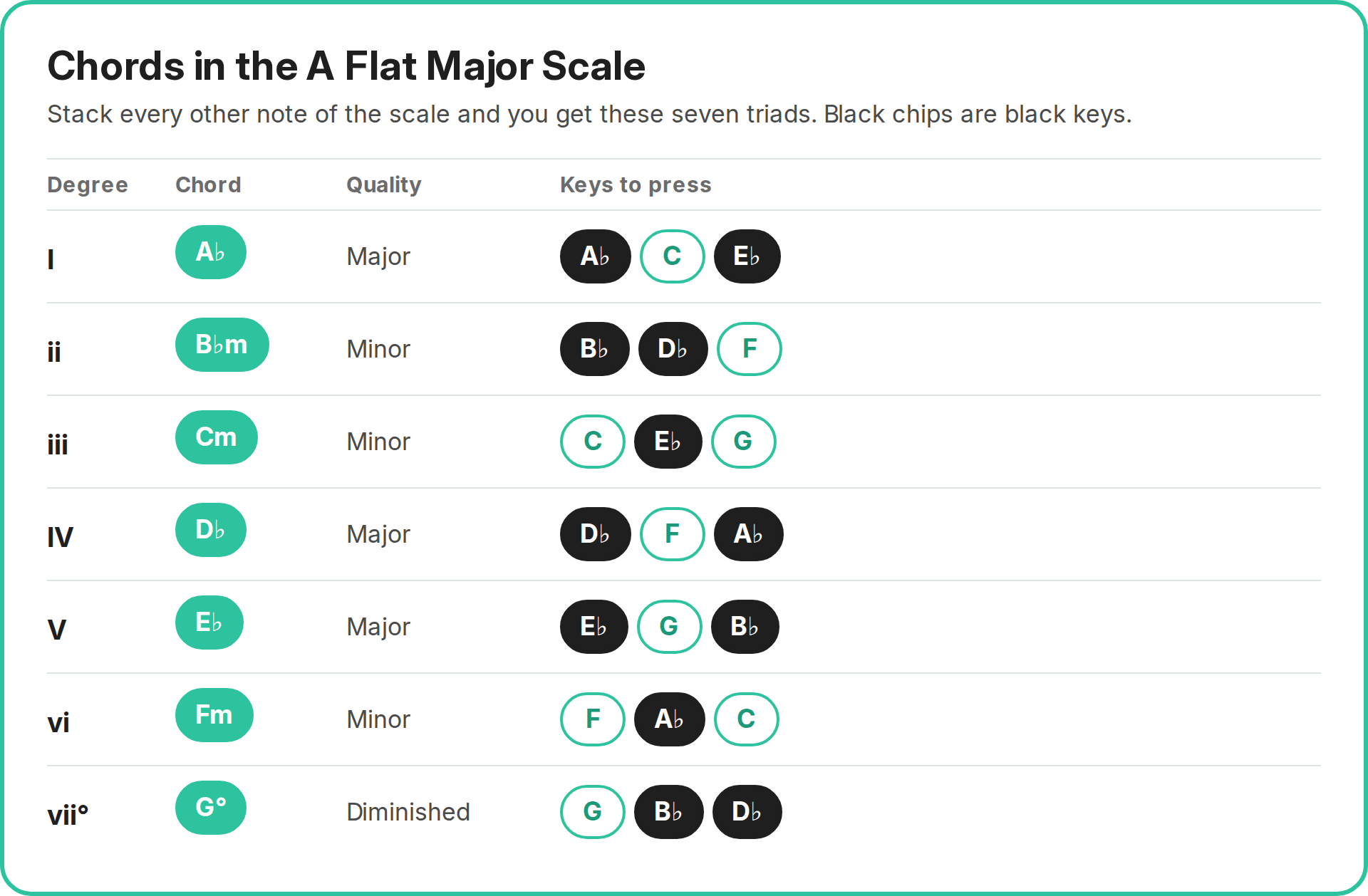
Stack every other note of the scale on each degree and you get the seven chords of A♭ major. As in every major key, three are major, three are minor and one is diminished. If you’d like to hear the difference first, start with major and minor chords.
| Numeral | Chord | Notes | Black and white keys |
|---|---|---|---|
| I | A♭ major | A♭ – C – E♭ | Black, white, black |
| ii | B♭ minor | B♭ – D♭ – F | Black, black, white |
| iii | C minor | C – E♭ – G | White, black, white |
| IV | D♭ major | D♭ – F – A♭ | Black, white, black |
| V | E♭ major | E♭ – G – B♭ | Black, white, black |
| vi | F minor | F – A♭ – C | White, black, white |
| vii° | G diminished | G – B♭ – D♭ | White, black, black |
Notice that the three major chords, I, IV and V, all have the same black–white–black shape. Learn one and your hand already knows the other two. To see the home chord in every inversion with fingerings and audio, open the Ab major chord in Skoove’s chord tool.
Try the 50s progression in A flat major
The I – vi – IV – V progression powers decades of ballads and doo-wop songs. In A♭ major it’s A♭ – Fm – D♭ – E♭. Play the root of each chord with your left hand and the full chord with your right, four beats each, and loop it. It’s a simple, satisfying way to hear the key, and a good first step into any piano chord progression.
A flat major relative minor: F minor
The relative minor of A♭ major is F minor. It uses exactly the same notes and the same four flats, but it starts on F, the sixth note of the A♭ major scale: F – G – A♭ – B♭ – C – D♭ – E♭ – F. Every major key has a minor partner like this, and relative major and minor scales always share a key signature.
In real music, F minor often raises its seventh note from E♭ to E natural. That version is the F harmonic minor scale, and it’s the one reason you’ll see an E natural pop up in pieces that sit between these two keys.
Don’t confuse it with A flat minor
A♭ minor is a different scale. It starts on the same note as A♭ major but has seven flats instead of four, so the two are parallel scales rather than relatives. A♭ minor is rarely written down. Composers almost always spell it as G♯ minor, which needs only five sharps.
Why A flat major and not G sharp major?
A♭ and G♯ are the same key on the piano, so in theory you could build the same scale starting on G♯. In practice, nobody does. Spelled with sharps, the scale needs a double sharp, because the seventh note would have to be F double sharp to keep every letter name in order.
| A♭ major | G♯ major | |
|---|---|---|
| Notes | A♭ B♭ C D♭ E♭ F G | G♯ A♯ B♯ C♯ D♯ E♯ F𝄪 |
| Key signature | 4 flats | 6 sharps + 1 double sharp |
| How often you’ll see it | All the time | Almost never, only in passing |
Four flats are far easier to read than six sharps plus a double sharp, so A♭ major is the name you’ll find in sheet music. You can see where it sits among all 12 keys on Skoove’s interactive circle of fifths: four steps anticlockwise from C, between E♭ major (3 flats) and D♭ major (5 flats).
A flat major pentatonic scale
Take away the 4th and 7th notes (D♭ and G) and you’re left with the A flat major pentatonic scale: A♭ – B♭ – C – E♭ – F. With no half steps left, every note sounds good against the others, which is why this five-note scale is a favorite for first improvisations.
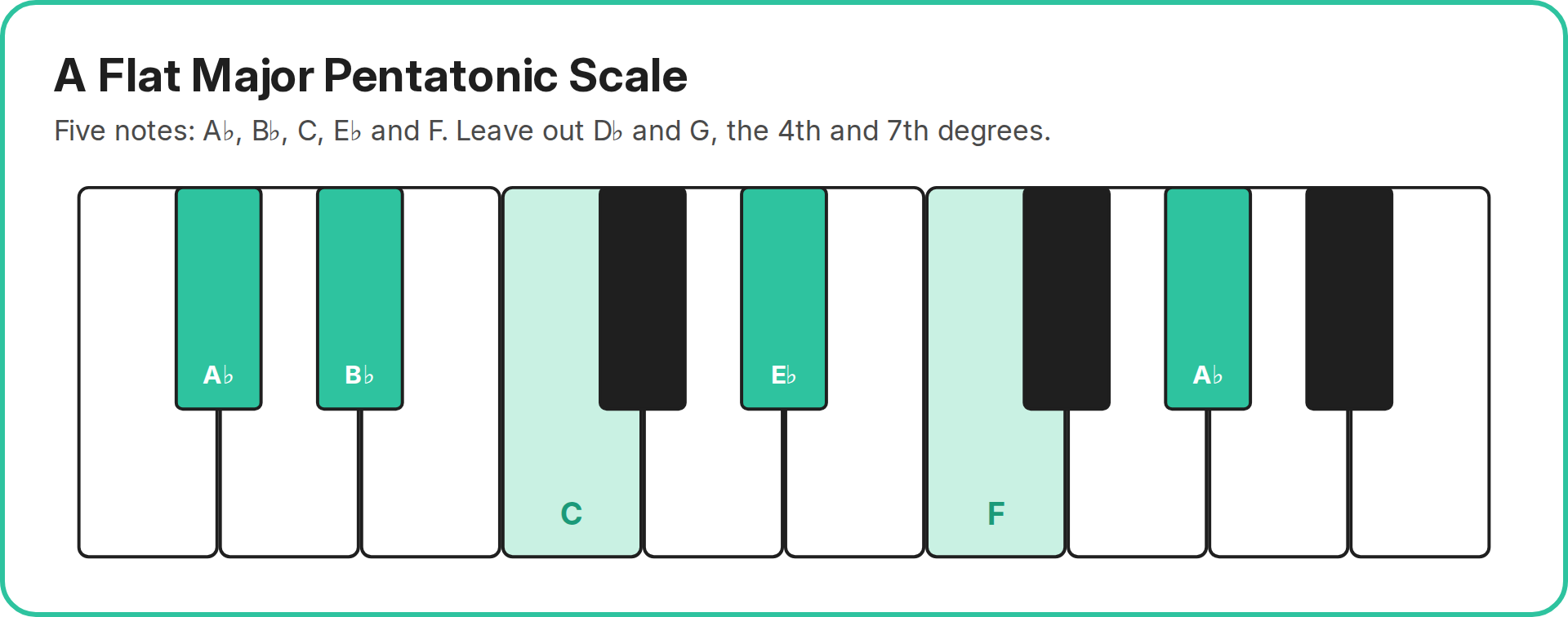
Hold an A♭ chord in your left hand and let your right hand wander over these five notes in any order. You can’t hit a wrong note. The pentatonic scale on piano has plenty more ways to use the pattern in other keys.
Music in A flat major you might already know
A♭ major has a reputation as a warm, singing key, and the repertoire backs it up. The slow second movement of Beethoven’s “Pathétique” Sonata, the Adagio cantabile, is in A♭ major, and it’s a highlight among famous Beethoven songs. Schubert wrote two of his Impromptus in the key (Op. 90 No. 4 and Op. 142 No. 2), and Chopin chose it for his Ballade No. 3 and the “Heroic” Polonaise, Op. 53.
Liszt’s Liebestraum No. 3, perhaps the most romantic of all Franz Liszt piano pieces, is also in A♭ major. It’s an advanced piece, but its opening melody is built almost entirely from the notes of this scale, so the key will already feel familiar when you get there.
The key isn’t only for the classics. John Legend’s “All of Me” and Ed Sheeran’s “Perfect” are both in A♭ major, and both feature in Skoove’s list of wedding piano songs. Play the scale and the I – vi – IV – V progression from above, and you’ll recognize the color of both songs straight away.
How to practice the A flat major scale
Because the fingering is built around checkpoints, you can learn this scale in small, logical steps. Give each step a couple of days before moving on:
- Play the checkpoints first. Hands together, play only A♭ – C – E♭ – A♭ with fingers 3 – 1 – 3 – 3 in both hands. This is the A♭ major chord as a broken chord, and it locks in where your fingers should match.
- One half at a time. Right hand alone, play A♭ – B♭ – C – D♭ (3 – 4 – 1 – 2), then E♭ – F – G – A♭ (3 – 1 – 2 – 3). Join them once both feel easy. Repeat with the left hand.
- Say the names aloud. Play each hand slowly up and down while saying “A flat, B flat, C…”. Saying the flats helps your eyes connect the key signature to the black keys.
- Change the rhythm. Play the scale in a long–short dotted rhythm, then short–long. Uneven rhythms expose any finger that hesitates on a thumb crossing.
- Hands together, then two octaves. Start very slowly, checking the matching fingers on A♭, C and E♭. When one octave feels steady, extend to two. You can play along with the scale on Skoove’s Piano Scales tool to hear and see each note as you go.
Where to go after A flat major
Once A♭ major feels natural, you’ve learned more than one scale. You know the BEAD key signature, the black-key fingering rule and the shape of the I, IV and V chords, and all of that carries straight into the flat keys around it. E♭ major (3 flats) begins with the same four notes as your second half, E♭ – F – G – A♭, and D♭ major (5 flats) ends with your first half, A♭ – B♭ – C – D♭.
If flat keys still feel unfamiliar, it can help to go back to the F major scale, which has just one flat and the same rule about keeping the thumb off black keys. Then come back to A♭ major and notice how much smoother it feels.
And if you’d like a hand while you practice, Skoove listens as you play and gives you real-time feedback on your notes and timing, so you can build clean scale habits from the very first week.
Author of this blog post:
Susana Pérez Posada

Susana Pérez Posada, Master in Music Therapy, Skoove Piano Educator With over seven years in piano education and a deep passion for music therapy, Susana brings a unique blend of expertise to Skoove. A graduate in Music Therapy from SRH Hochschule Heidelberg and an experienced classical pianist from Universidad EAFIT, she infuses her teaching with a holistic approach that transcends traditional piano lessons. In her writings for Skoove, Susana combines her rich musical knowledge with engaging storytelling, enriching the learning experience for pianists of all levels. Away from the piano, she loves exploring new places and immersing herself in a good book, believing these diverse experiences enhance her creative teaching style.
Published by Lydia Ogn from the Skoove team