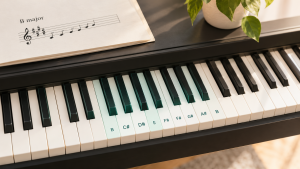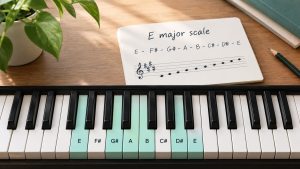



The C sharp major scale (often written as the C# major scale) uses the notes C♯, D♯, E♯, F♯, G♯, A♯ and B♯. Its key signature has seven sharps, which makes it the only major key in which every single note is sharp.
On paper, that looks like the hardest scale on the piano. Under your fingers it’s a different story. C♯ major is five black keys and just two white ones, and the fingering follows the black-key groups so closely that many players find it more comfortable than C major.
Below, you’ll see where every note sits, why two of them are called E♯ and B♯, how to finger the scale in each hand, and when the same keys are called D♭ major instead.
C sharp major scale notes
The notes of the C sharp major scale are C♯ – D♯ – E♯ – F♯ – G♯ – A♯ – B♯ – C♯. Like every major scale, it follows the pattern of whole steps and half steps W-W-H-W-W-W-H. The two half steps fall between E♯ and F♯ and between B♯ and C♯, and those are exactly the two places where the scale drops onto a white key.
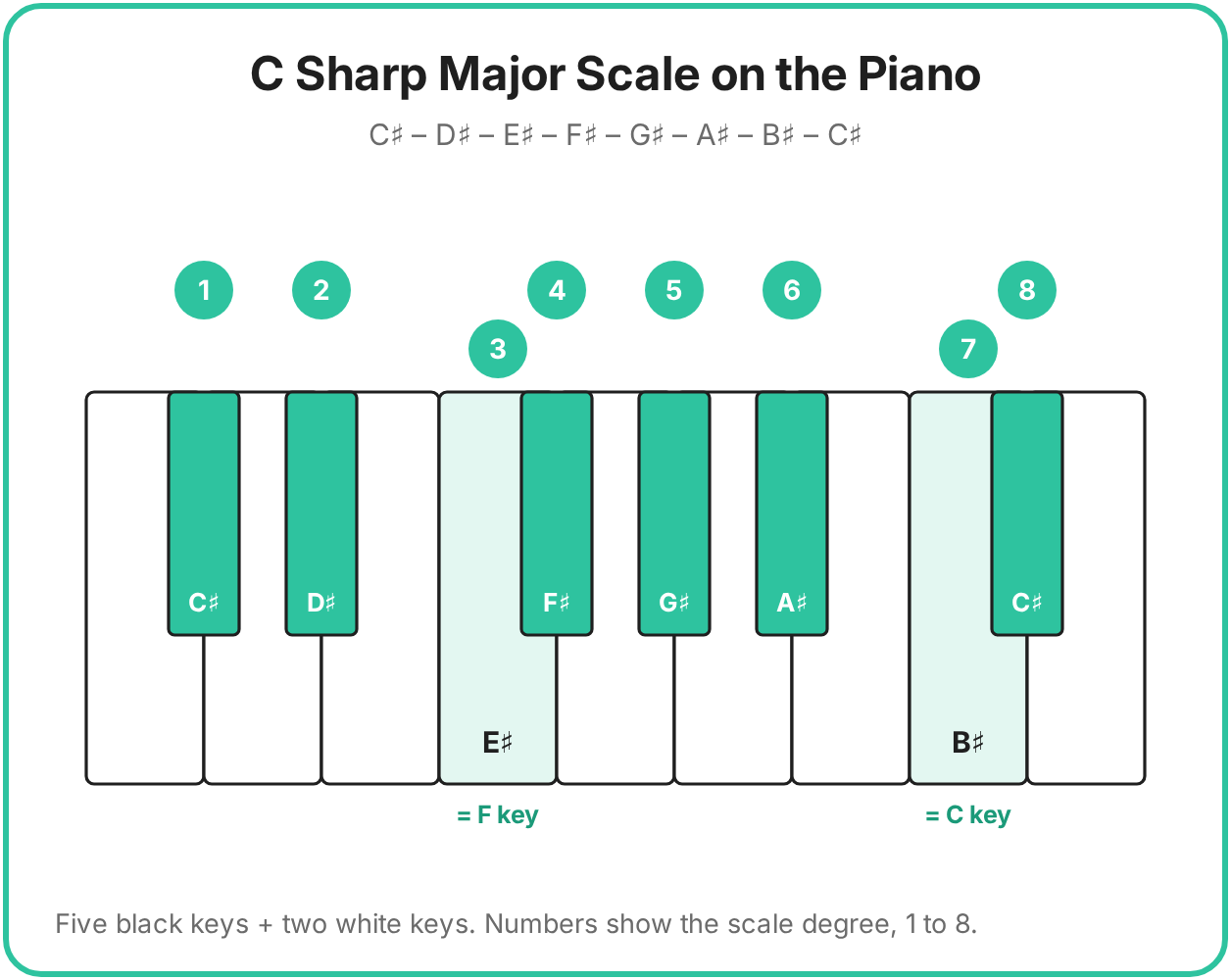
Each note also has a number and a name that describe its job in the key. These come up again whenever you work with scale degrees in music, chords or melodies.
| Degree | Name | Note | Key you press | Interval from C♯ |
|---|---|---|---|---|
| 1 | Tonic | C♯ | Black key | Unison |
| 2 | Supertonic | D♯ | Black key | Major 2nd |
| 3 | Mediant | E♯ | White key (F) | Major 3rd |
| 4 | Subdominant | F♯ | Black key | Perfect 4th |
| 5 | Dominant | G♯ | Black key | Perfect 5th |
| 6 | Submediant | A♯ | Black key | Major 6th |
| 7 | Leading tone | B♯ | White key (C) | Major 7th |
| 8 | Tonic | C♯ | Black key | Octave |
Where to find C sharp on the piano
C♯ is the black key directly to the right of C. Look for any group of two black keys: the left one is always C♯, and the right one is D♯. Both of these black keys are also the first two notes of the scale.
The pattern of piano keys repeats every 12 keys, so a full-size 88-key piano has seven C♯ keys. The one just above middle C is a good place to start the scale with your right hand, and the one an octave lower suits your left hand.
The C major shortcut: same letters, every note sharp
Here’s the easiest way to remember C♯ major. Take the C major scale, keep all seven letter names, and add a sharp to every one of them. C becomes C♯, D becomes D♯, E becomes E♯, and so on all the way up.
On the keyboard, every note moves exactly one key to the right. That distance is a half step, the smallest of all the piano intervals. Because each note moves by the same amount, the pattern of whole and half steps stays identical, which is why the result is still a major scale.
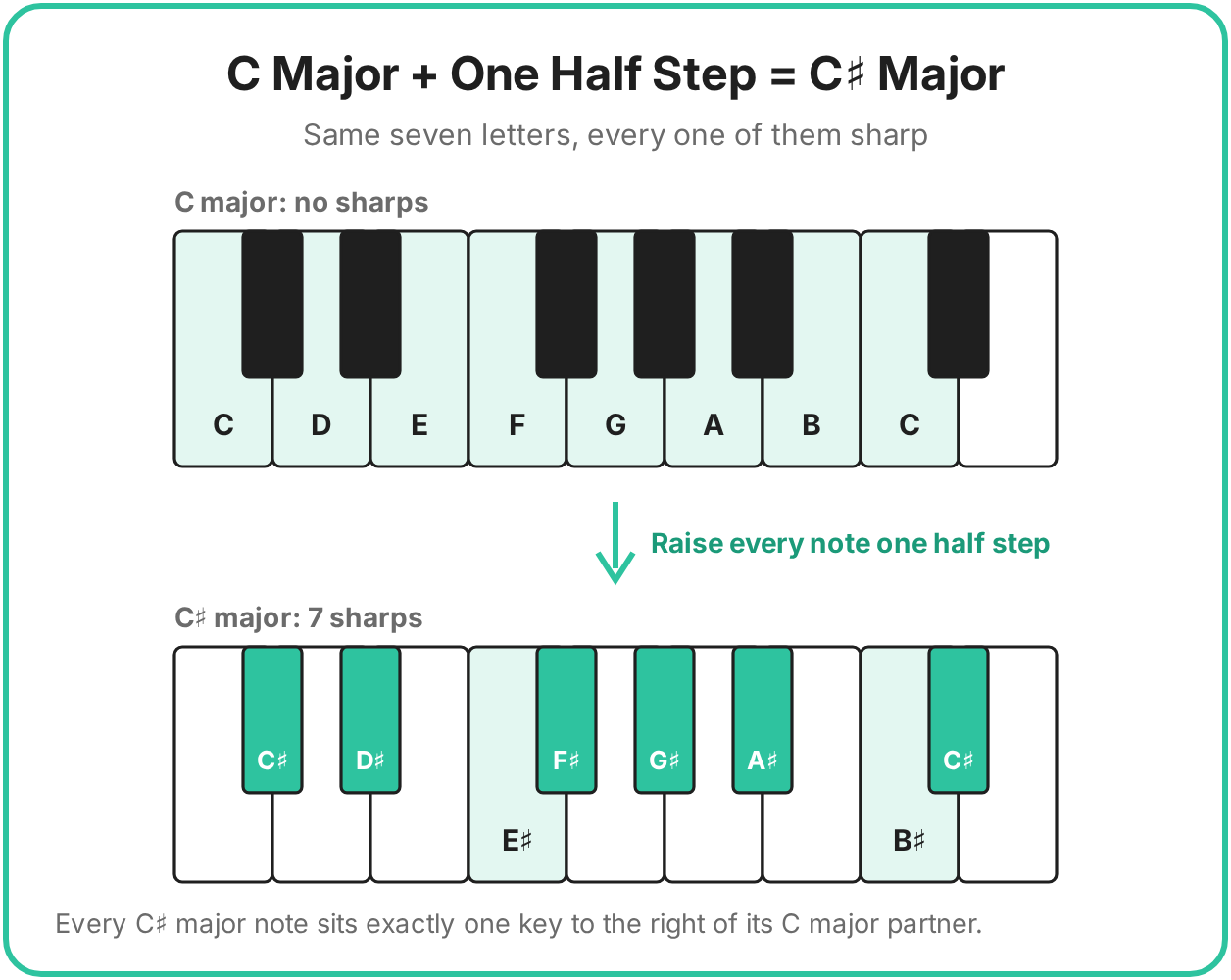
The shortcut also works on the staff. C♯ major uses the same lines and spaces as C major. The only difference is the key signature at the start of each line.
Why C sharp major uses E♯ and B♯
Look at the keyboard and you’ll notice that the third note is played on the F key and the seventh on the C key. So why not just call them F and C?
The reason is a simple spelling rule: a scale uses each letter name exactly once. If you called the third note F, the scale would contain both F and F♯ and skip E entirely. Calling it E♯ keeps every letter from A to G in the scale once and only once.
Sharps, flats and naturals are all piano accidentals, and a sharp always means one key to the right. Most of the time that’s a black key, but to the right of E and B there is no black key, so E♯ and B♯ land on white keys.
READING TIP
When you see E♯ in the music, think “F key”. When you see B♯, think “C key”. Your ears won’t notice any difference, only the name changes.
C sharp major key signature: all 7 sharps
The C sharp major key signature contains all seven sharps, in the fixed order F♯ – C♯ – G♯ – D♯ – A♯ – E♯ – B♯. A popular way to remember the order is “Father Charles Goes Down And Ends Battle”.
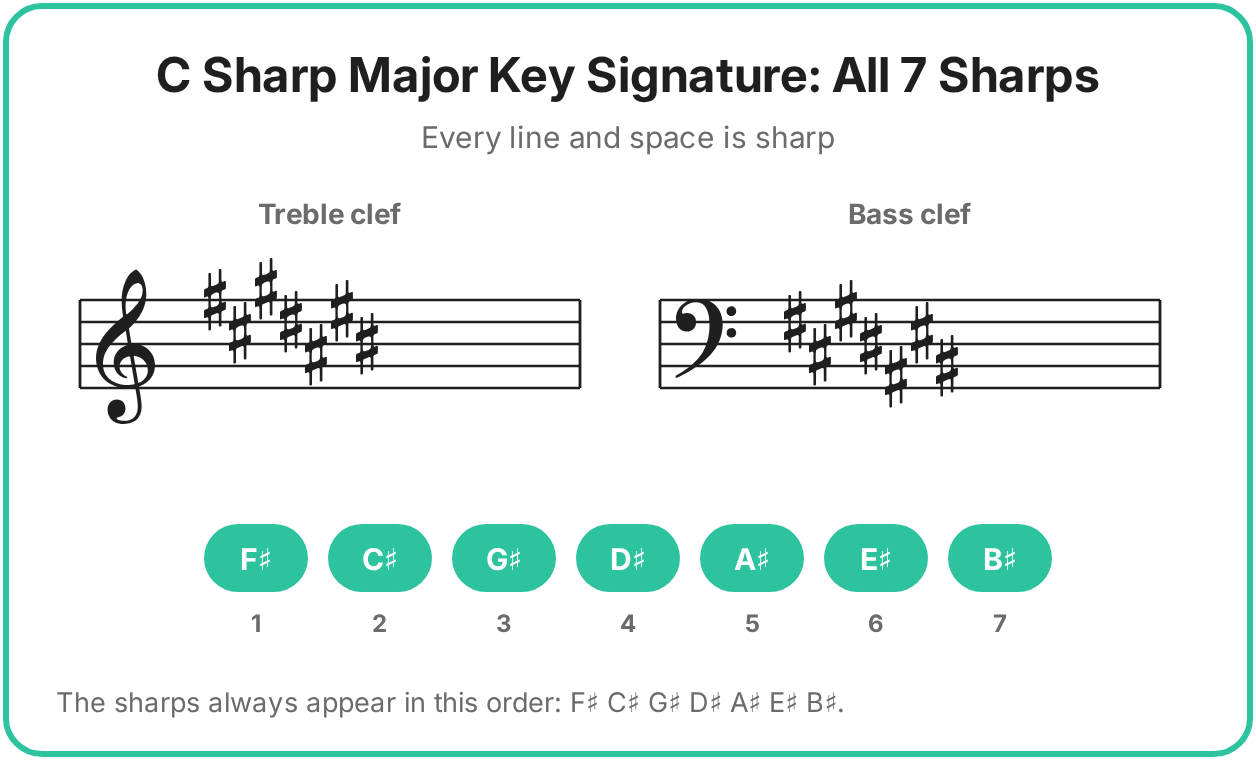
Because every note in the scale is sharp, every line and space on the staff is affected. If you see seven sharps at the start of a piece, it’s in C♯ major or its relative minor, A♯ minor.
Once you’ve seen key signatures explained in full, there’s a handy rule for any sharp key: the last sharp in the signature is a half step below the tonic. Here the last sharp is B♯, and one half step up from B♯ is C♯.
C sharp major scale in treble clef
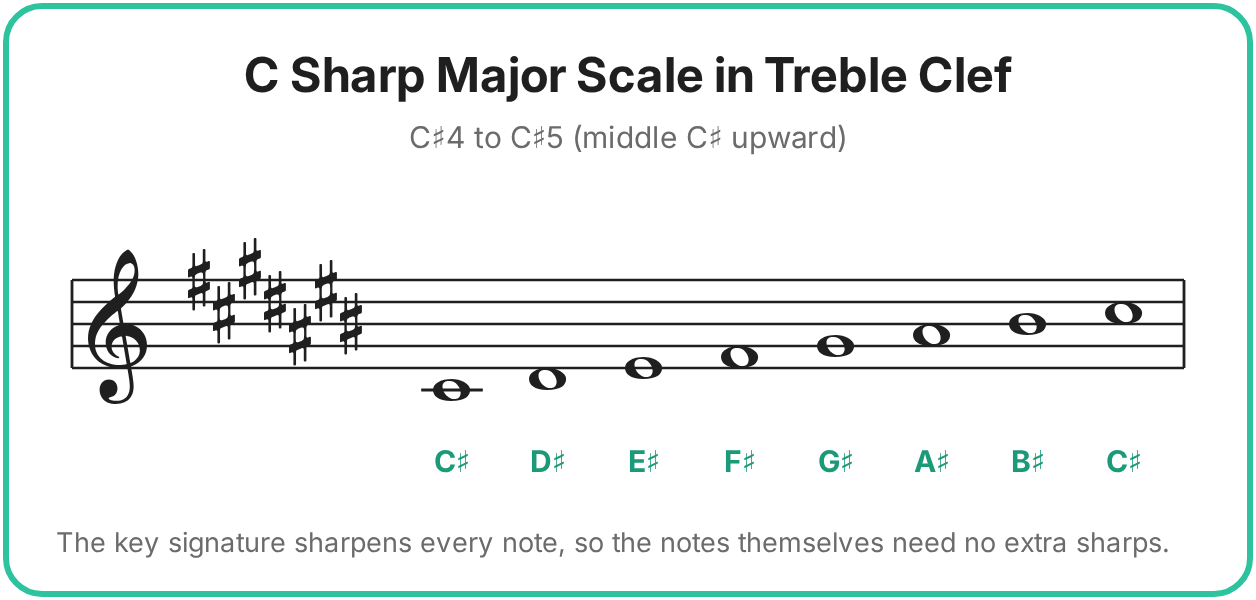
In treble clef, the scale starts on C♯ on the first ledger line below the staff (the middle C position) and climbs to C♯ in the third space. Because the key signature already sharpens everything, you read the notes exactly as you would ordinary treble clef notes, and the sharps take care of themselves.
C sharp major scale in bass clef
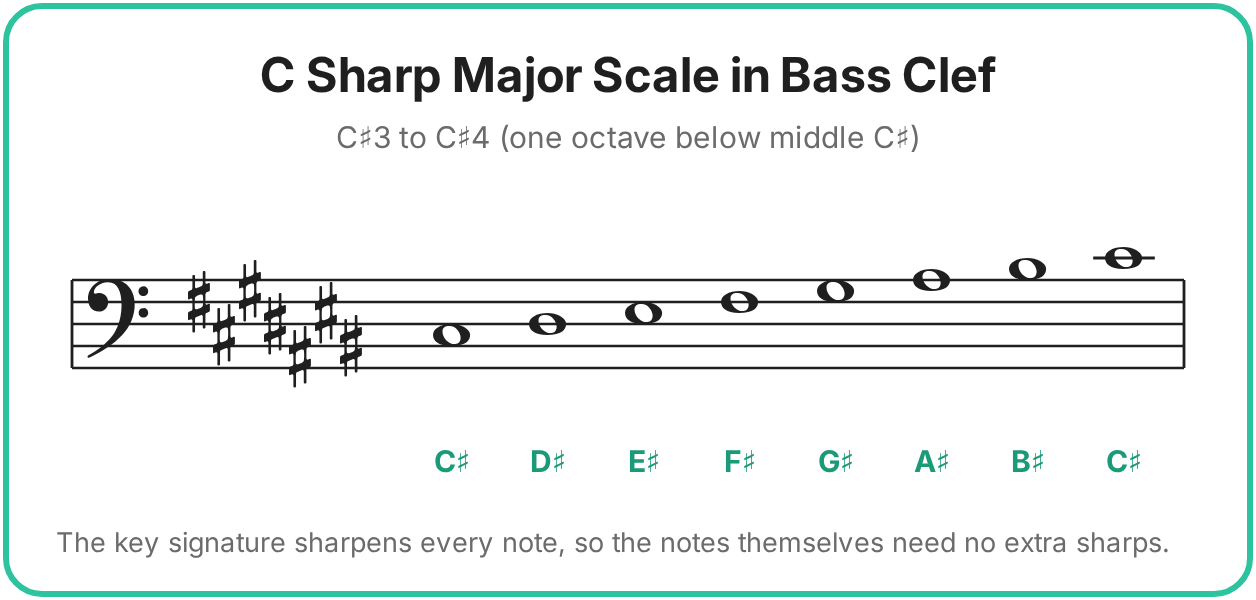
In bass clef, the left hand starts on C♯ in the second space and finishes on C♯ on the first ledger line above the staff. If you’re still getting fluent with bass clef notes on piano, say the letter names aloud first and add the word “sharp” to each one.
C sharp major scale fingering: black-key groups, white-key thumbs
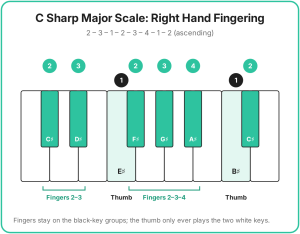
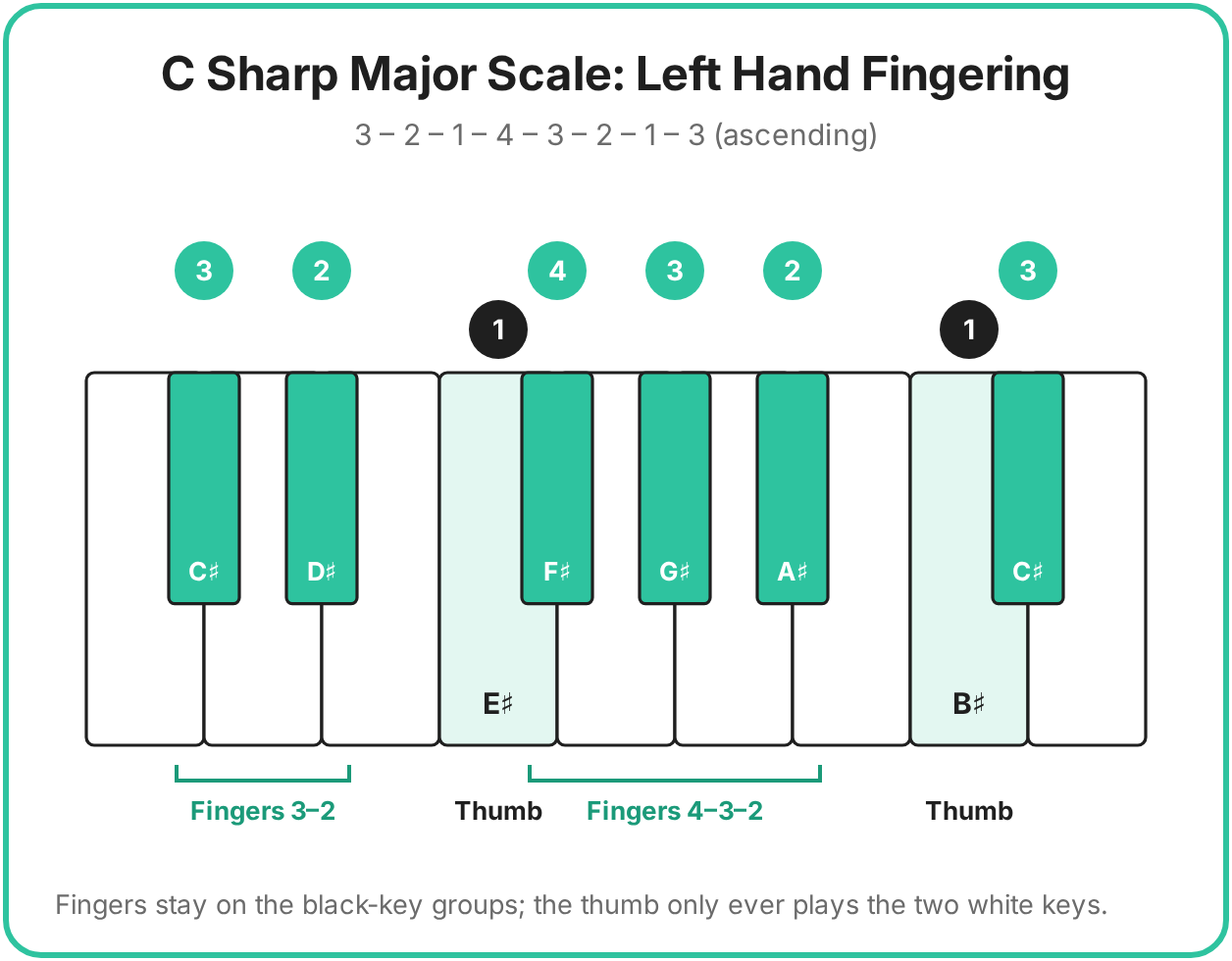
Most piano scales for beginners start with the thumb on the first note. C♯ major doesn’t, and that’s what makes it comfortable. The whole fingering comes from one idea: long fingers stay on the black-key groups, and the thumb only ever plays the two white keys, E♯ and B♯.
Right hand fingering
The right hand plays 2 – 3 – 1 – 2 – 3 – 4 – 1 – 2. Put fingers 2 and 3 on the group of two black keys (C♯ and D♯). Tuck your thumb under to play E♯ (the F key), then cover the group of three black keys with fingers 2, 3 and 4 (F♯, G♯, A♯). Tuck the thumb under again for B♯ (the C key) and finish on C♯ with finger 2.
Left hand fingering
The left hand plays 3 – 2 – 1 – 4 – 3 – 2 – 1 – 3 going up. Fingers 3 and 2 cover the two-black-key group, the thumb plays E♯, finger 4 crosses over to F♯, and fingers 3 and 2 finish the three-black-key group. The thumb takes B♯ and finger 3 crosses over to the top C♯. Coming down, reverse the order.
Hands together and two octaves
Put both hands together and something useful happens: both thumbs land on E♯ at the same moment, and again on B♯. Those two shared thumb notes act as checkpoints. If your thumbs don’t meet there, one hand has slipped a finger.
To play two octaves, keep repeating the pattern. The right hand plays 2 – 3 – 1 – 2 – 3 – 4 – 1 – 2 – 3 – 1 – 2 – 3 – 4 – 1 – 2, and the left hand plays 3 – 2 – 1 – 4 – 3 – 2 – 1 – 3 – 2 – 1 – 4 – 3 – 2 – 1 – 3. Because the keys are identical, this is also the standard fingering for D♭ major, so you’re learning two scales at once.
C sharp major vs D flat major: same keys, which name?
C♯ major and D♭ major use exactly the same keys on the piano and sound exactly the same. Keys like this are called enharmonic equivalents: two names for one sound. So yes, C sharp and D flat are the same key on the piano, and the two scales are the same scale with different spellings.
| C♯ major | D♭ major | |
|---|---|---|
| Key signature | 7 sharps | 5 flats |
| Notes | C♯ D♯ E♯ F♯ G♯ A♯ B♯ | D♭ E♭ F G♭ A♭ B♭ C |
| Fingering | RH 2-3-1-2-3-4-1-2, LH 3-2-1-4-3-2-1-3 | Identical |
| Relative minor | A♯ minor | B♭ minor |
| How often you’ll see it | Less common | Much more common in piano music |
Most composers and arrangers choose D♭ major because five flats are easier to read than seven sharps. C♯ major tends to appear when a piece in C♯ minor brightens into the major key, or in music written to explore every key. Learn the scale under either name and you can play both. You’ll just need to read the other spelling when the music calls for it.
C sharp major on the circle of fifths
On the sharp side of the circle, each step clockwise adds one sharp. The E major scale has four sharps and the B major scale has five. F♯ major adds a sixth, and C♯ major completes the set with all seven. That makes it the furthest point on the sharp side, and it shares its slot with D♭ major coming round from the flat side.
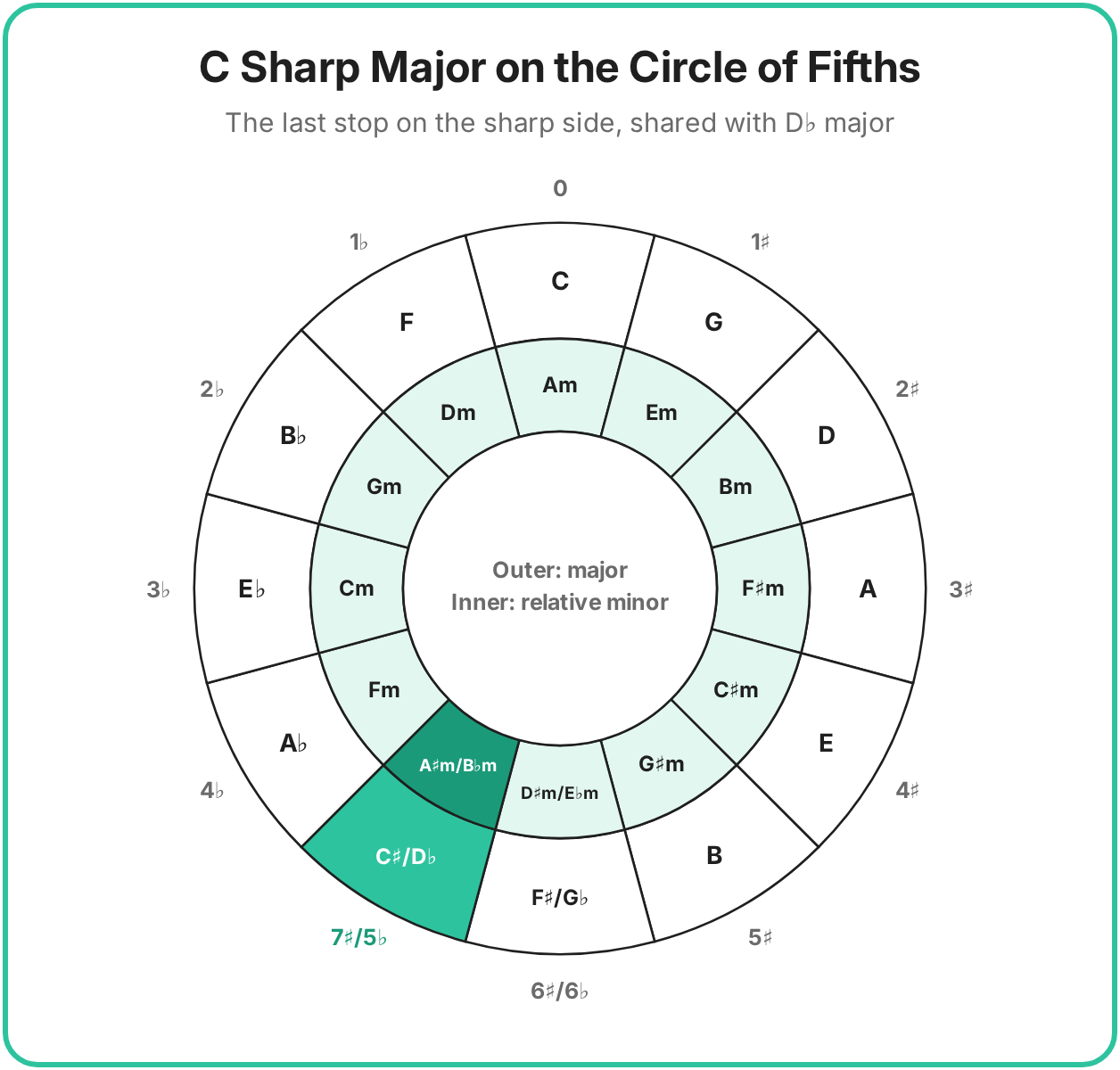
You can explore every neighbour of C♯ major, along with its signature and chords, on Skoove’s interactive circle of fifths.
Chords in C sharp major
Build a three-note chord on every note of the scale, using only notes from the scale, and you get seven chords. As in every major key, three are major, three are minor and one is diminished. If the difference is still fuzzy, it helps to hear major and minor chords side by side.
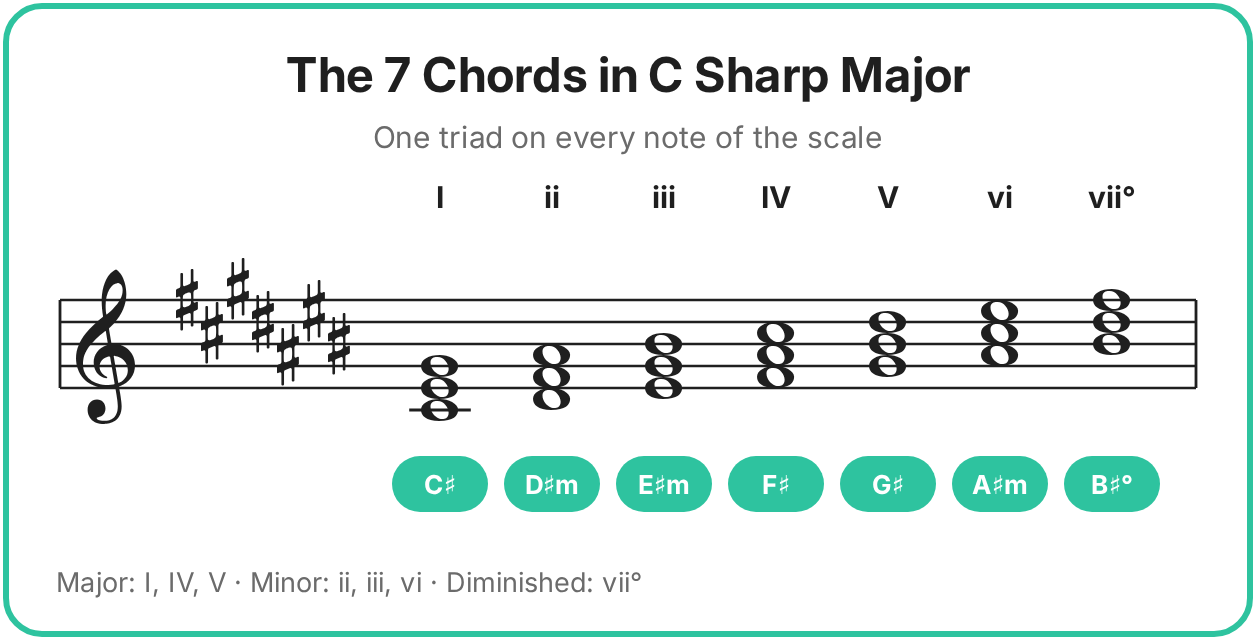
C sharp major scale chords and the keys you press
| Numeral | Chord | Spelled | Keys you press |
|---|---|---|---|
| I | C♯ major | C♯ – E♯ – G♯ | C♯, F, G♯ |
| ii | D♯ minor | D♯ – F♯ – A♯ | D♯, F♯, A♯ (all black) |
| iii | E♯ minor | E♯ – G♯ – B♯ | F, G♯, C |
| IV | F♯ major | F♯ – A♯ – C♯ | F♯, A♯, C♯ (all black) |
| V | G♯ major | G♯ – B♯ – D♯ | G♯, C, D♯ |
| vi | A♯ minor | A♯ – C♯ – E♯ | A♯, C♯, F |
| vii° | B♯ diminished | B♯ – D♯ – F♯ | C, D♯, F♯ |
Two chords in this key, ii and IV, sit entirely on black keys. The home chord is a useful one to memorize on its own, and you can see the C# major chord in every inversion, with fingerings and audio, in Skoove’s chord tool.
A first chord progression in C sharp major: I–IV–V–I
The simplest progression in any key is I–IV–V–I. In C♯ major that’s C♯ – F♯ – G♯ – C♯. Play the root of each chord in your left hand and the triad in your right hand, four beats per chord. It’s the backbone of countless songs, and a good first step into any piano chord progression.
C sharp major relative minor: A sharp minor
The C sharp major relative minor is A♯ minor. It uses the same seven sharps and the same notes, but starts on the sixth note of the scale: A♯ – B♯ – C♯ – D♯ – E♯ – F♯ – G♯ – A♯. Every major key has a partner like this, and relative major and minor scales always share a key signature.
In practice you’ll rarely see A♯ minor written down. Most music uses its enharmonic twin, B♭ minor, with five flats. Don’t confuse it with C♯ minor either. C♯ minor is the parallel minor, which starts on the same note but has only four sharps.
Where you’ll meet C sharp major in real music
C♯ major is rare in its sharp spelling, but it has one famous home. Bach wrote a prelude and fugue in every major and minor key for his Well-Tempered Clavier, and No. 3 in both Book I and Book II is in C♯ major. Neither is a first-year piece, but once you’ve tried a few Bach compositions for piano beginners, the C♯ major prelude from Book I is a bright, flowing goal to work towards.
Spelled as D♭ major, the same keys turn up far more often. Debussy’s Clair de Lune is written in D♭ major, as is Chopin’s “Minute” Waltz (Op. 64 No. 1). The middle section of Chopin’s Fantaisie-Impromptu, a piece in C♯ minor, also moves to D♭ major. A beginner-friendly Clair de Lune piano tutorial usually moves the piece to an easier key, but the original’s five flats sit on exactly the keys you’ve just learned.
A 5-minute practice routine for the C sharp major scale
Because the fingering follows the black-key groups, you can learn this scale in small chunks. Try this once a day for a week, one minute per step:
- Find the groups. Right hand only: play the two black keys with fingers 2 and 3, then the three black keys with fingers 2, 3 and 4. Repeat with the left hand (3 and 2, then 4, 3 and 2).
- Add the thumbs. Play the full right-hand scale slowly, saying each note name aloud, including “E sharp” and “B sharp”.
- Left hand alone. Same again with the left hand, up and down.
- Hands together. Very slowly, checking that both thumbs land on E♯ and B♯ at the same moment.
- Stretch it. Play two octaves, or play along with the scales tool at the top of this page set to C♯ major.
If you’d like feedback while you practice, Skoove listens as you play and tells you in real time whether your notes and timing are right, so mistakes don’t turn into habits.
Author of this blog post:
Susana Pérez Posada

Susana Pérez Posada, Master in Music Therapy, Skoove Piano Educator With over seven years in piano education and a deep passion for music therapy, Susana brings a unique blend of expertise to Skoove. A graduate in Music Therapy from SRH Hochschule Heidelberg and an experienced classical pianist from Universidad EAFIT, she infuses her teaching with a holistic approach that transcends traditional piano lessons. In her writings for Skoove, Susana combines her rich musical knowledge with engaging storytelling, enriching the learning experience for pianists of all levels. Away from the piano, she loves exploring new places and immersing herself in a good book, believing these diverse experiences enhance her creative teaching style.