O holy night began as “Cantique de Noël,” a French carol with music by Adolphe Adam, first performed in 1847. It’s now a Christmas standard and a good piece for beginners. Our easy arrangement is in C major and 3/4 time, with a printable PDF. This tutorial covers the chords, the melody notes and a step-by-step practice plan. Try it with the Skoove lesson below.
Facts about O holy night
Adolphe Adam wrote the music in 1847 for the poem “Minuit, chrétiens” by Placide Cappeau. John Sullivan Dwight wrote the English words in 1855.
A French carol from 1847 that became a Christmas standard.
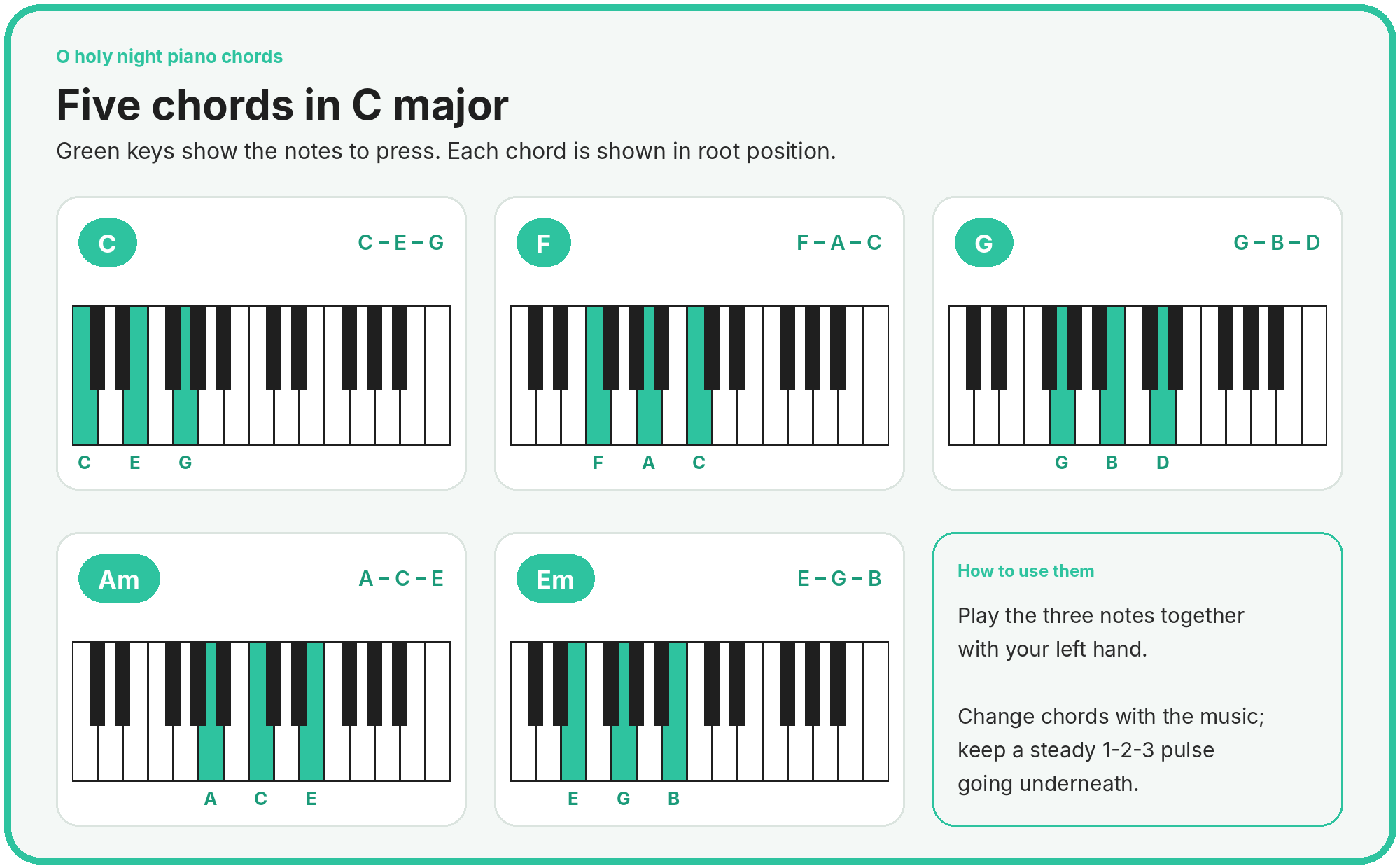
O holy night piano chords
he chords you need first, in C major, are C, F, G (or G7), A minor and E minor.. Play them with your left hand under the melody.
O holy night piano sheet music and notes
This is the easy version from the lesson, in C major and 3/4 time. The left hand (bass clef) plays alone for four measures. Then the right hand (treble clef) joins at measure 5 and holds middle C on piano in measures 7 and 8.
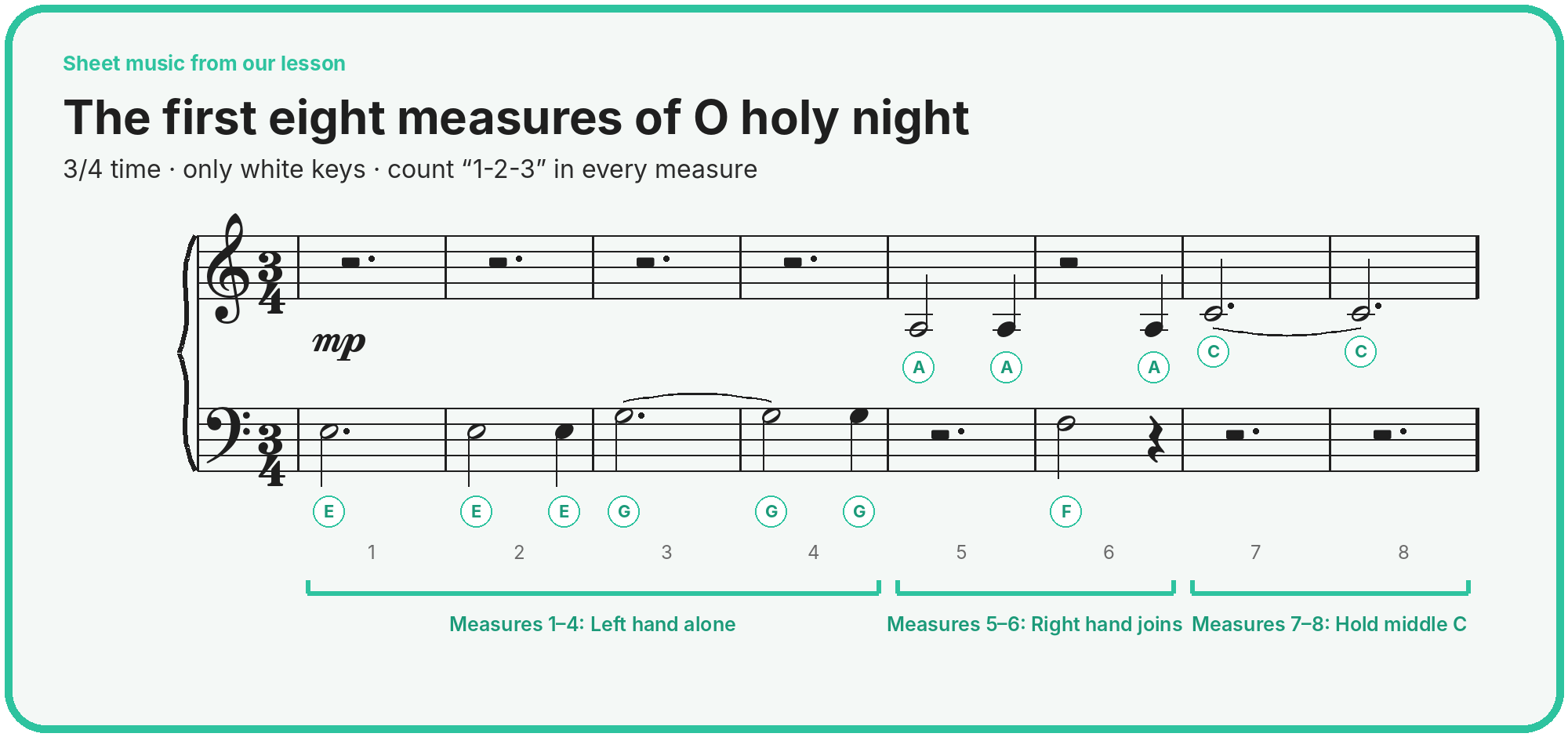
How to read the first eight measures
This O holy night piano easy arrangement uses only white keys in these eight measures. Count “1-2-3” in every measure.
Measures 1 to 4: Left hand alone
The left hand plays E for three beats in measure 1, then E for two beats and E for one beat in measure 2. A G starts in measure 3 and is tied into measure 4, so it lasts five beats. Measure 4 ends with G for one beat.
Measures 5 and 6: Right hand joins
The right hand enters on A in measure 5: A for two beats, then A for one beat. In measure 6, the left hand plays F for two beats, and the right hand plays A on beat 3.
Measures 7 and 8: Hold middle C
The right hand plays middle C for three beats in measure 7 and ties it into measure 8, so the note lasts six beats. The left hand rests.
The opening melody notes are E E E G G A A F A C G G E D C.
Practice the O holy night melody
How to play O holy night on piano, step by step
- Count “1 2 3” slowly with a metronome.
- Play the chords C, F, G, Am and Em with your left hand.
- Play the right-hand melody, starting with E E E G G A A F A C at measure 5.
- Put your hands together one phrase at a time.
- Build volume toward “Fall on your knees,” and add the pedal gently.
Common mistakes and how to fix them
These four mistakes can slow you down when learning to play O holy night on piano.
Rushing the 3/4 rhythm
Count “1 2 3” out loud and use a metronome at a slow tempo until the pulse stays steady.
Cutting long notes short
The opening notes are dotted half notes and half notes, so they last three and two beats. Hold each note for its full length.
Missing the right-hand entrance
The right hand rests for the first four measures. Count the four empty measures so you join in on time at measure 5.
Playing the wrong chord under the melody
A wrong chord clashes with the melody. Change chords only where the chord symbol changes, measure by measure, before you play both hands together.
You can now play O holy night piano from start to finish: count the 3/4 rhythm, learn the opening melody notes, add the chords with your left hand, and combine both hands one phrase at a time. Keep the tempo slow until each measure is steady, then speed up gradually.
For your next song, try Amazing Grace, which is also in 3/4 time, or Ode to Joy, a beginner piece in C major. When you are ready for more, learn Hallelujah, Lean on Me or Canon in D.
FAQ
Author of this blog post:
Susana Pérez Posada

Susana Pérez Posada, Master in Music Therapy, Skoove Piano Educator With over seven years in piano education and a deep passion for music therapy, Susana brings a unique blend of expertise to Skoove. A graduate in Music Therapy from SRH Hochschule Heidelberg and an experienced classical pianist from Universidad EAFIT, she infuses her teaching with a holistic approach that transcends traditional piano lessons. In her writings for Skoove, Susana combines her rich musical knowledge with engaging storytelling, enriching the learning experience for pianists of all levels. Away from the piano, she loves exploring new places and immersing herself in a good book, believing these diverse experiences enhance her creative teaching style.
Published by Lydia Ogn from the Skoove team