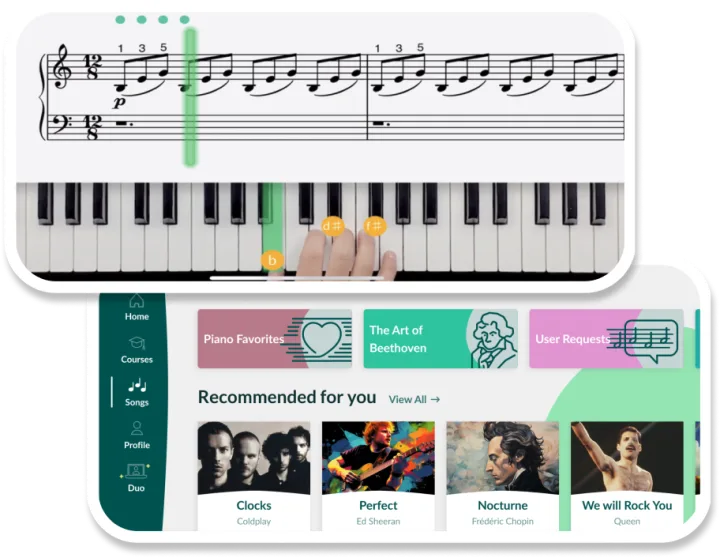




Learn to play Christmas carols like this step by step. Start a free trial today!
Silent Night was first performed on Christmas Eve 1818 in Oberndorf bei Salzburg, Austria, by a priest and a schoolteacher, accompanied by a choir and a guitar.
Today, this Christmas classic is a great piano song for both adult and young beginners. It’s slow and manageable, using only the white keys in C major and three easy chords.
By the end of this article, you’ll be able to play the Silent Night piano notes and chords, read the sheet music and even have a helpful cheat sheet to take away. Start practicing now, and you’ll be playing it with confidence by Christmas!
24 bars, 3 chords and a 3-week plan to play “Silent Night” by Christmas Eve. Tap a section to jump to it.
Composer Franz Xaver Gruber · Written 1818 · Key C major · Time 3/4 · Chords C, F, G7 · Level Beginner
Silent Night piano notes
The notes for Silent Night on piano begin with G A G E. The melody is played with your right hand using only white keys in C major, which makes it a great Christmas song for beginners.
The melody mostly moves step by step, with just a few places where your right hand shifts up. Start by finding the notes around middle C, then follow the melody one line at a time.
Beginner tip: Lines 3 and 4 use exactly the same notes, so you only need to learn that part of the melody once.
All three verses of Silent Night use the same melody. Only the lyrics change, so once you’ve learned the notes, you can play the entire song without learning a new tune for every verse.
Silent Night Piano Notes, Lyrics And Rhythm
The “Silent Night” pattern: long (1½) – short (½) – normal (1), then a long note (3). “Si” is sung over the first two notes, “lent” falls on beat 3 and “night” lands on the long note in the next bar.
Green notes: lines 3 and 4 use exactly the same notes and rhythm.
How do you count the rhythm?
Silent Night is usually written in 3/4 time. This means each bar has three beats, so you should count “one, two, three” as you play. At the start of most lines, you’ll hear a long-short pattern.
This is a great opportunity to learn about dotted notes and how to play them.
If the rhythm or hand movements feel tricky at first, you’re not alone. In a Reddit discussion about learning piano, one learner explained how dotted rhythms became harder to manage with a metronome.
Want to play the whole song? The Skoove app has an in-depth Silent Night tutorial with real-time feedback to help you practice the notes and play with confidence this Christmas.
Silent Night cheat sheet
This Silent Night cheat sheet gives you everything you need to remember the basics of the piece. Once you’ve learned the melody, the chords and timings with the lyrics will be easy to follow.
Silent Night Cheat Sheet
CEG
CFA
BFG
What chords are in Silent Night?
The three chords you’ll need are C, F and G7:
- C (I): C – E – G
- F (IV): F – A – C
- G7 (V7): G – B – D – F
These are chords I, IV and V7 in C major, and they appear everywhere in popular music. You might already be familiar with them if you’ve learned Happy Birthday.
How do you play Silent Night chords on piano?
Start with only the root note of each chord, playing one note per bar. Then practice the full chord shapes one at a time to get them under your fingers. Once you’re comfortable, play the chords together with the melody to get familiar with how they sound together.
When you can play with both hands together, start experimenting with chord inversions. Inversions change the order of the notes in a chord without changing the notes themselves. The cheat sheet shows inversion shapes for F and G7 that keep your hand in one place, which makes the transitions smoother and less jumpy, perfect for a gentle Christmas carol like Silent Night.
Silent Night piano sheet music
Ready to start playing? Download the free Silent Night piano sheet music PDF to follow along as you practice. It matches the notes and chords on this page, so it’s easy to see how the melody and accompaniment fit together.
Facts about Silent Night
Before you play Silent Night, discover six fascinating facts about the history of this beloved Christmas carol.
- Written in 1818: Joseph Mohr wrote the lyrics and Franz Xaver Gruber composed the melody.
- First performed on a guitar: The carol was performed on Christmas Eve 1818 in Oberndorf, Austria, with Mohr accompanying the singing on guitar, as the organ in the church was said to be broken.
- Originally faster: The original version was in D major and 6/8 time, giving it a lilting rhythm. Listen to Greensleeves for a similar compound rhythmic feel.
- Translated into English: John Freeman Young published the familiar English translation in 1859.
- A worldwide favorite: Bing Crosby recorded Silent Night in 1935. The carol has since been translated into around 300 languages and dialects.
- Free sheet music: Silent Night is in the public domain, meaning the original sheet music is free to use and share.
Your three-week plan for Christmas Eve
Want to play Silent Night on piano by this Christmas Eve? Just 15 minutes of practice a day can help you build confidence. Starting early gives you time to master the notes, coordinate both hands and feel confident playing Silent Night for your friends and family.
3-Week Plan: Silent Night By Christmas Eve
Week 1: Learn the right-hand melody
Your goal: Play the melody confidently.
- Days 1–2: Learn the first line with your right hand. Play slowly at first, and focus on the correct notes, timing and fingering.
- Days 3–4: Learn the next line, then practice both lines together with smooth transitions.
- Days 5–7: Add the remaining lines, repeating any tricky phrases until you can play the entire melody smoothly.
Top tip: Sing along as you play. Since you already know how Silent Night sounds, the familiar melody can help you remember the notes and keep time.
Week 2: Bring both hands together
Your goal: Add a simple left-hand accompaniment without losing the melody.
- Days 8–9: Practice the left-hand chords separately, paying particular attention to the G7-to-C chord change.
- Days 10–11: Repeat the G7-to-C transition until your fingers can move smoothly between the two chords.
- Days 12–14: Combine both hands, playing slowly enough to keep the melody and accompaniment together.
Top tip: Don’t rush. If your hands keep getting out of time with each other, practice the tricky bar separately before returning to the whole song. You can reduce the chords to their root notes to get the timing right, then go back to full chords and their inversions.
Week 3: Add expression
Your goal: Make your performance sound natural and full of feeling.
- Days 15–16: Practice playing softly, following the dynamic markings in the sheet music to understand how dynamic contrast shapes the song’s mood.
- Days 17–18: Add a little sustain pedal, changing it with each chord to keep the sound smooth. Use it sparingly, so the harmonies don’t become muddy.
- Days 19–20: Have fun with the structure. Try playing the last line as a short introduction before starting the song, and practice slowing down gently at the end to give the final notes room to ring.
- Day 21: Play the entire song from beginning to end without stopping. Focus on expressing the melody and chords rather than getting every note perfect.
Inspiration from other adult beginners
You’re not alone in wanting to learn Christmas songs to share with your family. In a Reddit discussion about adult piano learning, a 44-year-old beginner talked about working towards family Christmas gatherings where the younger generations performed on piano and violin. It shows how learning an instrument as an adult can be a rewarding way to take part in family traditions.
Keep the festive music playing
Learning Silent Night on piano is easier than you might think. Start with the melody and a few simple chords, and practice a little each day.
Once you’ve learned this Christmas classic, keep the festive spirit going with Jingle Bells, We Wish You a Merry Christmas or Amazing Grace. For more ideas beyond the holidays, explore our list of easy piano songs.
Ready to make music part of your everyday life? Start your free trial with Skoove and discover how fun and rewarding learning piano can be. Happy practicing!
Author of this blog post:
Matthew Dickman

With over a decade of experience in music education Matthew holds a BA in Music from Paul McCartney’s LIPA and an MA in Composition from the University of Salford. Mathew has developed a distinctive compositional voice and approach to music theory education through his research and work in the music industry. Matthew’s writing for Skoove combines experience from orchestral and media composition, and as a gigging jazz musician, to create a wholistic and accessible pedagogy for musicians of any level. Away from music, he enjoys reading and exploring nature to expand his horizons and knowledge contributing to his holistic teaching style.
Published by Lydia Ogn from the Skoove team