


Japan wants to learn music more than any other country we studied, but it has one thing in common with the rest of the world: the instrument it wants to play is the piano. In contrast, the guitar is falling out of favour: searches to learn it have halved in Germany, France, Spain and Italy since 2016.
The Musical Ambition Index, a study by Skoove and DataPulse Research, is built from the 1.1 million monthly searches across the 32 countries we studied for queries like “learn piano”, “guitar lessons” and “how to play the drums”. The data was compiled in 19 languages and adjusted for population and Google use.
 Click to enlarge
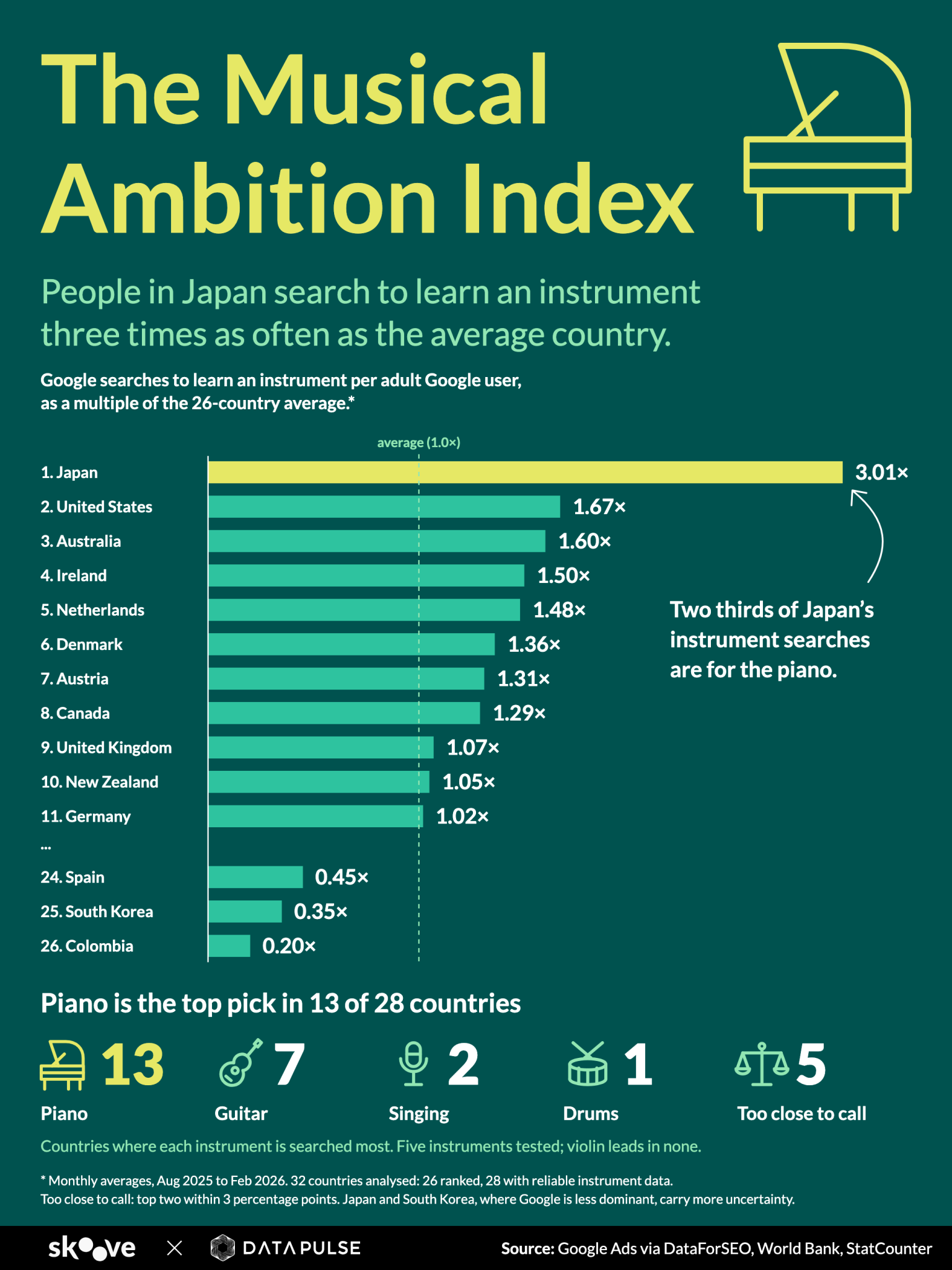
Japan is three times as interested in learning to play a musical instrument as the average country
People in Japan search to learn an instrument three times as often as adults in the average ranked country, well ahead of the United States (1.7 times) and Australia (1.6). Japan searches for music lessons at six times the rate of Italy, a country famous for its musical prowess. Two thirds of its instrument searches are for piano.
At the other end of the table, the gap is fifteenfold: Colombia, South Korea and Spain close out the ranking at 0.2, 0.35 and 0.45 times the average. One reading note applies to the top and bottom alike: Google handles only 74% of searches in Japan and 48% in South Korea, averaged over the search window, so those two figures lean on the market-share correction more than the rest of the table and carry more uncertainty.
It’s also worth noting that Japan’s lead reflects an old piano habit, not a recent boom. Demand there is actually falling: Google Trends puts Japanese searches for piano schools (ピアノ教室) at 27% below their 2021 peak. Japan still ranks first because it started so far ahead. Music is a compulsory school subject through junior high (national curriculum). Japanese makers shaped the instrument itself: Osaka-founded Roland launched the world’s first electronic piano with a touch-sensitive keyboard in 1974.
View underlying data
| Country | Times the 26-country average |
|---|---|
| 🇯🇵 Japan | 3.01× |
| 🇺🇸 United States | 1.67× |
| 🇦🇺 Australia | 1.60× |
| 🇮🇪 Ireland | 1.50× |
| 🇳🇱 Netherlands | 1.48× |
| 🇩🇰 Denmark | 1.36× |
| 🇦🇹 Austria | 1.31× |
| 🇨🇦 Canada | 1.29× |
| 🇬🇧 United Kingdom | 1.07× |
| 🇳🇿 New Zealand | 1.05× |
| 🇩🇪 Germany | 1.02× |
| 🇨🇭 Switzerland | 0.93× |
| 🇸🇪 Sweden | 0.86× |
| 🇵🇱 Poland | 0.85× |
| 🇫🇮 Finland | 0.79× |
| 🇳🇴 Norway | 0.76× |
| 🇫🇷 France | 0.75× |
| 🇲🇽 Mexico | 0.73× |
| 🇧🇷 Brazil | 0.70× |
| 🇦🇷 Argentina | 0.67× |
| 🇵🇹 Portugal | 0.63× |
| 🇮🇹 Italy | 0.48× |
| 🇨🇱 Chile | 0.47× |
| 🇪🇸 Spain | 0.45× |
| 🇰🇷 South Korea | 0.35× |
| 🇨🇴 Colombia | 0.20× |
Source: Google Ads via DataForSEO; World Bank; StatCounter. Local-language plus English search phrases. Adjusted for population, internet use and Google's share of searches, which is lower in Japan and South Korea.
Below Japan, the table belongs to the English-speaking world and the small, rich north: the United States and Australia come in second and third, then Ireland, the Netherlands, Denmark, Austria and Canada sit inside a narrow band. Europe’s biggest music markets sit lower. The United Kingdom is ninth, Germany eleventh, and France, for all its conservatoires, comes in just 17th of the 26 countries ranked.
Keep one pairing from this table in mind: Ireland, Europe’s highest placed nation at 1.5 times the average, and Norway, in the lower half at half Ireland’s rate. Two small, rich northern countries, one wide gap. Why they split is this study’s last question.
The world wants to play the piano
So much for who wants to learn. But which instrument do they want to play? To answer that, we tracked the popularity of five instruments in every country: piano, guitar, violin, the drums and singing. Across the 28 countries we could measure reliably (all 32 minus the four with thin local-language data), piano is the most-searched instrument of the five and is named in 38% of the searches that specify an instrument. Piano is the most popular option in 13 countries, including the United States, Germany, the United Kingdom, France and Japan. The guitar is named in 25% of these searches and is the most popular named instrument in seven countries: Ireland, New Zealand, Poland, Mexico, Brazil, Italy and Colombia. Finland would rather sing, South Korea’s Google searches lean towards drums, India’s English-language searches towards singing, while in five countries the race is too close to call.
- 🇯🇵Japan67%
- 🇨🇭Switzerland49%
- 🇨🇦Canada44%
- 🇬🇧United Kingdom44%
- 🇳🇴Norway41%
- 🇿🇦South Africa40%
- 🇫🇷France39%
- 🇩🇪Germany39%
- 🇺🇸United States37%
- 🇩🇰Denmark34%
- 🇦🇹Austria34%
- 🇵🇹Portugal32%
- 🇳🇱Netherlands31%
- 🇮🇹Italy57%
- 🇵🇱Poland46%
- 🇧🇷Brazil42%
- 🇲🇽Mexico39%
- 🇳🇿New Zealand39%
- 🇮🇪Ireland32%
- 🇨🇴Colombia31%
- 🇮🇳India36%
- 🇫🇮Finland34%
- 🇰🇷South Korea29%
- 🇸🇪SwedenGuitar 32% · Piano 31%
- 🇦🇺AustraliaPiano 31% · Singing 29%
- 🇪🇸SpainGuitar 30% · Piano 28%
- 🇨🇱ChileGuitar 30% · Singing 29%
- 🇦🇷ArgentinaSinging 29% · Piano 27%
Share = the winner’s share of the country’s searches that name one of the five instruments, own language and/or English (India and South Africa: English only), Aug 2025 to Feb 2026. Where the top two are within 3 percentage points the race is too close to call and both are shown. Other instruments were not measured.
Why does the piano win overall? It depends on how people search. When people want to teach themselves (for example using keywords like “learn guitar”, “how to play guitar”), guitar wins with 62% of these searches compared with 38% for the piano. When people look for lessons (using keywords like “piano lessons” or “piano lessons near me”), piano wins, with 66% of the search volume versus 34% for the guitar. Lesson searches are the bigger group, occupying about three quarters of all piano and guitar searches, and three times the self-taught ones. So, the piano’s lead there decides the overall result. The conclusion is clear. Guitar is the instrument people teach themselves. Piano is the instrument people take lessons for.
View underlying data
| Search type | Piano | Guitar |
|---|---|---|
| Looking for lessons (77% of these searches) | 66% | 34% |
| Teaching yourself (23% of these searches) | 38% | 62% |
Source: Google Ads via DataForSEO. Shares of the two instruments' combined monthly searches, August 2025 to February 2026.
The outside datasets that measure learning agree: among Americans who have never learned an instrument but wish they had, 47% name piano as their instrument of choice, while just 22% would opt for the guitar (YouGov, 2022). This is reflected in Europe too, with data from German public music schools confirming approximately 160,000 piano enrolments in comparison with 117,500 for guitar.
There is one area where guitar comes out on top, and that’s the number of amateur musicians already playing the instrument. Germany’s Allensbach survey of amateur musicians aged 16 and over (fieldwork winter 2024/25) found that 28% of them play guitar and just 24% play the piano. Our search data, which counts people trying to start, shows more Germans are currently looking for piano lessons than guitar lessons.
Guitar searches halved across continental Europe. The piano held up far better

Since 2016, searches to learn the guitar have fallen by half or more in Germany, France, Spain and Italy, and by two thirds in Brazil. In the United States they are down just 6%, in the United Kingdom 11%. The index is a seven-month snapshot, so to see which way demand is heading we followed the same query, “learn guitar” and “learn piano” in each country’s language on Google Trends from 2016 to 2025. We then compared each country against its 2016 level.
View underlying data
| Year | United States | United Kingdom | Germany | France | Spain | Italy | Brazil |
|---|---|---|---|---|---|---|---|
| 2016 | 100.0 | 100.0 | 100.0 | 100.0 | 100.0 | 100.0 | 100.0 |
| 2017 | 95.9 | 97.4 | 91.0 | 79.1 | 81.9 | 81.8 | 79.0 |
| 2018 | 91.2 | 86.6 | 84.1 | 72.5 | 77.4 | 72.1 | 64.4 |
| 2019 | 91.0 | 91.8 | 80.5 | 63.6 | 71.4 | 64.1 | 54.6 |
| 2020 | 112.0 | 139.8 | 83.5 | 77.9 | 97.1 | 91.8 | 62.1 |
| 2021 | 81.8 | 82.7 | 67.1 | 56.6 | 54.8 | 54.1 | 38.0 |
| 2022 | 89.0 | 79.8 | 56.9 | 48.9 | 48.6 | 48.5 | 40.0 |
| 2023 | 88.4 | 79.2 | 52.1 | 45.3 | 41.6 | 49.4 | 31.4 |
| 2024 | 84.4 | 77.5 | 43.6 | 38.2 | 37.6 | 49.0 | 26.2 |
| 2025 | 94.3 | 88.9 | 43.0 | 37.4 | 39.0 | 47.4 | 29.7 |
Source: Google Trends via DataForSEO. Lines show change within a country, not levels between countries. Japan is not shown: its query is not like-for-like.
The piano fell too, but by far less (2016 = 100): Germany 70, France 78, Spain 68, Brazil 73, Italy 87. In the United States and the United Kingdom it is flat.
View underlying data
| Year | United States | United Kingdom | Germany | France | Spain | Italy | Brazil |
|---|---|---|---|---|---|---|---|
| 2016 | 100.0 | 100.0 | 100.0 | 100.0 | 100.0 | 100.0 | 100.0 |
| 2017 | 105.5 | 110.6 | 91.5 | 100.3 | 93.8 | 90.0 | 93.9 |
| 2018 | 98.0 | 105.7 | 87.2 | 108.1 | 112.9 | 77.7 | 83.6 |
| 2019 | 97.6 | 112.5 | 91.3 | 109.3 | 100.0 | 83.3 | 87.0 |
| 2020 | 121.3 | 150.3 | 107.2 | 151.8 | 151.2 | 103.4 | 100.0 |
| 2021 | 89.0 | 101.9 | 87.2 | 108.7 | 83.7 | 78.3 | 67.2 |
| 2022 | 95.8 | 96.2 | 77.7 | 105.7 | 70.3 | 68.8 | 66.3 |
| 2023 | 96.2 | 107.6 | 77.5 | 100.9 | 74.6 | 81.0 | 72.4 |
| 2024 | 93.1 | 101.9 | 70.3 | 83.3 | 69.4 | 91.1 | 68.9 |
| 2025 | 98.6 | 100.0 | 69.7 | 78.1 | 67.5 | 87.2 | 73.3 |
Source: Google Trends via DataForSEO. Lines show change within a country, not levels between countries. Japan is not shown: its query is not like-for-like.
Most guitar searches spiked during lockdown in 2020 and then dropped, though Germany’s search volume barely rose even then (up just 4% on 2019, while UK interest jumped 52%). Every guitar line outside the US and UK ends 2025 at half or less of where it started. The German music-school enrolments we cited earlier tell the same story in enrolments rather than searches (VdM statistics via miz.org):
- Guitar: 137,000 enrolments in 2013, 128,600 in 2019, 117,500 in 2021. The decline began before the pandemic, even though the association has counted more broadly since 2014 (the whole year rather than one reference date).
- Piano: 159,000, 164,900 and 160,100 for the same period, indicating stagnant demand.
Could this just be learners moving to YouTube and TikTok instead of Google? We checked against Google’s own Music Education & Instruction search category, which counts every search Google classifies as music education, in any language and any phrasing. That category fell far less. Interest in Germany was down 10% from 2016 to 2025, France 17%, Italy 16%, Spain 23%, and in the United States it has been recovering since 2021. Japan’s category line is flat. A wholesale move away from Google would drag the whole category down with the guitar. It did not: within music learning, the guitar is the loser, not the search engine. Brazil is the one exception where the whole category fell by 41%. The category check shows people did not leave Google overall, but guitar learners may well have moved to YouTube and guitar apps faster than piano learners did. Some of that shift is surely in these numbers; it cannot explain the whole gap between the guitar and everything else. The data shows us that the decline that runs through continental Europe and Brazil has taken place gradually and started well before the pandemic.
The piano beats every national instrument. Some come close

The piano hasn’t only outlasted the guitar in popularity. Most countries also have a national instrument, so we asked Google the same question about those: does anyone want to learn it? We found a qualifying national instrument for 26 of the 28 countries measured; the chart shows the 25 with solid local data (Finland’s baseline is too thin to rate). Each country’s pick is the candidate from Wikipedia’s list of national instruments that people search for most by name: the bandoneón for Argentina, the Alphorn for Switzerland, the shamisen for Japan, the harmonium for India, and, in ten countries from Norway to Mexico, the accordion. In every one of them the piano draws more learning demand than the national instrument, but in a few places the local instrument comes close. Brazil’s pandeiro draws 78% as much learning demand as the piano, Austria’s Steirische Harmonika 43%, Poland’s accordion 40%.
Method: same three query forms as the main index (“learn X”, “X lessons”, “how to play X”), local language only, August 2025 to February 2026. The instrument shown is the candidate people search for most by name. Candidates came from Wikipedia’s list of national instruments plus the folk instruments we tested; the five instruments of the main index were excluded.
Countries whose local piano baseline is under 200 searches a month (Finland, and the four unranked thin-data countries) are not charted. “Below reporting floor” means under about ten searches a month.
At the other end, the instruments that stand for a country are rarely the ones anyone tries to learn. Switzerland’s Alphorn draws 11% of the piano’s learning demand; Argentina’s bandoneón, which is the sound of tango, is the focus of only a handful of searches a month. So is Sweden’s nyckelharpa. Japan’s shamisen draws 4,400 searches, and even that is just one twentieth of Japan’s piano demand in Japanese. The American banjo is the biggest heritage market in absolute terms (6,800 learning searches a month) while Brazil’s pandeiro is second (5,600). The heritage instrument people learn in the most countries is the accordion. It is the most-searched folk instrument in 10 of the 25 charted countries, and in Poland, Italy, the Netherlands and Norway it retains about 30% to 40% of the piano’s demand. Elsewhere it draws far less: in France, 7%.
Why Ireland searches twice as much as Norway
The instruments a nation claims as its own are not the ones it wants to learn. So, what influences how much a country wants to learn an instrument? The strongest clue we found is institutional. Across the 13 ranked European countries with comparable figures, a pattern emerges. Where a country has more people practising some form of art, there are also more searches for musical tuition (r = 0.55). Practising art here means doing it yourself, not watching: the share of people aged 16 and over who practised an artistic activity in the last 12 months (Eurostat EU-SILC 2022). Playing an instrument is only one such activity, and Germany is not in the chart because it did not collect these figures in the 2022 survey.
View underlying data
| Country | Practise artistic activities (%) | Musical Ambition Index |
|---|---|---|
| Ireland | 45.3 | 1.5 |
| Denmark | 59.7 | 1.36 |
| Austria | 58.4 | 1.31 |
| Netherlands | 46.7 | 1.48 |
| Finland | 65.8 | 0.79 |
| Sweden | 40.7 | 0.86 |
| Norway | 47.6 | 0.76 |
| Switzerland | 40.7 | 0.93 |
| Spain | 40.1 | 0.45 |
| Poland | 23.0 | 0.85 |
| Portugal | 20.5 | 0.63 |
| France | 19.2 | 0.75 |
| Italy | 17.3 | 0.48 |
Source: Eurostat ilc_scp07; Google Ads via DataForSEO. Dashed lines: the index average (1.0×, yellow) and the average practising share (40%, grey). Correlation r = 0.55.
Two countries break the pattern. Norway and Ireland practise art at almost the same rate (48% and 45% respectively), but split sharply on how often they search to learn an instrument. Ireland has Europe’s highest demand for musical tuition, while Norway has just half of that and sits in the lower half of the table. One plausible reason: Norway’s municipal culture schools (known as kulturskole) must be offered to all children and young people in every Norwegian municipality by law. This practice enables Norwegians to learn an instrument earlier in life, meaning many don’t need to search Google for musical tuition later on. Ireland is the mirror case: Irish adults exhibit Europe’s strongest appetite to learn, and with no public music-school system to absorb it, Google searches abound. Instrumental tuition is overwhelmingly private, with the main state-backed programme reaching only about 10% of children.
That may be the quiet finding underneath the whole index: Google measures the ambition a country’s institutions leave unmet. Read that way, Japan stops being a contradiction: its schools nurture the desire to learn, but a Japanese learner still has to find private lessons, and that is exactly the search we count. Where music schools exist and have places available for young learners, those later-in-life Google searches never materialise. Where learners must go looking, the demand shows up here.
Find your country
Pick a country: its rank, its instrument split, and how its national instrument fares against the piano.
All 32 countries, 26 ranked
One row per country: the Ambition Index (1.0 = the average of the 26 ranked countries), the underlying search rate, and the most-wanted instrument. The six greyed rows at the bottom are measured but not ranked. Search or sort.
| Country | Ambition Indextimes the 26-country average | Searchesper 1,000 Google-using adults, monthly | Most wanted“Too close” = top two within 3 points |
|---|---|---|---|
| 🇯🇵Japan | 2.52 | Piano | |
| 🇺🇸United States | 1.40 | Piano | |
| 🇦🇺Australia | 1.34 | Too close | |
| 🇮🇪Ireland | 1.26 | Guitar | |
| 🇳🇱Netherlands | 1.24 | Piano | |
| 🇩🇰Denmark | 1.14 | Piano | |
| 🇦🇹Austria | 1.10 | Piano | |
| 🇨🇦Canada | 1.08 | Piano | |
| 🇬🇧United Kingdom | 0.90 | Piano | |
| 🇳🇿New Zealand | 0.88 | Guitar | |
| 🇩🇪Germany | 0.85 | Piano | |
| 🇨🇭Switzerland | 0.78 | Piano | |
| 🇸🇪Sweden | 0.72 | Too close | |
| 🇵🇱Poland | 0.71 | Guitar | |
| 🇫🇮Finland | 0.66 | Singing | |
| 🇳🇴Norway | 0.64 | Piano | |
| 🇫🇷France | 0.63 | Piano | |
| 🇲🇽Mexico | 0.61 | Guitar | |
| 🇧🇷Brazil | 0.59 | Guitar | |
| 🇦🇷Argentina | 0.56 | Too close | |
| 🇵🇹Portugal | 0.53 | Piano | |
| 🇮🇹Italy | 0.40 | Guitar | |
| 🇨🇱Chile | 0.39 | Too close | |
| 🇪🇸Spain | 0.38 | Too close | |
| 🇰🇷South Korea | 0.29 | Drums | |
| 🇨🇴Colombia | 0.17 | Guitar | |
| 🇬🇷Greece | not ranked (thin data) | 0.45 | Piano |
| 🇭🇺Hungary | not ranked (thin data) | 0.40 | Guitar |
| 🇨🇿Czechia | not ranked (thin data) | 0.38 | Guitar |
| 🇮🇳India | not ranked (English-only) | 0.32 | Singing |
| 🇷🇴Romania | not ranked (thin data) | 0.21 | Piano |
| 🇿🇦South Africa | not ranked (English-only) | 0.20 | Piano |
Monthly averages, August 2025 to February 2026. Unranked rows: Greece, Czechia, Romania and Hungary rest mostly on English-language searches with much of the local basket below Google’s reporting floor; India and South Africa were measured in English only against an all-adults denominator, so their rates are floors.
Methodology in brief
- The index. Monthly searches to learn music per 1,000 Google-using adults (population aged 15+ × internet use × Google’s search share), shown as a multiple of the average of the 26 ranked countries (1.0 = average).
- What we counted. Google searches, as reported by Google Ads, for “learn X”, “X lessons”, “how to play X” and similar, for piano, guitar, violin, drums and singing. 32 countries, 19 languages, each country’s own language and/or English. Monthly averages, August 2025 to February 2026.
- Japan and Korea. Google has a smaller share of searches in both, and the index corrects for it. Google’s window-average share there is 73.8% (South Korea 48.2%), and Japan stays first at every share we tested.
- The main limitation. Google Ads merges some different search phrases into one figure and reports that figure for each of them. We count each merged figure once, not once per phrase. Japan is first either way, though ranks further down shift; per-country merged shares are in the table at the end of the full methodology.
- Not ranked. Greece, Czechia, Romania and Hungary (thin local data) and India and South Africa (measured in English only) are reported without ranks. The index averages the 26 ranked countries.
- Too close to call. Where a country’s top two instruments are within three percentage points, we do not name a winner.
Full methodology
How the index works. We divided each country’s monthly searches to learn music by its Google-using adults: population aged 15+ (World Bank 2025) × share who use the internet (ITU 2024; Austria, Switzerland and Sweden 2025) × Google’s share of searches (StatCounter, averaged over the same months as the searches). That gives a rate per 1,000. The index is that rate as a multiple of the average of the 26 ranked countries: 1.0 = average, Japan 3.0, Colombia 0.2. Unrounded figures are in the table below and in the full dataset, available to journalists on request.
What we counted. Google Ads search volumes, averaged over August 2025 to February 2026, for five instruments fixed in advance: piano, guitar, violin, drums and singing. “Most-wanted instrument” always means most wanted of these five. Every language got the same 28 phrases (“learn X”, “X lessons”, “X course”, “how to play X”, “X lessons near me” for each instrument, plus three general music phrases), in dictionary form, adapted only where a language genuinely differs (Brazilians say violão for the guitar people learn) and checked against Google’s own related-search suggestions in that language.
Languages, and the six unranked countries. 24 countries were measured in their own language plus English, eight in English only. The denominator is always every Google-using adult, so where the measured language misses much of the country, the rate comes out too low. That is mild for Canada (no French basket) and Switzerland (German only), and severe for India and South Africa, which is why those two appear without ranks. Counting only English speakers instead would not fix India: its online population is already largely its English-speaking one, so that would correct for the same thing twice. Greece, Czechia, Romania and Hungary are unranked for a different reason, with a stated cutoff: when a country’s own language carries less than 30% of its measured volume, Google’s reporting floor has swallowed the local basket and we do not rank the result. Romania keeps 10% of its volume in Romanian, Greece 16%, Czechia 21% and Hungary 25%; Finland, the closest ranked case, keeps 36% in Finnish. On its Japanese-language searches alone, Japan scores 2.23 per 1,000 (2.52 with English), still first by a wide margin.
Merged phrases, the main limitation. Google Ads often merges similar phrases and reports one combined figure for each of them, and from October 2025 it also began merging unrelated phrases. Adding these up would count the same searches several times, so we count each merged figure once. We count phrases as merged when they report an identical seven-month series with real volume, or when phrases for different instruments report the same monthly figure of 100 or more: three or more at once, or two that match in at least four of the seven months. Such a cross-instrument figure counts towards the country total but towards no instrument. Merged volume ranges from 1% of a country’s total (Chile) to 67% (Romania; table below). Against a naive sum, seven of the 26 ranked countries would move four or more places; Japan is first either way.
Below Google’s reporting floor. Phrases searched fewer than roughly ten times a month get no number and count as zero: none in Germany, Japan or the English-only countries, up to 45% of phrases in Greece. Small-language rates are therefore minimums.
Japan and Korea. Google’s share of searches is far lower in both countries, and it moved during our window: StatCounter puts Japan at 80% in August 2025, sliding to 66% by February 2026 and 59.7% by July 2026; South Korea stays near 48% (Naver holds most of the rest). We divide by each country’s average share over the window: Japan 73.8%, South Korea 48.2%. The size of that correction is why both carry more uncertainty than the rest of the table. At Japan’s early-2025 share of 82%, its rate falls to 2.27 per 1,000 and Japan remains first; at the July 2026 snapshot it would rise to 3.11. Yahoo! Japan (roughly another 7%) is not counted by Google Ads, so we divide by Google’s own share.
Country selection. The 32 countries are major markets in Europe, the Americas, the English-speaking world and East Asia, restricted to languages where Google applies its phrase-merging in full, so every country is measured under the same merging regime. How much volume that regime merges still varies widely by country (1% to 67%, table below).
National instruments. Candidates came from Wikipedia’s list of national instruments plus the folk instruments we tested, minus the five index instruments. Each country’s pick is the candidate people search for most by name in the local language, and its learning phrases are compared with the piano’s. All candidates and their volumes are in the chart tooltips.
Practising art. Eurostat EU-SILC 2022 (ilc_scp07): the share of people aged 16+ who practised any artistic activity themselves in the last 12 months, all the arts, not only music. Germany did not collect these figures in the 2022 survey. Pearson r with the Ambition Index: 0.55 across the 13 ranked countries with both figures.
Where we used Google Trends. Only for the trend charts (“learn guitar” and “learn piano” in each country’s language, 2016 to 2025, each line rebased to its own 2016 = 100), the Music Education & Instruction category check in the same chapter, and Japan’s piano-school series. Trends shows how interest changes within one country, never levels between countries.
What this data cannot say. Search volume measures interest shown on one platform. It misses people who walk into a music school, learn from family, or ask an AI assistant. It also cannot tell who a search is for: some lesson searches come from parents looking for lessons for their children. Google’s numbers are rounded estimates: a single phrase can be off by 50%, which is why every country figure sums dozens of phrases, instrument verdicts within three points are called too close to call, and rate differences under about 0.1 per 1,000 are not meaningful.
Per-country inputs. Adult population, internet use, Google share, the resulting number of Google-using adults (the denominator), how many phrases had no reported volume, and the share of volume that arrived merged:
| Country | Pop 15+ | Internet use | Google share | Denominator | No-volume phrases | Merged share |
|---|---|---|---|---|---|---|
| Argentina | 36.2m | 89.7% | 94.36% | 30.7m | 1 of 56 | 14% |
| Australia | 22.7m | 96.1% | 90.81% | 19.8m | 0 of 28 | 25% |
| Austria | 7.9m | 91.9% | 84.86% | 6.2m | 0 of 56 | 43% |
| Brazil | 171.6m | 84.5% | 90.96% | 131.9m | 0 of 56 | 10% |
| Canada | 35.4m | 94.4% | 87.46% | 29.2m | 0 of 28 | 22% |
| Chile | 16.6m | 95.6% | 91.98% | 14.6m | 1 of 56 | 1% |
| Colombia | 42.7m | 79.3% | 95.05% | 32.2m | 1 of 56 | 19% |
| Czechia * | 9.2m | 87.7% | 81.48% | 6.6m | 13 of 56 | 66% |
| Denmark | 5.1m | 99.8% | 88.62% | 4.5m | 8 of 56 | 49% |
| Finland | 4.8m | 93.7% | 87.68% | 4.0m | 12 of 56 | 56% |
| France | 57.6m | 88.7% | 88.28% | 45.1m | 5 of 56 | 30% |
| Germany | 71.9m | 93.5% | 84.70% | 56.9m | 0 of 56 | 37% |
| Greece * | 9.1m | 86.3% | 95.78% | 7.5m | 25 of 56 | 64% |
| Hungary * | 8.2m | 93.8% | 96.22% | 7.4m | 12 of 56 | 65% |
| India * | 1109.7m | 55.0% | 97.24% | 593.5m | 0 of 28 | 25% |
| Ireland | 4.5m | 97.2% | 94.46% | 4.1m | 0 of 28 | 51% |
| Italy | 52.0m | 89.2% | 91.39% | 42.4m | 3 of 56 | 42% |
| Japan | 109.5m | 85.5% | 73.78% | 69.1m | 0 of 56 | 16% |
| Mexico | 100.2m | 83.1% | 88.83% | 73.9m | 1 of 56 | 51% |
| Netherlands | 15.4m | 97.0% | 86.60% | 12.9m | 2 of 56 | 34% |
| New Zealand | 4.4m | 93.5% | 90.85% | 3.7m | 0 of 28 | 28% |
| Norway | 4.7m | 99.0% | 89.68% | 4.2m | 7 of 56 | 31% |
| Poland | 31.2m | 88.6% | 89.34% | 24.7m | 6 of 56 | 36% |
| Portugal | 9.4m | 88.5% | 91.29% | 7.6m | 0 of 56 | 49% |
| Romania * | 16.1m | 91.3% | 95.99% | 14.1m | 21 of 56 | 67% |
| South Africa * | 48.1m | 78.4% | 93.10% | 35.1m | 0 of 28 | 14% |
| South Korea | 46.4m | 97.9% | 48.16% | 21.9m | 10 of 56 | 21% |
| Spain | 43.1m | 95.8% | 93.98% | 38.8m | 1 of 56 | 53% |
| Sweden | 8.8m | 95.8% | 87.71% | 7.4m | 7 of 56 | 48% |
| Switzerland | 7.7m | 97.3% | 84.30% | 6.3m | 0 of 56 | 18% |
| United Kingdom | 57.7m | 95.5% | 92.33% | 50.9m | 0 of 28 | 31% |
| United States | 283.3m | 94.7% | 84.78% | 227.5m | 0 of 28 | 28% |
Sources. Google Ads search volumes and Google Trends series via DataForSEO, downloaded on 28-29 August, 14 September and 23 September 2026 (the periods the data covers are given above); World Bank population and internet-use indicators; StatCounter search-engine market shares (monthly, averaged over August 2025 to February 2026); Eurostat EU-SILC 2022.
Study by: Skoove & DataPulse Research
Edited by: Susana Pérez Posada

With over seven years of piano education and a deep passion for music therapy, Susana brings a unique blend of expertise to Skoove. A graduate in Music Therapy from SRH Hochschule Heidelberg and an experienced classical pianist from Universidad EAFIT, she infuses her teaching with a holistic approach that transcends traditional piano lessons. Susana’s writings for Skoove combine her rich musical knowledge with engaging storytelling, enriching the learning experience for pianists of all levels. Away from the piano, she loves exploring new places and immersing herself in a good book, believing these diverse experiences enhance her creative teaching style.
Feel free to use this content
This content, including the infographic and data visualizations, is licensed under a Creative Commons Attribution-ShareAlike 4.0 International License. Photos are from Pexels and are not covered by this license. You are free to share, copy, redistribute, adapt, remix, and transform the material for any purpose, even commercially, as long as you provide proper attribution. Please credit and link to: Skoove.com when using any part of this content.