

Learn piano classics like this step by step. Start a free trial today!
Even if you’ve never seen the ballet, you know this tune. The Swan theme, the “Scène” from Act II (No. 10) of Tchaikovsky’s Swan Lake, is one of the most recognisable melodies in classical music. Tchaikovsky wrote it in 1875–76 for a solo oboe, and the ballet premiered at Moscow’s Bolshoi Theatre in 1877.
Can you play Swan Lake on piano? Absolutely. This Swan Lake piano tutorial uses Skoove’s easy arrangement in A minor: a right-hand melody over a simple left-hand bass line, all on white keys.
Below, you’ll find the Swan Lake piano sheet music PDF, number and letter notes, the left-hand part and practice tips, so you can learn how to play Swan Lake on piano step by step.
Swan Lake piano sheet music
Download the Swan Lake piano sheet music PDF and print it, or keep it on your tablet while you practise.
This Swan Lake easy piano arrangement by Skoove is made for beginners. Finger numbers above and below the notes show you which finger to use, so you never have to guess.
Tchaikovsky wrote the theme in B minor, which has two sharps. Skoove’s Swan Lake sheet music for piano moves it to A minor, so every note is on a white key. It sounds just as dramatic and is far easier to read. If you enjoy playing in A minor, the Für Elise piano notes for beginners use the same white-key-friendly key.
Skoove’s easy Swan Lake piano arrangement of Tchaikovsky’s Swan theme, written in A minor so every note is on a white key.
How to read the Swan Lake sheet music
Can’t read music yet? You don’t need to. You can play the whole melody from the Swan Lake piano notes below, using numbers or letters, and come back to the staff later.
How the piece is built: the 24 bars are made of just two short melodies.
- Part A (bars 1–8): the famous Swan theme, played twice.
- Part B (bars 9–16): a new melody that climbs higher, also played twice.
- Part A again (bars 17–24): the Swan theme returns and ends on a long A.
Starting position: place your right thumb on the A just above middle C on piano. Your five fingers now rest on A, B, C, D and E, which covers most of Part A.
Swan Lake number notes
Numbers are the fastest way in. Give each white key from F (just below your thumb) up to the high B a number from 1 to 11, then play the numbers in order. You’ll use 1 to 7 for Part A, and 8 to 11 when the melody climbs in Part B. Small stickers on the keys help for the first few days.
Part A (bars 1–4)
Bars 5–8 repeat this line, but bar 8 ends on a long A instead: 3 – – 3 (A – – A).
Part B (bars 9–12)
Bars 13–16 repeat Part B, but bar 16 ends with 11 – 10 7 (B – A E) to lead back to the Swan theme.
Ending (bars 23–24)
How to read it:
- Each number or letter is one white key.
- A dash (–) means hold the note a little longer.
- A line (|) separates the bars.
Practise it bar by bar
Here’s how to play Swan Lake on piano one bar at a time. Tap a bar to see which keys to press.
Bar 1: 7 – 3 4 5 6 (E – A B C D)
Thumb on A (3). Hold 7 for two beats, then climb up one key at a time: 3, 4, 5, 6.
Bar 2: 7 – 5 7 – 5 (E – C E – C)
Long–short, long–short. Rock gently between E (7) and C (5).
Bar 3: 7 – 3 5 3 1 5 (E – A C A F C)
Your hand moves down here. Follow the finger numbers in the sheet music, which bring your thumb down to F (1).
Bar 4: 3 – 6 5 4 (A – D C B)
Hold A for two beats, take a short breath on the rest, then walk down D, C, B. That little walk leads you back to the start of the tune.
Bar 9: 4 5 6 7 8 (B C D E F)
Part B begins. Climb steadily from B up to the high F (8).
Bar 10: 9 – 8 7 8 9 (G – F E F G)
A long G, then a gentle turn around it: down to F and E, back up to G.
Bar 11: 10 – 9 8 9 10 (A – G F G A)
The same pattern one key higher, this time around the high A (10).
Bar 12: 11 – 10 7 5 4 3 (B – A E C B A)
The highest note in the piece (11). Hold it, then let the melody tumble back down to A.
Once the tune is in your fingers, learning how to read sheet music will help you follow the PDF note by note. If the keys still blur together, learning how to read piano notes on the keyboard and staff will help them stick.
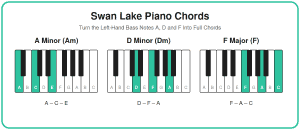
Swan Lake piano chords and left-hand notes
In Skoove’s arrangement, your left hand doesn’t play full chords. It plays single bass notes, two per bar, which keeps it simple for beginners. These bass notes are the roots of the Swan Lake piano chords behind the melody: A for A minor (Am), D for D minor (Dm) and F for F major (F).
Left-hand notes, bar by bar
Start with finger 4 on the second A to the left of middle C. Each note lasts two beats.
| Bars | Part A | Bars | Part B |
|---|---|---|---|
| 1 | A – D | 9 | G – F |
| 2 | A – A | 10 | E – G |
| 3 | A – F | 11 | D – C |
| 4 | A – D | 12 | B – E |
Bars 5–7 and 17–23 repeat the Part A pattern, and bars 13–16 repeat Part B. In bar 8 you hold a single A, and the piece ends on a long A in bar 24. Follow the finger numbers in the sheet music for the smoothest hand position.
Want a fuller sound? Add the chords
Once the bass notes feel easy, you can turn the Part A notes into full chords: play A minor where you see A, D minor where you see D and F major where you see F.
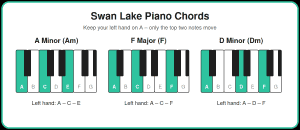
Am and Dm give Swan Lake its dark, longing sound, while F adds a brief moment of warmth. That contrast comes down to the differences between major and minor chords. Later, piano chord inversions will help you move between these chords with less hand movement.
Top tips for playing Swan Lake on piano
The notes are easy. Making them sound beautiful takes a little care, and these tips will help.
Listen before you play
Watch the video lesson or a recording of the ballet first. In the orchestra, this melody belongs to a solo oboe, so aim for a sound that’s smooth, gentle and a little sad.
Make the melody sing
Follow the curved slur lines in the sheet music and join those notes with no gaps, as if you were singing. Keep your fingers close to the keys and release each note only as the next one starts.
Count the long–short rhythms
Bars 2, 3, 10 and 11 use dotted rhythms: a long note followed by a short one. Clap them first while saying “loooong-short.” Counting dotted notes in music accurately keeps the melody’s gentle sway.
Plan the hand move in bars 3 and 4
Bar 3 is where your right hand moves: the finger numbers bring your thumb down to F. The short rest in bar 4 gives you time to move back up. Practise these two bars on their own until the move feels easy.
Let Part B grow
Part B climbs step by step to the high B in bar 12, the highest note in the piece. Let the sound grow a little as you climb, then relax as the melody falls back to A. This gradual swell is a crescendo, one of the most useful dynamic markings in music.
Keep the left hand soft
The bass notes are the background, like the cellos in the orchestra. Play them gently so the right-hand melody always sits on top.
Go hands separately, then slowly together
Learn each hand on its own first, starting with Part A. Then play hands together at around 60 beats per minute with a metronome, like the one in the Skoove app, and speed up gradually once you can play it twice without mistakes.
Interesting facts about Swan Lake
- Swan Lake was Tchaikovsky’s first ballet. The Bolshoi Theatre commissioned it in 1875, and he finished the score in about a year.
- The 1877 Moscow premiere was a disappointment. Critics disliked the choreography and staging, and some thought the music too complex for ballet.
- It became a classic only after the 1895 revival in St Petersburg, choreographed by Marius Petipa and Lev Ivanov, two years after Tchaikovsky’s death.
- The Swan theme returns throughout the ballet as Odette’s musical signature. Hearing it again and again is one reason it’s so easy to remember.
- One ballerina usually dances both Odette, the white swan, and Odile, the black swan. Odile’s 32 fouetté turns in Act III are among the most famous challenges in ballet.
Swan Lake proves that a famous classical piece doesn’t have to be hard. Download the Swan Lake piano sheet music, keep the number notes nearby and learn it one part at a time. With a melody that repeats, a simple bass line and only white keys, you’ll soon be playing a tune almost everyone recognises.
Ready for more? Start with the top Tchaikovsky compositions you need to know, or try another famous orchestral tune. In the Hall of the Mountain King piano sheet music builds from a quiet start to a thrilling finish, and The Sorcerer’s Apprentice piano notes are also in A minor and full of playful energy. For something gentle, this Ode to Joy piano tutorial is a perfect next step. You’ll find plenty more ideas among these famous classical piano songs to learn at every level.
FAQ
Author of this blog post:
Susana Pérez Posada

Susana Pérez Posada, Master in Music Therapy, Skoove Piano Educator With over seven years in piano education and a deep passion for music therapy, Susana brings a unique blend of expertise to Skoove. A graduate in Music Therapy from SRH Hochschule Heidelberg and an experienced classical pianist from Universidad EAFIT, she infuses her teaching with a holistic approach that transcends traditional piano lessons. In her writings for Skoove, Susana combines her rich musical knowledge with engaging storytelling, enriching the learning experience for pianists of all levels. Away from the piano, she loves exploring new places and immersing herself in a good book, believing these diverse experiences enhance her creative teaching style.
Published by Lydia Ogn from the Skoove team