


Bass clef is a musical symbol that shows where lower pitches appear on a musical staff. Learning bass clef is a vital component of learning to read sheet music. Have you ever noticed that piano music is split into two separate lines? These two staves show the treble clef and bass clef. These clefs on the grand staff usually dictate which notes to play in which hands.
If you feel like your left hand notes on piano are lagging behind, then don’t worry Skoove is here to help you learn. This article will break down the key elements of the bass clef, how to read it with handy tips, mnemonics and practice advice. Let’s get stuck in!
Key takeaways
What it is: The bass clef (F clef) marks lower-pitched notes on the staff, mostly the piano’s left hand.
Anchor note: Its two dots surround the F line below middle C, which is why it’s called the F clef.
Line notes: G-B-D-F-A → Good Burritos Don’t Fall Apart
Space notes: A-C-E-G → All Cows Eat Grass
Beyond the staff: Ledger lines extend the range up or down, following the same alphabetical sequence as the staff.
The bigger picture: Bass clef pairs with treble clef on the grand staff, with middle C as the shared reference point between them.
What is the bass clef?
The bass clef is the most common way to notate pitches below middle C and mostly used for the piano’s left hand. Learning the bass clef on piano is very important as it shows what the left hand plays. The bass clef is an F clef, its two dots enclose the F line on the staff. Here is what the bass clef symbol looks like:

| Also called | F clef |
| Used for | Low-pitched music and instruments |
| Which hand | Left hand on piano (most of the time) |
| Anchor note | F below middle C (the two dots surround the F line) |
How Is the Bass Clef Written?
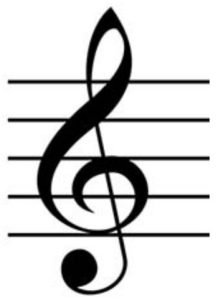
Bass clef is written like a revered C with a loop on the top left. The two dots on the right of the symbol surround the F line on the staff. This is why the bass clef is referred to as an F clef.

How to read bass clef on the staff?
The bass clef staff consists of five lines and four spaces, each representing specific notes. Notice on this bass clef notes chart how all the notes are in alphabetical order, just like treble clef.

Here are a few helpful tips to help you remember all these notes on the bass clef.
Bass clef lines
The five lines represent:
G – B – D – F – A

A helpful bass clef mnemonic to remember the lines of a bass clef is Good Burritos Don’t Fall Apart.
Bass clef spaces
The four spaces represent:
A – C – E – G

A helpful mnemonic to remember the spaces on a bass clef is All Cows Eat Grass.
Bass clef notes chart
Here’s a bass clef notes chart to help you quickly identify all bass clef notes on piano:
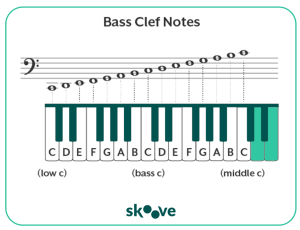
With this basic understanding, you’re well on your way to reading and playing bass clef notes on piano. Practice often and soon you’ll recognize them instantly.
Bass clef ledger lines
When playing piano you will encounter notes that go below and above the bass clef staff. Ledger lines are small horizontal lines added above or below the staff to extend its range. Here are some common bass clef notes above and below the staff:
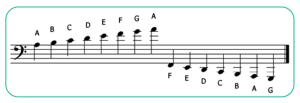
The further below the staff a note is, the lower it sounds and the further above the staff the higher the pitch. Reading ledger lines requires practice but recognizing patterns will make it easier over time. For both high and low ledger lines, it helps to recognize intervals between notes instead of reading each note individually.
Bass vs. Treble and other clefs
The quickest way to get happy reading treble and bass clefs is to be familiar with their landmark notes and the position of middle C. To help you with this use this handy table form Skoove which also covers bass, treble, alto and tenor clef.
 |
Treble clef | The treble clef is a G clef that marks where G is on the staff. |
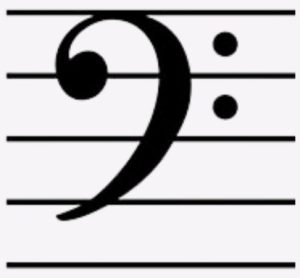 |
Bass clef | The bass clef is an F clef. The two dots mark the F note below middle C. The bass clef is mainly used for lower instruments like bass guitar, cello and left-hand piano parts. |
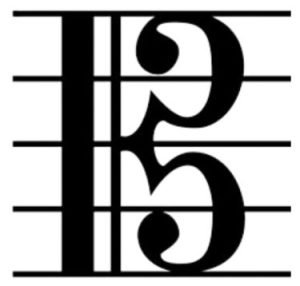 |
Alto clef | The alto clef places C on the middle line; it is used mainly for viola and trombone parts. |
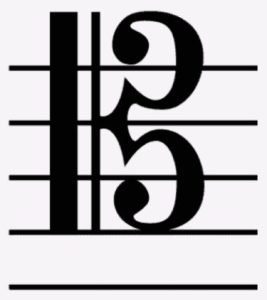 |
Tenor clef | The tenor clef places C one line higher and is used for cello, bassoon and trombone music. |
On the grand staff, the combination of treble and bass clef, middle C sits as the reference point between the two clefs.

Bass Clef Key Signatures
Bass clef key signatures use the same sharps and flats as treble clef. However, their positions on the staff are shifted because the bass clef lines and spaces represent different notes. For example, F major has one flat (B♭) and G major has one sharp (F♯), but you’ll see those accidentals placed on different staff lines than you would in treble clef.


How to practice bass clef on piano?
Now you’re familiar with bass clef and how it works it’s time to learn how to practice the bass clef and incorporate all you’ve learned in this article with these top practice tips.
- Practice daily – Sight-reading improves recognition.
- Use mnemonics – Helpful memory devices reinforce the bass clef lines and spaces.
- Slow and steady – Accuracy before speed, make good eyes to piano connections.
- Recognize intervals – Spot note and interval relationships instead of reading one by one.
- Try bass clef exercises – Practice these note patterns hands-on with Skoove’s bass clef exercises
Make sure you put this new approach into practice by taking your best piano posture and playing through all the songs in the Piano Beginner 1 course. Intermediates should check out all the great songs from the Intermediate song courses as well.
Continue grooving with the bass clef and Skoove
Now you’ve got to grips with the basics of the bass clef you have opened up a whole world of piano music for yourself. The information in this article is a vital first step to piano mastery. With practice and help from Skooves courses and our great library of songs you will be comfortable reading bass clef in no time. Happy Practicing!
Explore all types of clefs
Author of this blog post:
Matthew Dickman

With over a decade of experience in music education Matthew holds a BA in Music from Paul McCartney’s LIPA and an MA in Composition from the University of Salford. Mathew has developed a distinctive compositional voice and approach to music theory education through his research and work in the music industry. Matthew’s writing for Skoove combines experience from orchestral and media composition, and as a gigging jazz musician, to create a wholistic and accessible pedagogy for musicians of any level. Away from music, he enjoys reading and exploring nature to expand his horizons and knowledge contributing to his holistic teaching style.