


Treble clef notes are one the first things you’ll need to understand if you want to read piano sheet music. If you feel your right-hand notes aren’t as confident as you’d like, don’t worry Skoove is here to help you build a solid understanding of the treble clef.
In this article, we’ll break down the essentials of the treble clef. We will cover how to read it and share handy tips, mnemonics and practice strategies to help you feel comfortable and fluent on the upper staff. Let’s get started.
Key takeaways
What it is: The treble clef (G-clef) marks the higher-pitched notes on the staff, the right hand on piano.
Line notes: E-G-B-D-F → Every Good Boy Does Fine
Space notes: F-A-C-E → spells FACE
Beyond the staff: Ledger lines extend the range up or down, following the same alphabetical pattern.
The bigger picture: Treble clef pairs with bass clef to form the grand staff, covering both hands on piano.
What is the treble clef?
The treble clef is a musical symbol placed at the beginning of a staff to notate pitches above and around middle C on the piano. Also known as the G-clef, it is used for higher-pitched instruments like violins, flutes and the right hand of the piano

The treble clef staff: Lines and paces
Want to know how to read treble clef piano notes? You will first need to understand the staff. The staff is the set of five horizontal lines that help us read pitches in sheet music. Musical notes are placed on these lines and the spaces.
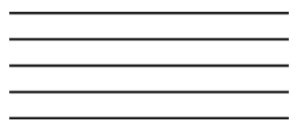
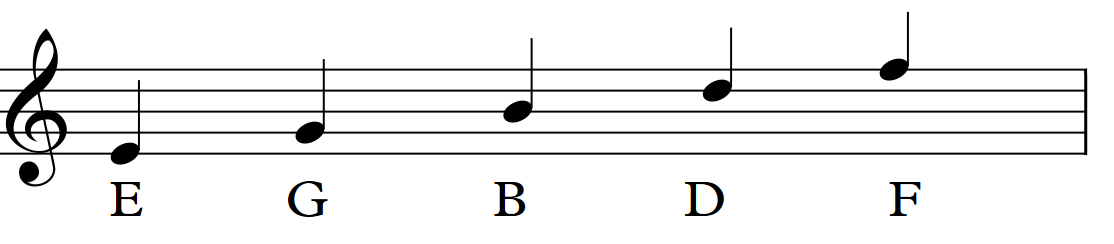
The placement of these notes shows us what pitches to press and how to play piano music. When you place a treble clef on the staff, each line and space then has a specific note name assigned to it. The line notes are E, G, B, D and F. The space notes are F, A, C and E. Let’s take a look at some easy ways to remember this.
How to remember treble clef notes
There are a few different techniques for learning how to read piano notes on treble clef. The easiest way to memorize notes of the treble clef lines and spaces is by using mnemonic devices like these:
Treble clef lines
The notes on the lines can be remembered with a mnemonic like
- Every Good Boy Does Fine
Treble clef spaces
Each space represents a pitch and from bottom to top the spaces spell F-A-C-E. This can be remembered with the rhyme “FACE in the space”.

These mnemonics make treble clef piano notes easy to remember. Let’s take a look at how all the notes fit together on the staff.

Each step up or down on the staff moves alphabetically by one letter. For example, going up from the second line, G, to the next space gives us an A, then up to the next line is B and so on. These are some handy methods to understand the treble clef note names on the staff rather than just trying to memorize them when reading piano music. Try out your newfound knowledge on one of Skoove’s beginner friendly piano lessons.
Ledger lines in the treble clef
Ledger lines are short horizontal lines added above or below a musical staff which extend its range. This allows us to read and write notes that fall outside the five main lines of the staff.
Each ledger line follows the same spacing and letter sequence as the staff, moving sequentially by step. To read notes above the staff in treble clef, start from the top line, then continue in order: the first ledger line represents A, the space above it is B and the second ledger line is C. Ledger line notes keep going upward as notes extend as you can see in this example.

As you can see, below the staff, ledger lines descend through G, F, E etc. As with upper ledger lines this allows musicians to read lower notes without changing clefs.
Treble clef, bass and other clefs
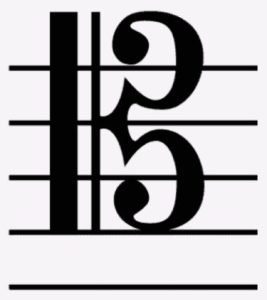
The most common clefs are the treble and bass clefs, but these aren’t the only clefs in music. These different clefs outline the position of different notes on the staff, with treble clef used for higher pitched instruments and bass clef used for lower ranges. Different instruments and situations call for the use of other clefs to make music easier to read. In piano music, the grand staff combines treble and bass working together. There are other clefs used for different situations; these C clefs are known as alto clef and tenor clef.
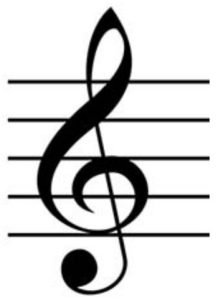 |
Treble clef | The treble clef is a G clef that marks where G is on the staff. |
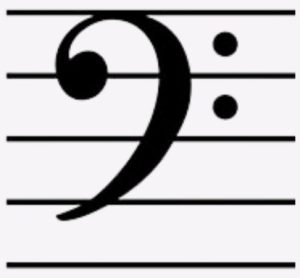 |
Bass clef | The bass clef is an F clef. The two dots mark the F note below middle C. The bass clef is mainly used for lower instruments like bass guitar, cello and left-hand piano parts. |
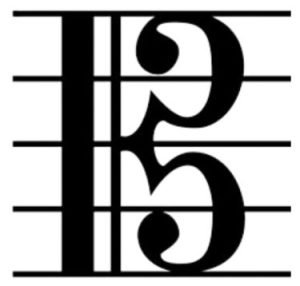 |
Alto clef | The alto clef places C on the middle line; it is used mainly for viola and trombone parts. |
 |
Tenor clef | The tenor clef places C one line higher and is used for cello, bassoon and trombone music. |
How to practice reading treble clef notes?
Now you’re familiar with how to read the treble clef it’s time to learn how to practice the treble clef and incorporate all you’ve learned in this article with these top practice tips.
- Practice daily – Sight-reading improves recognition.
- Use mnemonics – Helpful memory devices reinforce the treble clef lines and spaces.
- Slow and steady – Accuracy before speed, make good eyes to piano connections.
- Recognize intervals – Spot note and interval relationships instead of reading one by one.
- Try treble clef exercises – Strengthen your right hand with targeted drills.
Make sure you put this new approach into practice by taking your best piano posture and playing through all the songs in the Piano Beginner 1 course. Intermediates should check out all the great songs from the Intermediate song courses as well!
How to draw a treble clef
If you ever need to write your own sheet music, knowing how to draw a treble clef is a vital skill.
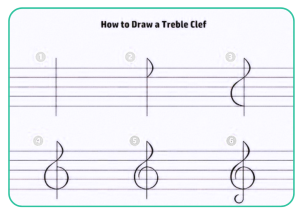
- Start by drawing a vertical line that extends slightly above and below all 5 lines of the staff.
- Add a semi-circle from the top of the line to the 4th line of the staff on the right, like a big P.
- Then continue this line by drawing a semi-circle to the left lower third of the vertical line, connecting the 4th line to the bottom line on the left.
- Continue the curve to start a spiral shape around the 2nd line of the staff, this shows the G position.
- Complete the spiral around the G line.
- Add a small left curving tail or swoop to the left at the bottom of the vertical line.
Keep practicing treble clef with Skoove
Well done, you now know all the treble clef notes on a stave and are prepared with new knowledge and a few mnemonic tools to decipher the puzzle. That’s a big first step into the world of reading music. Let’s put our new found skills to work with a little practice Skoove . We have everything you need to improve your treble clef skills with lessons and all your favorite piano songs. Keep up the good work and happy playing!
Explore all types of clefs
Author of this blog post
Vicki Young

Vicki Young is a pianist and singer with a degree in Music from the University of Sheffield. She lives in London, UK with her husband and son. Vicki is a communications and marketing freelancer who has worked with a range of organizations across the music and charity sectors.
Published by the Skoove team