
The D minor scale is one of the friendliest minor scales to learn. It has seven notes, only one black key, and a warm, slightly sad sound you will recognise from many well-known pieces. If you are an adult starting piano, it is a good first minor scale because your hands can stay in a comfortable shape the whole way up.
This guide shows you the notes, exactly which fingers to use in each hand, and how the natural, harmonic and melodic versions differ. You will also find a simple 10-minute practice routine you can fit into a busy day.
What is the D minor scale?
The D minor scale is a series of seven notes that starts and ends on D and follows a minor pattern of whole and half steps. A step is the distance from one key to the very next key, black or white. A whole step skips one key. A half step moves to the neighbouring key with nothing in between. If scales are new to you, it helps to understand how piano scales are built before you go on.
The pattern for the natural minor scale is whole, half, whole, whole, half, whole, whole. That pattern is what gives minor scales their darker colour compared with major scales.
D minor scale notes
The notes of the D natural minor scale are D, E, F, G, A, B♭ and C, then D again an octave higher.
On the keyboard, six of these notes are white keys. The only black key is B♭, which sits between A and B. To find the starting note, look for the group of two black keys and play the white key between them. That key is D.
How to play the D minor scale on piano
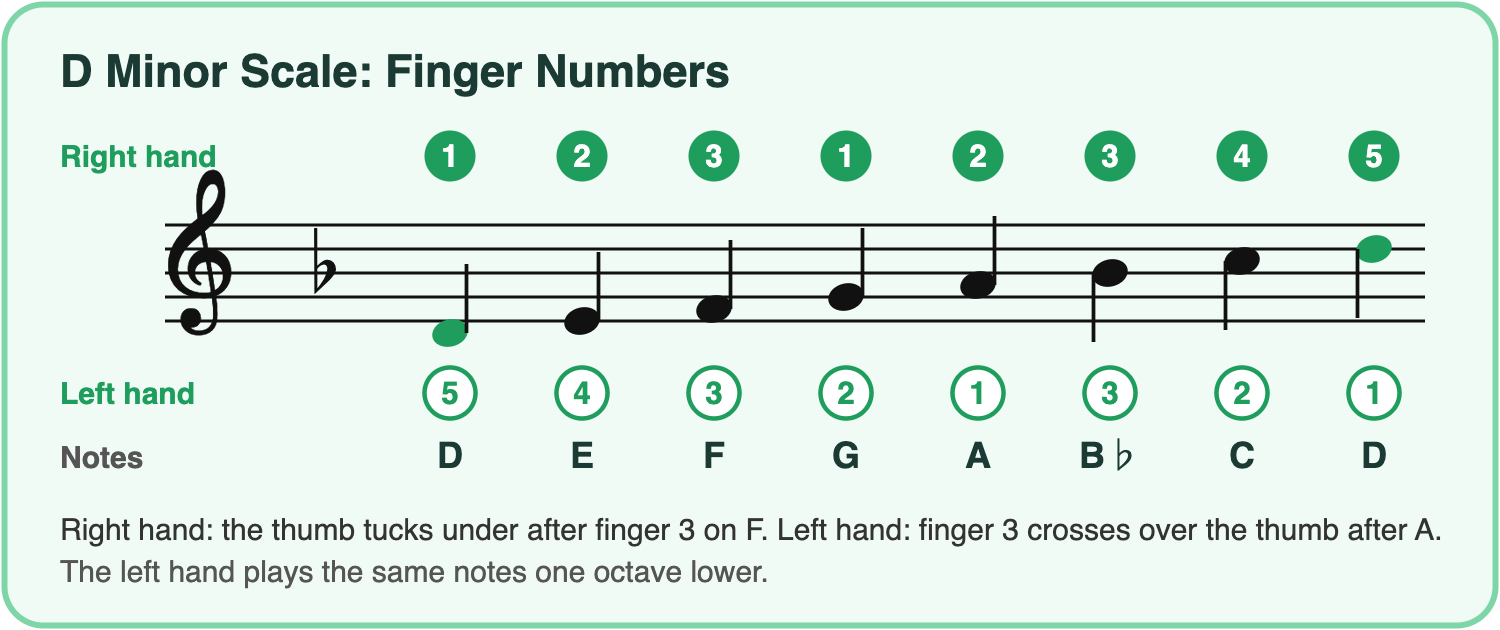
Use these finger numbers, where 1 is the thumb and 5 is the little finger.
Right hand, going up: 1 2 3 1 2 3 4 5, so D with your thumb, E with 2, F with 3, then tuck the thumb under to G, then A with 2, B♭ with 3, C with 4 and D with 5.
Left hand, going up: 5 4 3 2 1 3 2 1, so D with your little finger, E with 4, F with 3, G with 2, A with your thumb, then cross 3 over the thumb to B♭, C with 2 and D with your thumb.
Coming down, use the same fingers in reverse order.
Three tips make this easier:
- Play B♭ with your third finger in both hands. Your middle finger is the longest, so it reaches the black key comfortably.
- Keep your wrist level and your thumb relaxed while it passes under or over. Avoid twisting your hand.
- Start with each hand alone and slowly. Add both hands together only when each hand feels automatic.
Natural, harmonic and melodic D minor: what changes
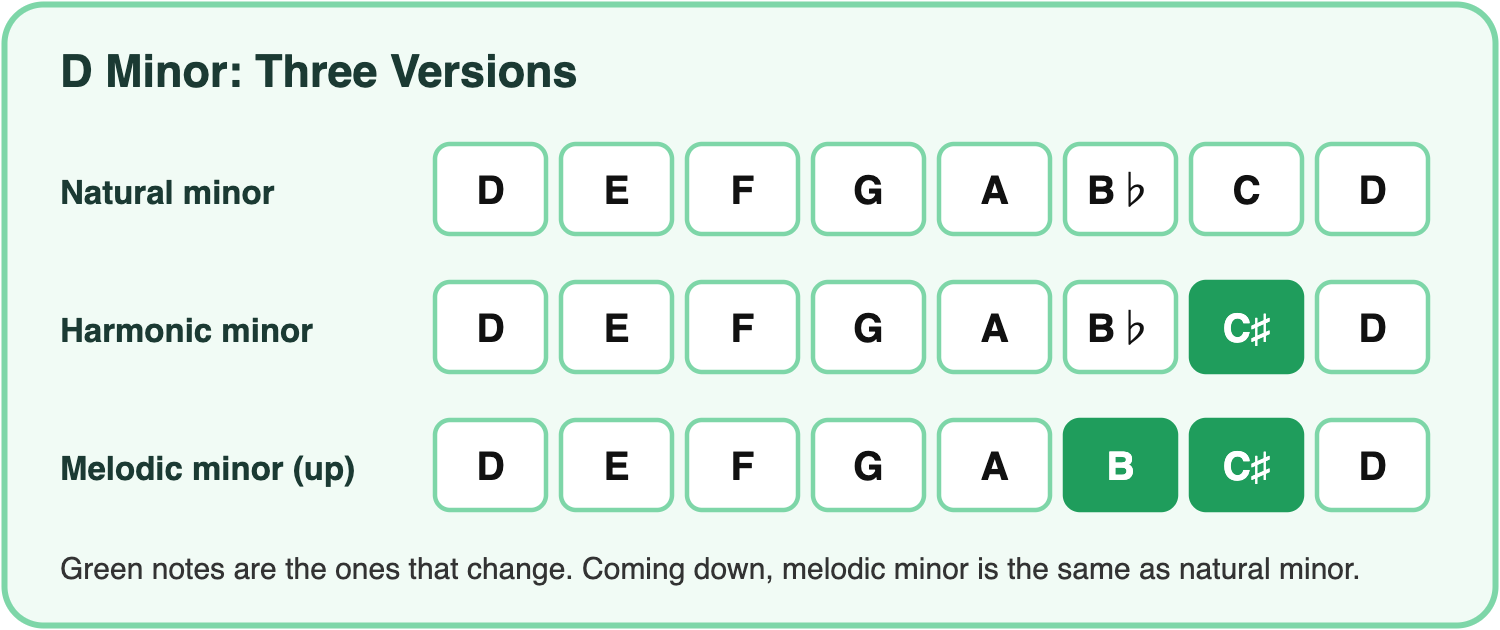
There are three versions of every minor scale. They share the same starting note and most of the same notes, and they differ in one or two places. Your fingering stays the same for all three.
Natural minor is the version you learned above: D, E, F, G, A, B♭, C. It is the simplest and the one most beginners start with.
Harmonic minor raises the seventh note by one half step, so C becomes C♯. The notes are D, E, F, G, A, B♭, C♯, D. The big jump from B♭ to C♯ gives it a dramatic, slightly Eastern sound. Read more about how the harmonic minor scale works once the natural version feels easy.
Melodic minor raises both the sixth and seventh notes on the way up, so B♭ becomes B and C becomes C♯. The notes going up are D, E, F, G, A, B, C♯, D. Coming down, you play the natural minor again. This smooths out the melody, and you can see how the melodic minor scale is used in the dedicated guide.
Start with natural minor. Once your hands know it, play the harmonic and melodic versions by changing just the one or two notes that move.
D minor key signature: one flat
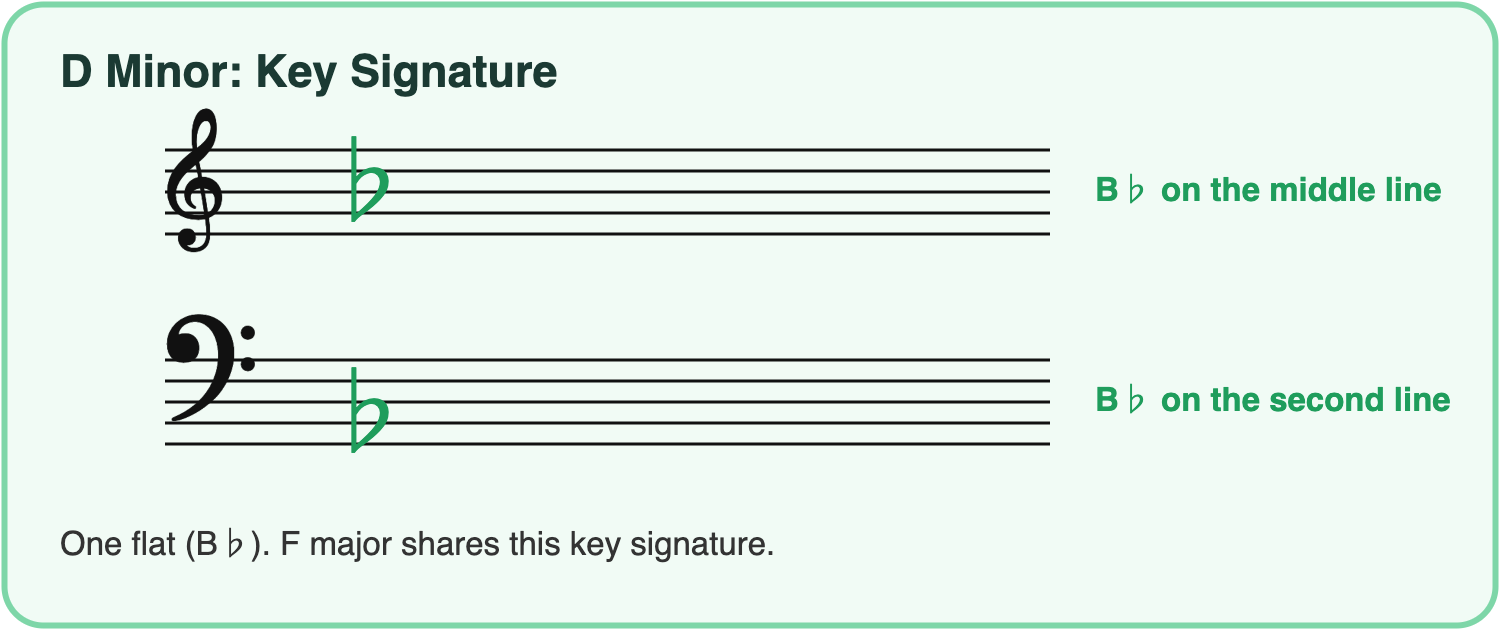
The key signature of D minor has one flat, B♭. It means every B in the piece is played as B♭ unless you see a natural sign. On the staff, the flat sits on the middle line of the treble clef and on the second line from the bottom of the bass clef.
A useful habit is to say the note out loud as you play it: “D, E, F, G, A, B-flat, C, D.” Saying B♭ every time trains your eyes and hands to expect the black key.
The relative major of D minor: F major
Every minor key shares its key signature with a major key, called its relative major. For D minor, that is F major. Both use one flat, B♭, and they use exactly the same seven notes. Only the starting note and the home sound change. You can learn more about relative major and minor scales and how to find them for any key.
The parallel major, which starts on the same note, is D major. It has two sharps instead of one flat, so it sounds brighter even though it also starts on D.
When you are ready to play chords in this key, the D minor chord page shows the notes, fingering and inversions.
D minor pentatonic scale
The D minor pentatonic scale has five notes: D, F, G, A and C. It leaves out E and B♭, which makes it easy to play and a good starting point for improvising. Play it with the same hand position as the full scale and skip the two missing notes.
How to practice the D minor scale in 10 minutes a day
Short, regular sessions work better for adults than one long session a week. Try this routine:
- Minutes 1 to 2: Play the right hand alone, up and down, at a slow, even speed. Say the note names out loud.
- Minutes 3 to 4: Do the same with the left hand.
- Minutes 5 to 7: Play both hands together, one octave, very slowly. Stop and repeat the thumb-crossing spots if they feel uneven.
- Minutes 8 to 9: Play the harmonic version, then the melodic version, changing only the notes that move.
- Minute 10: Play the natural scale once more, a little more smoothly, and stop on a good repetition.
Use a metronome at a speed where you can play every note evenly, and only speed up when five repetitions in a row are clean.
Once D minor feels comfortable, the A minor scale is a natural next step, because it uses white keys only.
Ready to play the D minor scale?
You now know the notes, the one flat, the fingering and the three versions of the D minor scale. The next step is to hear and feel it under your hands, with feedback on every note.
With interactive piano lessons, you can practise scales and pieces at your own pace and get instant feedback as you play.
Frequently asked questions
Author of this blog post:
Susana Pérez Posada

Susana Pérez Posada, Master in Music Therapy, Skoove Piano Educator With over seven years in piano education and a deep passion for music therapy, Susana brings a unique blend of expertise to Skoove. A graduate in Music Therapy from SRH Hochschule Heidelberg and an experienced classical pianist from Universidad EAFIT, she infuses her teaching with a holistic approach that transcends traditional piano lessons. In her writings for Skoove, Susana combines her rich musical knowledge with engaging storytelling, enriching the learning experience for pianists of all levels. Away from the piano, she loves exploring new places and immersing herself in a good book, believing these diverse experiences enhance her creative teaching style.