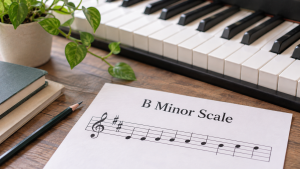
The A minor scale is a seven-note scale that starts and ends on A and uses the notes A, B, C, D, E, F and G. It has no sharps and no flats, so you only play white keys on the piano. That makes A minor the easiest minor scale to learn and a great first step into minor keys.
A minor sounds soft, serious and a little sad, which is why it turns up in classical pieces, pop ballads and film music alike. It is also the relative minor of C major, so the two keys use exactly the same seven notes.
In this guide you will learn the notes of the A minor scale, how it is built, its key signature in treble and bass clef, the natural, harmonic and melodic forms, the chords it creates, and the fingering for each hand, hands together and over two octaves.
A minor scale notes
The notes of the A minor scale are A, B, C, D, E, F, G and A again an octave higher. All seven are white keys, so there are no black keys to remember.
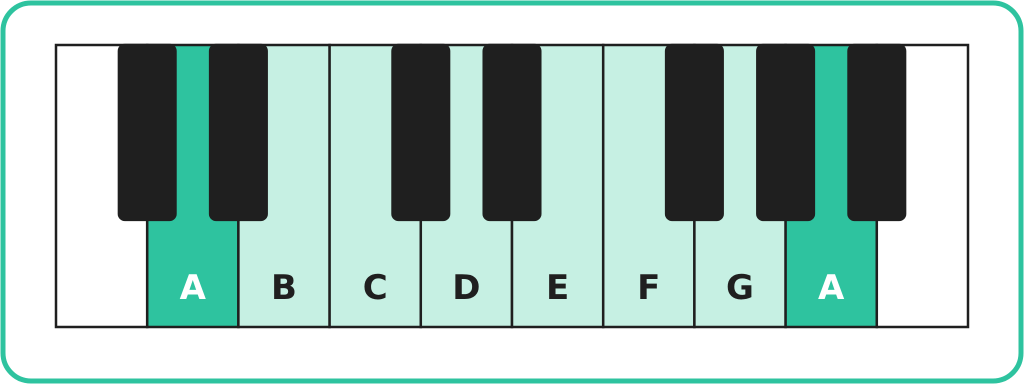
To find the scale on the keyboard, start on A, the white key between the second and third black keys of the group of three. From there, play every white key up to the next A. This is the A natural minor scale, the form most people mean when they say “the A minor scale”, “the Am scale” or “the A minor piano scale”. The harmonic and melodic forms are covered a little further down.
How the A minor scale is built
Every natural minor scale follows the same formula of whole steps (W) and half steps (H): W – H – W – W – H – W – W. A half step is the very next key, black or white. A whole step skips one key. These two step sizes are the building blocks behind all piano scales for beginners, so once you know the formula you can build a minor scale from any note.
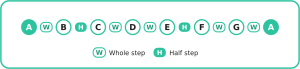
Start on A and apply the formula: a whole step takes you to B, then a half step to C. From C, two whole steps give you D and E, a half step brings you to F, and two more whole steps take you through G and back to A. The two half steps, B to C and E to F, fall between neighboring white keys, which is why A minor needs no black keys at all.
A minor scale degrees and intervals
Each note of the scale has a number and a name, called its scale degree. Knowing the scale degrees in music helps you talk about chords and melodies in any key. The interval column shows the distance from A to each note.
| Degree | Note | Degree name | Interval from A |
|---|---|---|---|
| 1 | A | Tonic | Unison |
| 2 | B | Supertonic | Major 2nd |
| 3 | C | Mediant | Minor 3rd |
| 4 | D | Subdominant | Perfect 4th |
| 5 | E | Dominant | Perfect 5th |
| 6 | F | Submediant | Minor 6th |
| 7 | G | Subtonic | Minor 7th |
| 8 | A | Tonic (octave) | Perfect octave |
The minor 3rd, 6th and 7th are what give minor scales their darker sound compared with major ones. Playing each of these piano intervals from A, one at a time, is a simple way to train your ear to hear what makes a scale sound minor.
A minor key signature: No sharps or flats
The A minor key signature has no sharps and no flats, so the staff is left empty at the start of a piece. It is the same key signature as C major, which makes the two keys easy to mix up. To tell them apart, check which note feels like home: a piece in A minor usually ends on A or on an A minor chord, and you will often spot G♯ accidentals along the way. Once key signatures make sense, you can name the key of a piece at a glance.
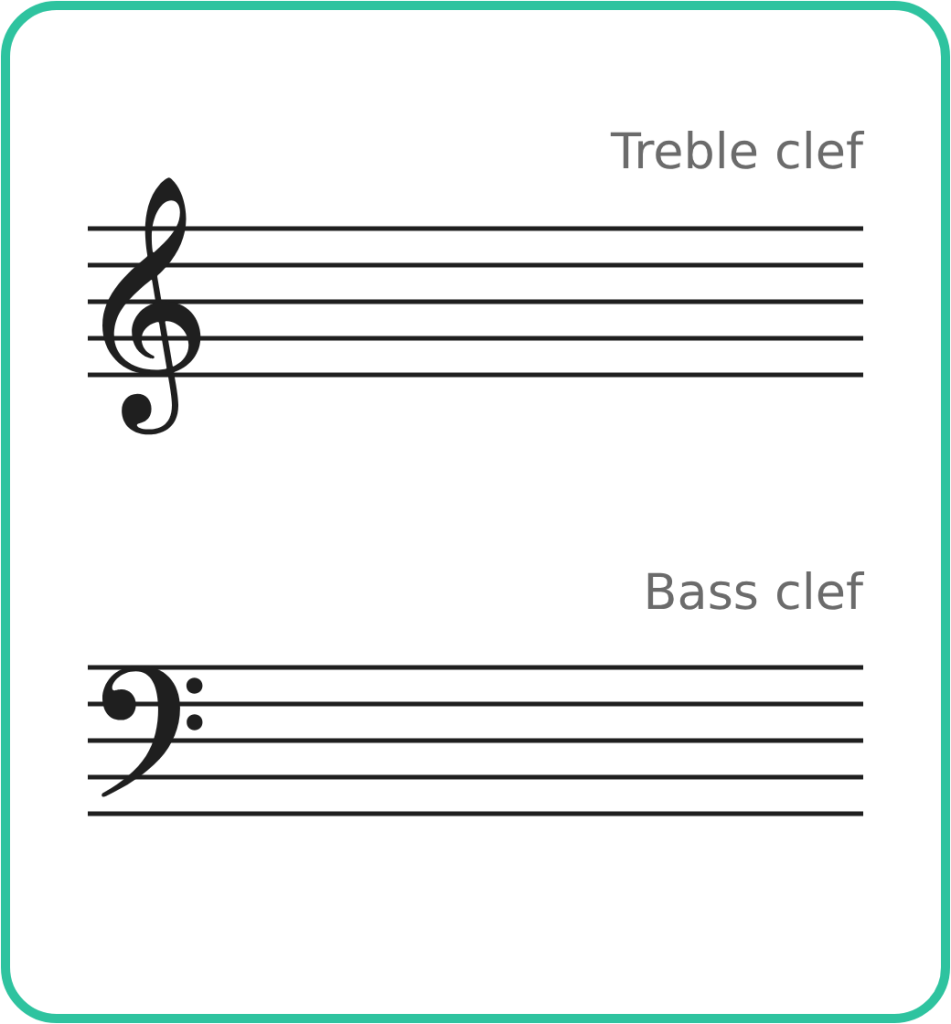
Two quick ways to recognize A minor: it starts on the 6th note of the C major scale, and on the circle of fifths it sits at the top, paired with C major.
A minor scale in treble clef
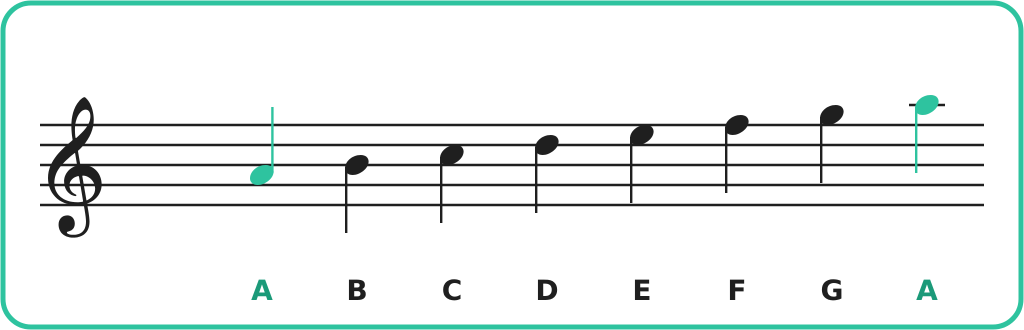
In treble clef, the A minor scale starts on A in the second space, the A just above middle C, and climbs to A on the first ledger line above the staff. No sharps or flats are written, because the scale uses only natural notes. If reading the lines and spaces still takes a moment, a quick review of treble clef notes makes this scale much easier to follow.
A minor scale in bass clef
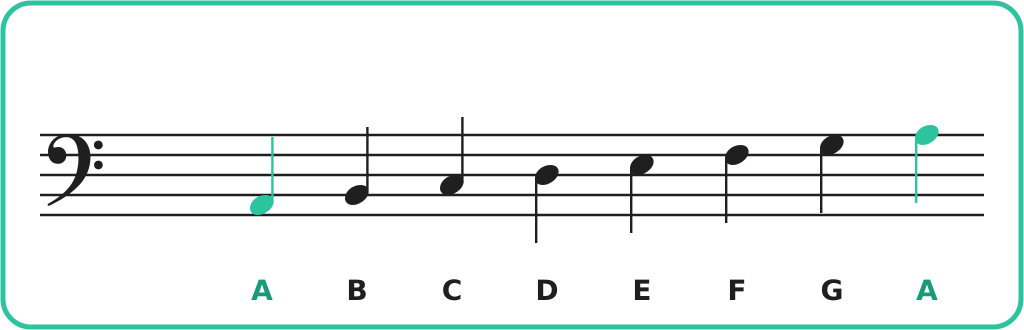
In bass clef, a comfortable left-hand A minor scale starts on A in the bottom space and finishes on A on the top line, the A just below middle C. Every note stays inside the staff, so you will not need a single ledger line. Scales like this one are a great way to get fluent with bass clef notes on piano, because every note appears in order.
A minor scale: Natural, harmonic and melodic
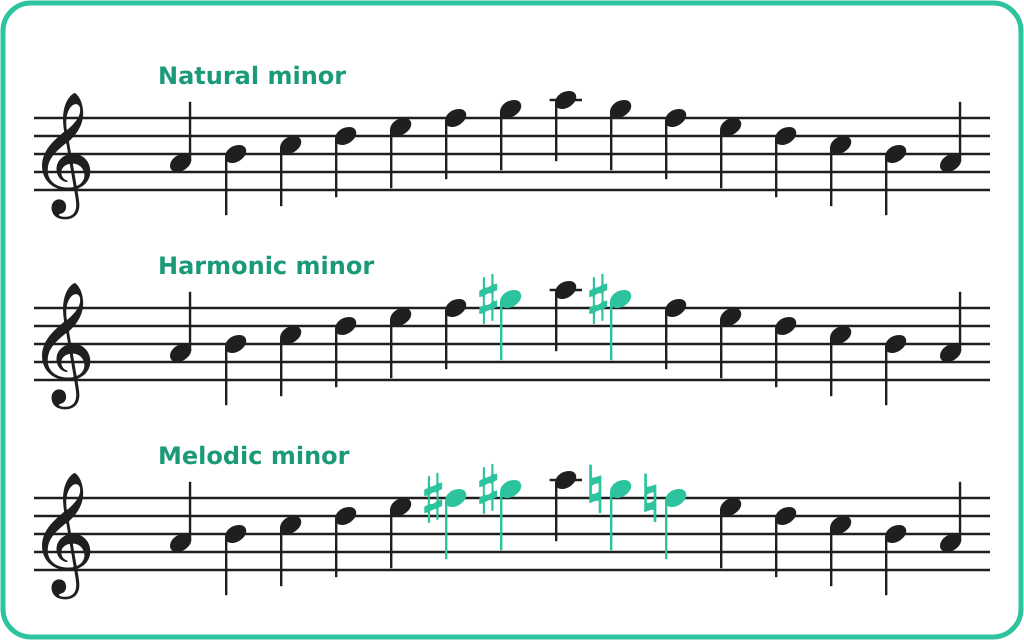
Minor scales come in three forms. All three share the same first five notes, A, B, C, D and E. They differ only in the 6th and 7th notes, which is where the harmonic and melodic forms get their distinctive sounds.
A natural minor scale
The A natural minor scale is the one you have seen so far: A, B, C, D, E, F, G, A. It uses only white keys, so no accidentals are needed. It is the same going up and going down, and it is the form the chords and fingering below are based on.
A harmonic minor scale
The A harmonic minor scale raises the 7th note by a half step: A, B, C, D, E, F, G♯, A. The G♯ sits a half step below the top A, so it pulls strongly toward the home note. The jump from F to G♯ is three half steps, larger than any other step in the scale, which gives it a dramatic, slightly exotic sound. You can explore this sound in more depth in our guide to the harmonic minor scale. The fingering stays the same as for the natural form, with G♯ played by finger 4 in the right hand and finger 2 in the left. On the keyboard, G♯ is the only black key you need.
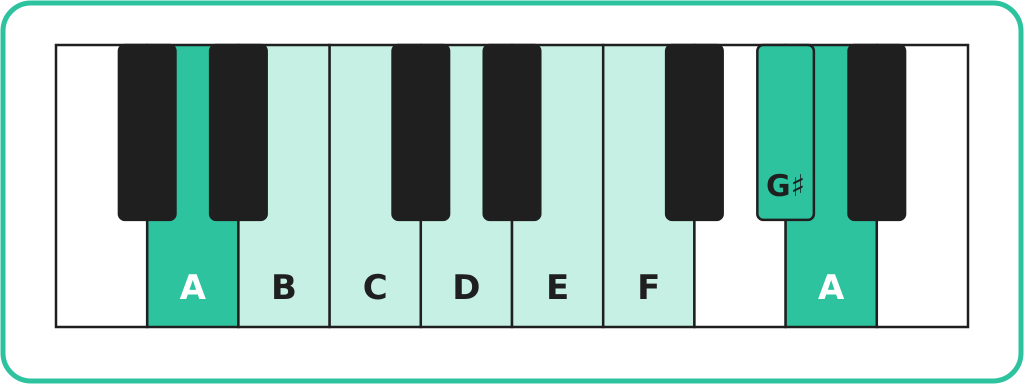
A melodic minor scale
The A melodic minor scale smooths out that large jump. Going up, it raises both the 6th and 7th notes: A, B, C, D, E, F♯, G♯, A. Coming down, it returns to the natural minor: A, G, F, E, D, C, B, A. If you want to hear why this form is so singable, the melodic minor scale is worth a closer look.
| Form | Going up | Going down | What changes |
|---|---|---|---|
| Natural | A B C D E F G A | A G F E D C B A | Nothing, no sharps or flats |
| Harmonic | A B C D E F G♯ A | A G♯ F E D C B A | 7th note raised |
| Melodic | A B C D E F♯ G♯ A | A G F E D C B A | 6th and 7th raised going up only |
Chords in the A minor scale
Stack every other note of the scale on top of each scale degree and you get the seven chords that belong to the key of A minor. They are called diatonic chords, and they are the chords most songs in A minor use. The home chord is the A minor piano chord: A, C and E.
The 7 diatonic chords in A minor
| Roman numeral | Chord | Notes | Type |
|---|---|---|---|
| i | Am | A – C – E | Minor |
| ii° | Bdim | B – D – F | Diminished |
| III | C | C – E – G | Major |
| iv | Dm | D – F – A | Minor |
| v | Em | E – G – B | Minor |
| VI | F | F – A – C | Major |
| VII | G | G – B – D | Major |
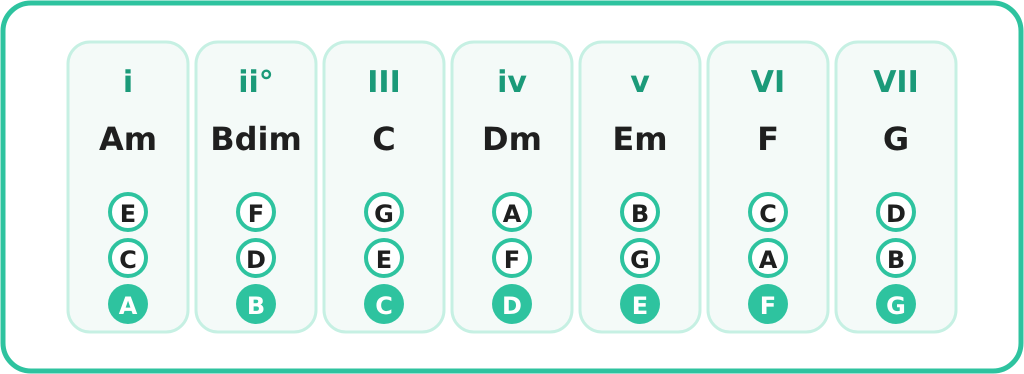
Upper-case numerals are major chords, lower-case are minor, and the small circle marks the diminished chord. The pattern is the same in every natural minor key, so once you learn it here, it transfers to all of them. Because the harmonic minor scale raises the 7th note, songs in A minor often borrow a major E chord (E – G♯ – B) in place of Em. It gives the music a stronger pull back to Am. If you want to compare how these chord types sound, our guide to the main differences between major and minor chords is a good place to start, and the diminished chord is worth a look for the B chord in this key.
Common chord progressions in A minor
A progression is a sequence of chords, and a handful of them power thousands of songs. Try these in A minor, playing the chord in your right hand and the root note in your left. Every piano chord progression in this table works the same way in any minor key, so you can move them to other scales later.
| Progression | In A minor | Where you hear it |
|---|---|---|
| i – iv – v | Am – Dm – Em | Folk, rock and moody ballads |
| i – VI – III – VII | Am – F – C – G | Pop and rock choruses |
| i – VII – VI – V | Am – G – F – E | Flamenco-style and rock descents, as in “Hit the Road Jack” |
| ii° – V – i | Bdim – E – Am | Jazz and classical minor cadences |
How to play the A minor scale on piano
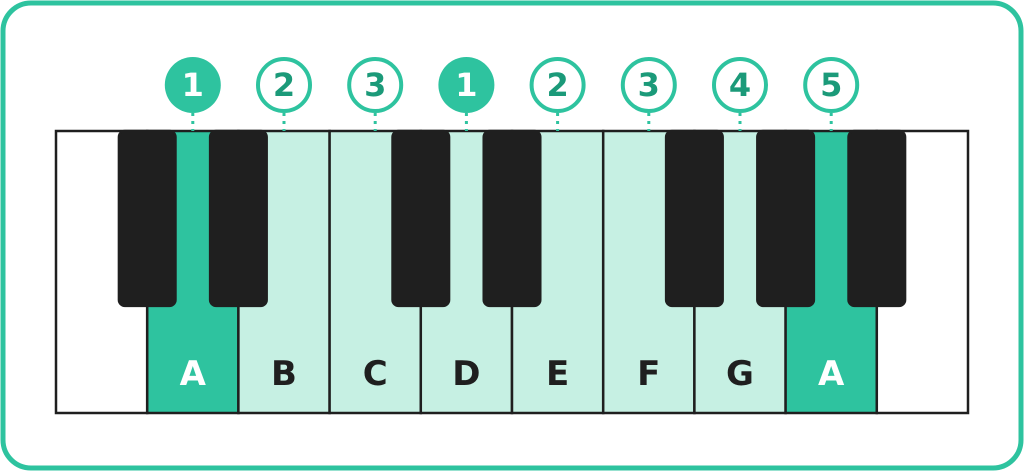
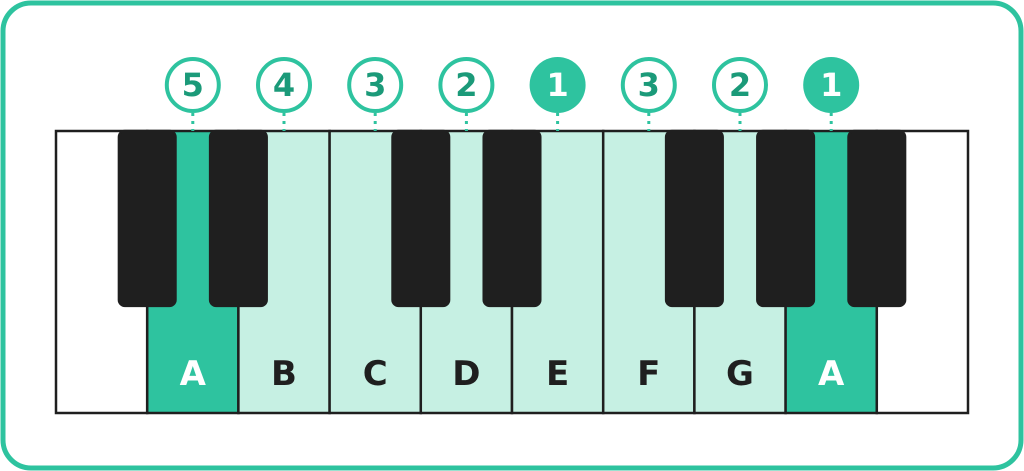
Good news if you already know the C major scale: A minor uses the same notes and the same finger numbers in both hands. Going up, the right hand plays 1 2 3 1 2 3 4 5 and the left hand plays 5 4 3 2 1 3 2 1. With no black keys to find, your hands stay relaxed and you can focus on smooth thumb crossings.
Right-hand fingering
Going up, the right hand plays 1 2 3 1 2 3 4 5. Play A, B and C with fingers 1, 2 and 3, then tuck your thumb under to land on D. Continue with E, F, G and A using fingers 2, 3, 4 and 5. Coming down, reverse it: 5 4 3 2 1, then cross finger 3 over your thumb onto C, and finish with B and A on fingers 2 and 1.
Left-hand fingering
Going up, the left hand plays 5 4 3 2 1 3 2 1. Start with your little finger on A and walk up to E with your thumb. Then cross finger 3 over your thumb onto F, and finish G and A with fingers 2 and 1. Coming down, the left hand plays 1 2 3 on A, G and F, tucks the thumb under onto E, then plays 2 3 4 5 back down to A.
Playing the A minor scale hands together
Hands together is where most beginners get stuck, because the two hands change position at different moments. The trick is to find the notes where they match. In A minor, going up, both hands play C and F with finger 3. Treat those two white keys as checkpoints: if both third fingers arrive together, everything in between is in the right place.
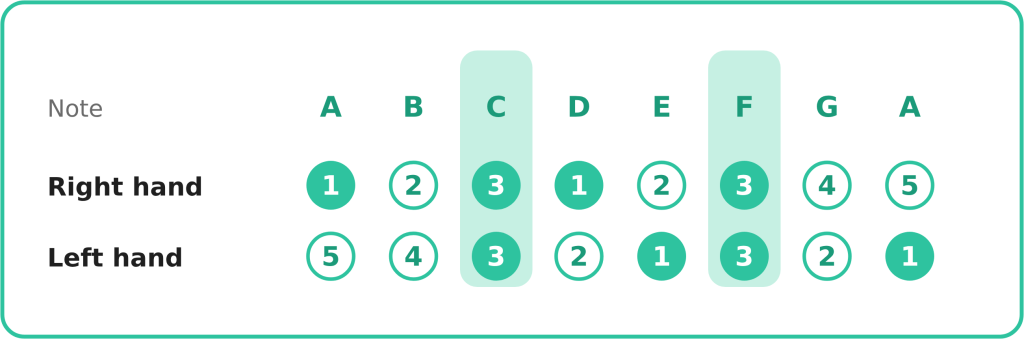
The thumbs, on the other hand, never land on the same note when you play in similar motion. The right thumb moves to D while the left hand is still on finger 2, and the left thumb reaches E while the right hand is on finger 2. Practice this slowly, saying the finger numbers out loud, until the crossings stop surprising you.
Contrary motion shortcut: start both thumbs on the same A and play outward, right hand up and left hand down. In contrary motion, both hands use the same finger on every note, 1 2 3 1 2 3 4 5, so it is the easiest way to play A minor hands together for the first time.
A minor scale in two octaves
To play two octaves, the thumb crosses one extra time in each hand. Instead of finishing with finger 5 at the top of the first octave, the right hand uses finger 4 on G and passes the thumb to the next A. The left hand plays its thumb on the middle A and continues with finger 4 on B.
| Hand | Notes (going up) | Fingering |
|---|---|---|
| Right hand | A B C D E F G A B C D E F G A | 1 2 3 1 2 3 4 1 2 3 1 2 3 4 5 |
| Left hand | A B C D E F G A B C D E F G A | 5 4 3 2 1 3 2 1 4 3 2 1 3 2 1 |
Common fingering mistakes
The most common slip is drifting to C. Because A minor and C major share the same notes, it is easy to end up playing the pattern from C without noticing, so say “A” in your head and finish firmly on the top A. Another is playing the right-hand G with finger 5 in a two-octave scale, which leaves no finger for the next note. Crossing too late is a third: if your thumb only starts moving once C is finished, you will hear a gap before D. Let the thumb travel under your hand while finger 3 is still playing. Finally, when you move on to the harmonic form, remember to play G♯ on the way down as well as on the way up.
A minor vs C major, A major and A-flat minor
Several scales sound or look close to A minor, and mixing them up is easy. C major is the relative major of A minor: it uses exactly the same seven notes and the same key signature, but starts on C (C, D, E, F, G, A, B). All relative major and minor scales pair up like this, with the minor starting on the 6th degree of the major.
A major is the parallel major: it starts on the same note but changes three of them. C, F and G become C♯, F♯ and G♯, which gives A major a brighter sound and a key signature of three sharps. Pairs like this are called parallel scales, and you can see the full A major scale on piano for comparison.
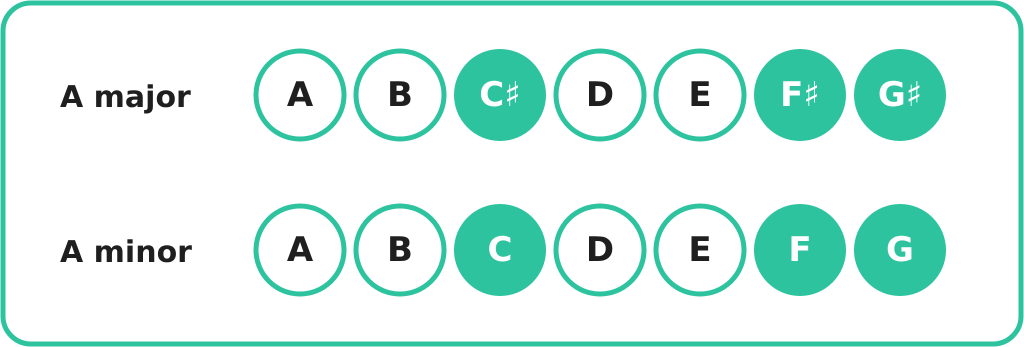
A-flat minor is a completely different key, even though the names look alike. It sits a half step lower, has seven flats instead of none, and uses the notes A♭, B♭, C♭, D♭, E♭, F♭ and G♭. In the image above, the green notes are the three that change between A major and A minor.
| Scale | Notes | Key signature |
|---|---|---|
| A minor | A B C D E F G | No sharps or flats |
| C major (relative) | C D E F G A B | No sharps or flats |
| A major (parallel) | A B C♯ D E F♯ G♯ | 3 sharps |
| A-flat minor | A♭ B♭ C♭ D♭ E♭ F♭ G♭ | 7 flats |
Other scales to play in A minor
Once the natural minor scale feels secure, these related scales give you new sounds to improvise and play melodies with, all over the same A minor chords.
A minor pentatonic scale
The A minor pentatonic scale keeps five notes of the natural minor scale and leaves out the 2nd and 6th: A, C, D, E, G. With no half steps, almost any combination of notes sounds good over A minor chords. Because it has no clashing notes, the pentatonic scale on piano is a favorite starting point for first improvisations.
A minor blues scale
The A minor blues scale adds one “blue” note, E♭, to the minor pentatonic: A, C, D, E♭, E, G. Sliding from E♭ to E gives you an instant bluesy sound. If you are new to this sound, our guide to the piano blues scale for beginners shows how to use it.
Modes of the A minor scale
A minor shares its notes with C major, so starting those seven notes on each of its steps gives you the seven modes. They all use only white keys, but each has its own character, and A minor itself is the Aeolian mode. You can read about all 7 modes in music theory to hear how each one sounds.
| Mode | Starting note | Notes |
|---|---|---|
| Aeolian (natural minor) | A | A B C D E F G |
| Locrian | B | B C D E F G A |
| Ionian (major) | C | C D E F G A B |
| Dorian | D | D E F G A B C |
| Phrygian | E | E F G A B C D |
| Lydian | F | F G A B C D E |
| Mixolydian | G | G A B C D E F |
Songs in A minor to practice
Playing music in A minor is the best way to make the scale stick, because you start recognizing its notes and chords as part of real melodies. Here are pieces you can play in A minor, in the keys used in Skoove’s arrangements, from classical favorites to pop and folk.
| Piece | Composer or artist | Style |
|---|---|---|
| “Für Elise” | Ludwig van Beethoven | Classical |
| “Swan Lake” theme | Pyotr Ilyich Tchaikovsky | Ballet |
| “Mad World” | Tears for Fears | Pop ballad |
| “Counting Stars” | OneRepublic | Pop |
| “Bella Ciao” | Traditional | Folk |
| “The Sorcerer’s Apprentice” | Paul Dukas | Classical |
If you are just getting comfortable with the scale, start with “Für Elise”: its famous opening melody moves between E and D♯, a gentle way to meet accidentals in a minor key. “Swan Lake” is written here with every note on a white key, which makes it a natural companion to the scale itself. “Mad World” and “Counting Stars” are good ways to practice the chords of the key you met above, and “The Sorcerer’s Apprentice” puts the melodic minor form to work.
How to practice the A minor scale
Short, regular practice beats long, occasional sessions. Five to ten focused minutes a day will take you further than one long session a week.
| Step | What to do | Goal |
|---|---|---|
| 1 | Right hand alone, one octave, up and down, at 60 BPM, one note per click | Smooth thumb crossing onto D |
| 2 | Left hand alone, same tempo | Smooth finger-3 crossing onto F |
| 3 | Contrary motion from the same A, both hands | Matching fingers in both hands |
| 4 | Hands together, similar motion, slowly | Both 3rd fingers on C and F together |
| 5 | Two notes per click, then two octaves | Even tone at a faster tempo |
| 6 | Raise G to G♯, then play the harmonic form | Hear how the 7th note pulls toward A |
| 7 | Play the A minor chord and its arpeggio | Connect the scale to the chords of the key |
Playing arpeggios on piano means spreading a chord’s notes into a flowing pattern, which makes a natural next step once the scale feels comfortable.
Seven white keys, endless melodies
The A minor scale is proof that a minor key does not have to be complicated. You get seven white keys, a fingering pattern you may already know from C major, and a home base for everything from Beethoven to pop ballads built on Am, F, C and G. Along the way you have also met the harmonic and melodic forms, the chords of the key, and the checkpoints that make hands together feel easy.
Your next step is simple: play the scale hands separately every day, link the hands with the finger-3 checkpoints on C and F, and then bring it to life with a song in A minor. If you would like step-by-step guidance and instant feedback as you play, Skoove’s interactive piano lessons take you from scales to full songs at your own pace.
Author of this blog post:
Susana Pérez Posada

Susana Pérez Posada, Master in Music Therapy, Skoove Piano Educator With over seven years in piano education and a deep passion for music therapy, Susana brings a unique blend of expertise to Skoove. A graduate in Music Therapy from SRH Hochschule Heidelberg and an experienced classical pianist from Universidad EAFIT, she infuses her teaching with a holistic approach that transcends traditional piano lessons. In her writings for Skoove, Susana combines her rich musical knowledge with engaging storytelling, enriching the learning experience for pianists of all levels. Away from the piano, she loves exploring new places and immersing herself in a good book, believing these diverse experiences enhance her creative teaching style.