


If you have ever opened a piece, spotted six sharps in the key signature, and quietly closed it again, this guide is for you. The F sharp major scale (also written F# major) looks like the scariest scale on the keyboard. In my years of teaching, I have watched students go pale at the sight of it, and then, ten minutes later, discover it is one of the most comfortable scales they know.
Here is the secret: F♯ major is almost the mirror image of C major. C major lives entirely on the white keys. F♯ major lives on the black ones, five black keys and just two white keys, in a shape your hand will love. Let’s learn it the friendly way.
The F sharp major scale has seven notes (F♯, G♯, A♯, B, C♯, D♯, E♯), six sharps in the key signature, and D♯ minor as its relative minor. Right-hand fingering is 2-3-4-1-2-3-4-1 and left-hand fingering is 4-3-2-1-4-3-2-1.
F Sharp on Piano: Find Your Starting Note
Before the scale, let’s find the note. F♯ is the black key sitting between F and G. The easiest way to spot it: look for a group of three black keys. F♯ is the first (leftmost) of the three, followed by G♯ and A♯. The group of two to its left is C♯ and D♯, which, as you will see, belong to our scale too.
If the layout of black and white keys still feels fuzzy, a quick look at the piano keys will make every scale in this series easier to find your way around.
F Sharp Major Scale Notes
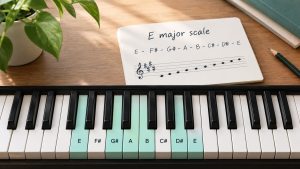
Every major scale follows the same recipe of whole steps and half steps, the same pattern of piano intervals, just starting from a different note. Apply it to F♯ and you get: F♯, G♯, A♯, B, C♯, D♯, E♯, F♯.
F♯ major on the keyboard: five black keys plus B and E♯ (the white key you normally call F).
Two things usually surprise students here. First, only two of those notes are white keys: B and E♯. Second, the seventh note is called E♯, not F. They are the same key on the piano, but a scale uses each letter name once, so after D♯ comes E, and because every note in this scale except B is raised, that E becomes E♯. Think of it as the scale’s one little spelling quirk. When you see E♯ in the music, play the white F key.
When you reach the top F♯ you have played a full octave: the same note, eight steps higher.
F# Major Scale Piano Fingering: Black Keys First
Here is the teaching trick I use with every student: do not start at the beginning. Start with the black keys.
Step 1: the black-key shape. Place your right-hand fingers 2, 3 and 4 on F♯, G♯ and A♯, then 2 and 3 on C♯ and D♯. These five notes form an F♯ major pentatonic scale, and playing them feels easy and natural. Step 2: tuck your thumb in for B. Step 3: add E♯ with your 4th finger and finish on F♯ with the thumb.
Right hand, one octave going up: 2-3-4-1-2-3-4-1. Thumb plays B, then returns on the top F♯.
Left hand, one octave going up: 4-3-2-1-4-3-2-1. Thumb plays B, then lands on the top F♯.
For two octaves, the right hand continues 2-3-4-1-2-3-4-1-2-3-1-2-3-4-1 and the left hand 4-3-2-1-4-3-2-1-3-2-1-4-3-2-1. Coming back down, simply reverse the numbers.
Why this scale feels so comfortable
Your longer fingers (2, 3 and 4) land on the raised black keys, while your shorter thumb takes the white key B at the front. That keeps your hand curved and relaxed, with no awkward stretching. Piano teachers often pass on the story that Chopin started his students on scales with plenty of black keys, such as B major, before C major, for exactly this reason. Whether or not you take the story literally, the hand-shape logic is real.
F Sharp Major Key Signature: How Many Sharps?
F sharp major has six sharps: F♯, C♯, G♯, D♯, A♯ and E♯. Sharps are always added in the same order, and a classic way to remember it is “Father Charles Goes Down And Ends Battle” (F-C-G-D-A-E-B). F♯ major uses the first six of those and leaves out only B, which is why B is the one note in the scale that stays natural.
Here is a handy trick for spotting the key in a score: find the last sharp in the key signature, then go up one half step. The last sharp here is E♯, and a half step above it is F♯, so you are in F♯ major.
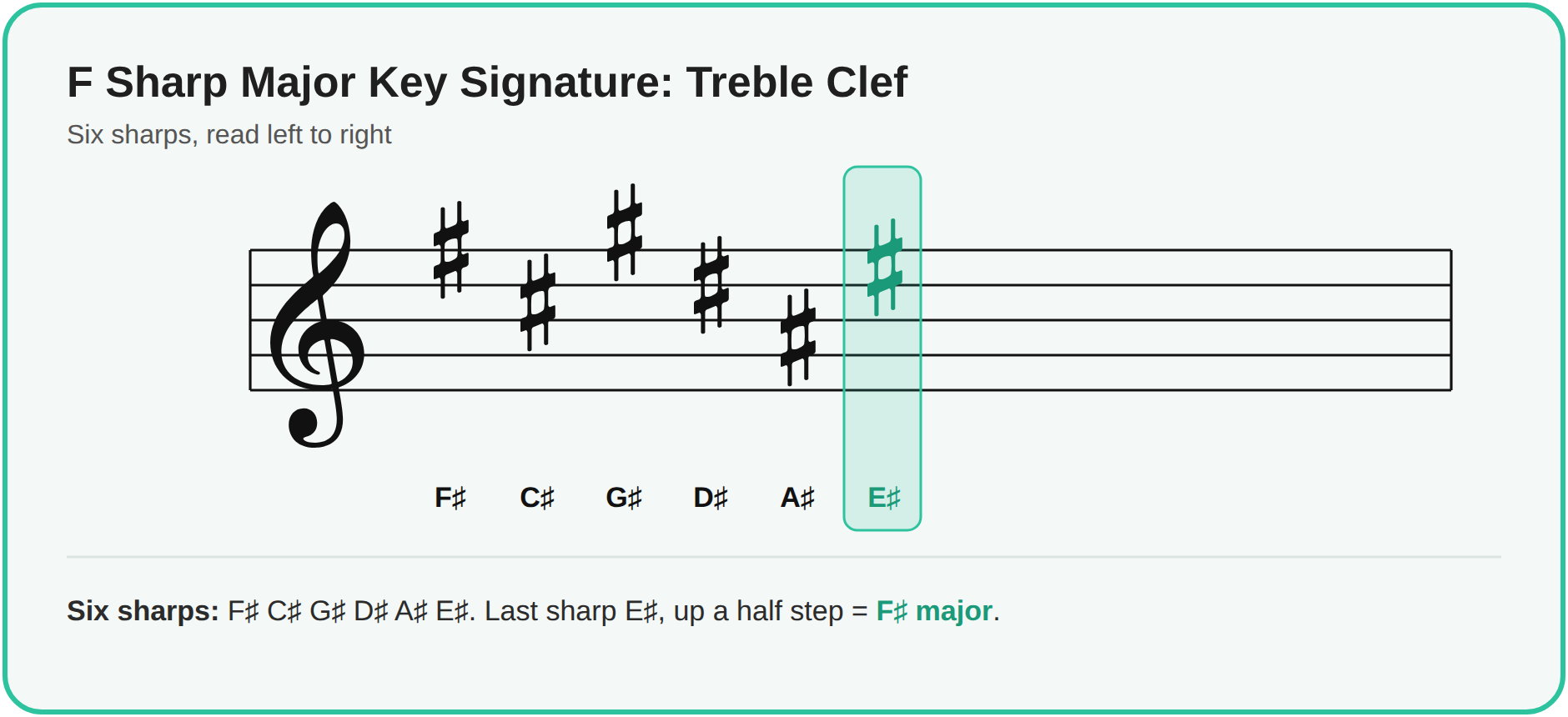
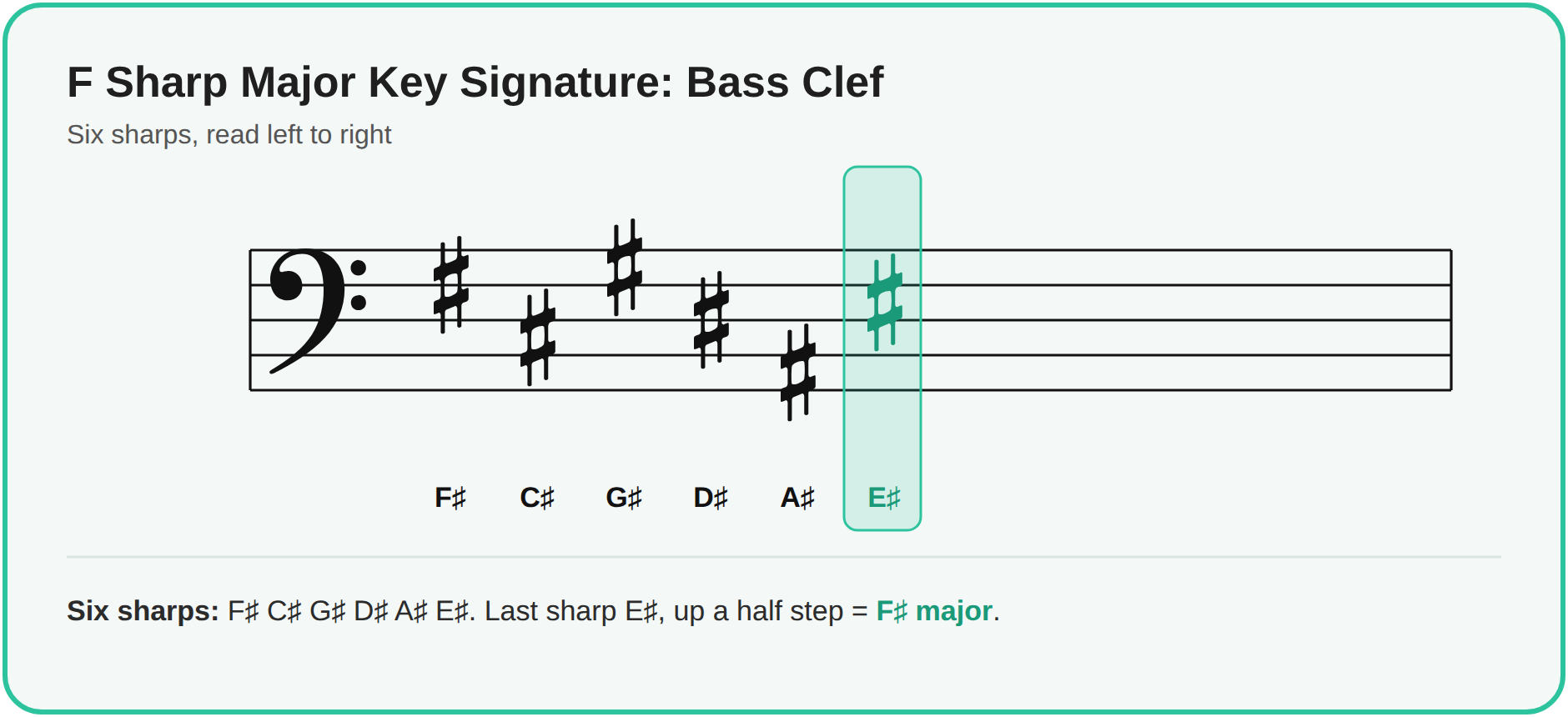
The sharps sit on different lines and spaces in the treble clef and the bass clef, so take a minute to trace each one on both staves.
F Sharp Major vs C Major: Opposite Ends of the Circle of Fifths
Place the two scales side by side and the mirror effect is striking.
C major: seven white keys, no black keys.
F♯ major: all five black keys plus B and E♯. Only those two white keys are shared with C major.
C major has no sharps. Each step clockwise around the circle of fifths adds one: G major has one, then two, three, four, five, until F♯ major arrives at six. It sits directly opposite C major, and the two scales share only two keys: B, and the white F that F♯ major calls E♯.
F Sharp Major vs G Flat Major: Same Keys, Different Names
On the piano, F♯ major and G♭ major are enharmonic keys: they use exactly the same keys and sound identical. Only the spelling changes. G♭ major is G♭, A♭, B♭, C♭, D♭, E♭, F, with six flats instead of six sharps.
Composers choose whichever spelling makes the music easier to read in context. Chopin’s famous “Black Key” Étude, for example, is written in G♭ major. The same flat-key logic applies to chords: the G flat major chord is the same chord as F♯ major on the keyboard.
F Sharp Major Relative Minor: D Sharp Minor
Every major key has a relative minor that shares its key signature. For F♯ major, that is D sharp minor, built from the sixth note of the scale. Its natural minor scale is D♯, E♯, F♯, G♯, A♯, B, C♯: exactly the same notes, just starting from a different place. If you are ever playing a piece with six sharps that sounds more serious than bright, check whether it is in D♯ minor.
Chords in F Sharp Major
Build a three-note chord on each step of the scale and you get these seven chords. Notice how many are almost entirely black keys.
The I chord is all black keys. Learn it first, then work through the rest.
The F♯ major chord (F♯-A♯-C♯) is made up of black keys only, which makes it a wonderful first chord for little hands and beginners. Once it feels comfortable, try common chord progressions in this key, such as F♯ – B – C♯ (I – IV – V). For a wider look at how triads are built, see our collection of piano chords.
Songs and Pieces in F Sharp Major to Practice
Real F♯ major repertoire leans classical, and it is wonderful: Chopin’s Nocturne Op. 15 No. 2, his Barcarolle Op. 60 and his Impromptu No. 2 are all in F♯ major. They are advanced pieces, so for practice I would start with these three lessons, which train the same skills: black-key comfort and confident accidentals.
1. Chopin, Nocturne Op. 9 No. 2. Same composer, same singing right-hand melody, and plenty of accidentals to get used to. A lovely first step toward Chopin’s F♯ major nocturne.
2. Debussy, Clair de Lune. Debussy wrote it in D♭ major, the other key with five black keys and two white ones, so the hand shape you learned today carries straight over.
3. Frank Sinatra, Fly Me to the Moon. A friendly jazz standard that practises accidentals and a steady left hand without the intimidation of six sharps.
Practice the F Sharp Major Scale
Ten focused minutes a day beat an hour once a week. Here is the routine I give my own students.
Common Mistakes and Fixes
Hesitating on E♯. It looks odd on paper, but it is simply the white F key. Say “E sharp, that’s F” out loud a few times and it stops being strange.
Squeezing the thumb under too early. On the way up, prepare the thumb for B while your 4th finger plays A♯, and let the hand glide smoothly across.
Flat, stretched fingers. Keep the fingers gently curved and the wrist level. If you feel tension in the forearm, slow down.
Rushing the white keys. Because B and E♯ feel different under the hand, many players speed up or slow down there. A metronome at a slow tempo keeps the notes even.
The F sharp major scale is a real milestone: once your hands know it, every other key feels friendlier. If you would like to explore the rest of the piano scales, or have your playing checked in real time as you go, Skoove will guide you through each one, step by step.
Author of this blog post:
Susana Pérez Posada

Susana Pérez Posada, Master in Music Therapy, Skoove Piano Educator With over seven years in piano education and a deep passion for music therapy, Susana brings a unique blend of expertise to Skoove. A graduate in Music Therapy from SRH Hochschule Heidelberg and an experienced classical pianist from Universidad EAFIT, she infuses her teaching with a holistic approach that transcends traditional piano lessons. In her writings for Skoove, Susana combines her rich musical knowledge with engaging storytelling, enriching the learning experience for pianists of all levels. Away from the piano, she loves exploring new places and immersing herself in a good book, believing these diverse experiences enhance her creative teaching style.
Published by Lydia Ogn from the Skoove team