
G minor is a scale with two flats, B♭ and E♭. Its notes are G, A, B♭, C, D, E♭ and F, and the scale finishes on G an octave higher. It is the relative minor of B♭ major, so the two scales share the same notes and the same key signature. Only the home note is different.
Only two black keys are needed for G minor, which keeps the hand position comfortable, and the fingering is the same one you may know from G major. In this guide you will see the notes of the scale, how its natural, harmonic and melodic forms differ, the fingering for each hand, the key signature, how the scale looks in treble and bass clef, the chords it contains and two songs to try.
What notes are in the G minor scale?
The G minor scale uses the seven notes G, A, B♭, C, D, E♭ and F before returning to G. When musicians say “the G minor scale” without any other detail, they usually mean this form, known as G natural minor. The harmonic and melodic versions change one or two notes and are covered further down.
G minor on the keyboard
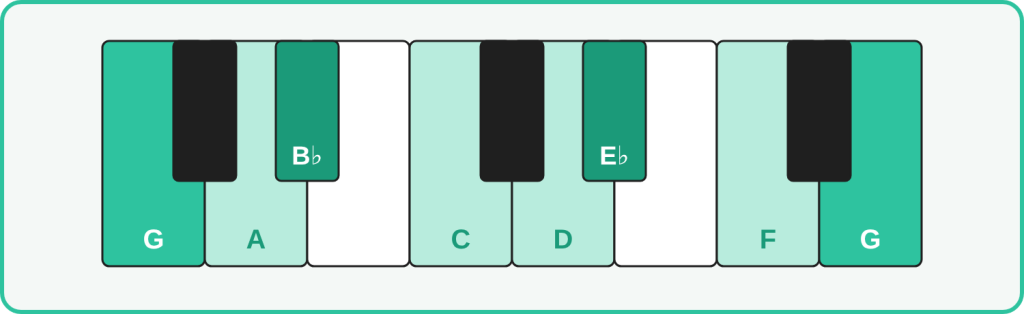
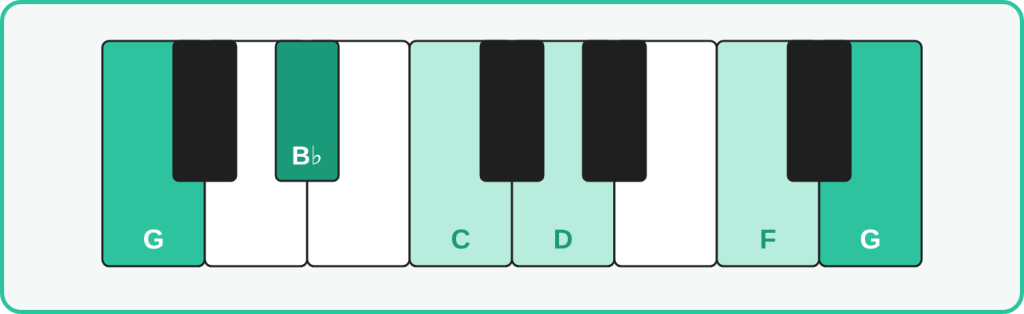
Start on G, the white key between the first and second black keys of a group of three. Both black keys you need sit in the right half of their groups: B♭ is the right-hand black key of the group of three, and E♭ is the right-hand key of the group of two. Every other note in the scale is a white key.
The step pattern behind the scale
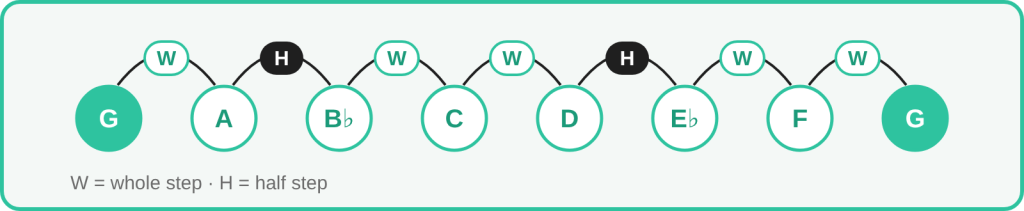
Every natural minor scale is built from the same pattern of whole steps and half steps: whole, half, whole, whole, half, whole, whole (W H W W H W W). A half step is the distance to the very next key, black or white, and a whole step skips one key. Compared with a major scale, the 3rd, 6th and 7th notes sit a half step lower, which is what gives minor its darker sound.
Apply the pattern from G: a whole step up reaches A, a half step reaches B♭, then whole steps reach C and D, a half step reaches E♭, and two more whole steps lead through F back to G.
Scale degrees and intervals in G minor
Each note in a scale has a function, and musicians name it with a scale degree. Tonic is the home note, dominant is the fifth note above it, and so on. In natural minor the 7th degree is called the subtonic because it sits a whole step below G. In harmonic minor it is raised by a half step and becomes the leading tone.
Each note of G natural minor has a number and a name. The numbers return in the chords section.
G natural, harmonic and melodic minor scales
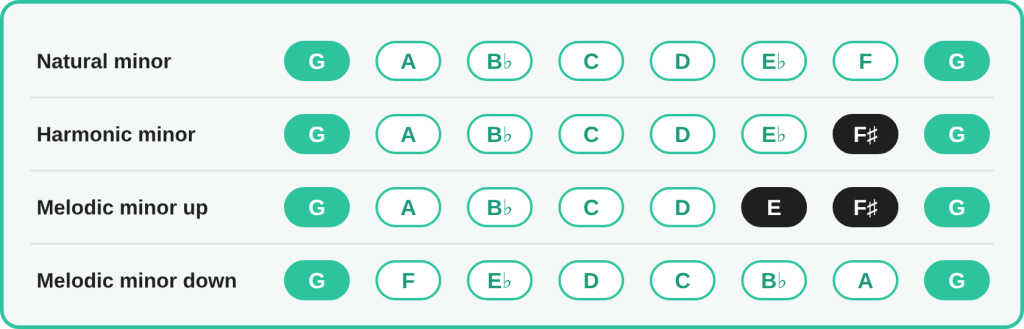
All three forms share the first five notes, G, A, B♭, C and D. They differ only in the 6th and 7th notes, and the picture below shows which notes change.
G natural minor scale
The natural form is G, A, B♭, C, D, E♭, F, G. It only uses notes from the key signature, so no accidentals are needed, and it is identical going up and coming down. The fingering and chords in this article are based on this form.
G harmonic minor scale
The harmonic form raises the 7th note by a half step, so F becomes F♯: G, A, B♭, C, D, E♭, F♯, G. The F♯ sits a half step below the top G and pulls strongly towards it. The gap between E♭ and F♯ is a step and a half, the largest in the scale, and it gives this form a dramatic sound. If you want to hear more of it, read about the harmonic minor scale.
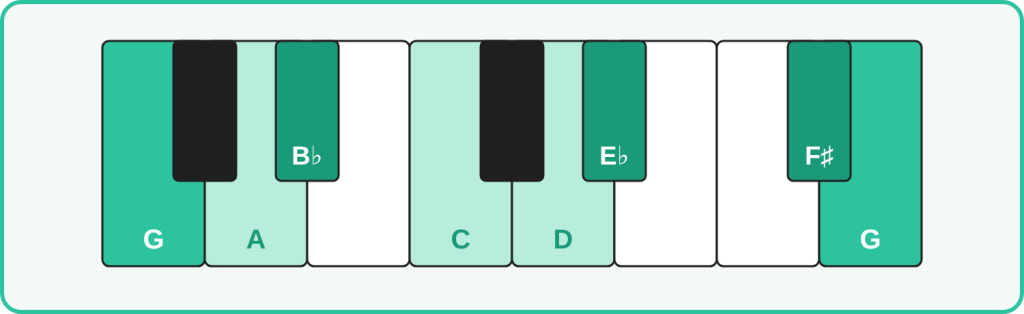
G melodic minor scale
The melodic form smooths out that large gap. Going up it raises both the 6th and 7th notes: G, A, B♭, C, D, E, F♯, G. Coming down it returns to natural minor: G, F, E♭, D, C, B♭, A, G. Because the key signature contains E♭, the E on the way up needs a natural sign in the music. The melodic minor scale is the version that sounds most singable.
G minor scale fingering for both hands
Finger numbers show which finger plays each note: 1 is the thumb, 2 the index finger, 3 the middle finger, 4 the ring finger and 5 the little finger. Learn each hand on its own first and listen for an even sound, then combine them. G minor uses the same fingering shape as G major, so if you already play that scale your hands will know the pattern.
Right hand: Thumb tuck after B♭
Start with your thumb on G, then play A with finger 2 and B♭ with finger 3. Tuck your thumb under to reach C, and continue with D on finger 2, E♭ on finger 3, F on finger 4 and the top G on finger 5. The fingering is 1 2 3 1 2 3 4 5. Keep your wrist level and let only the thumb travel, which is easier when you sit with good piano posture and technique.
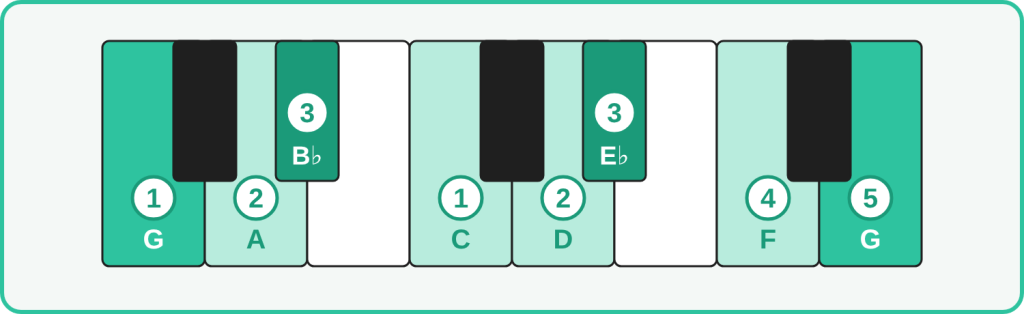
Left hand: Crossover after D
Start with your little finger on G, then play A with finger 4, B♭ with finger 3, C with finger 2 and D with your thumb. Cross your middle finger over the thumb to reach E♭, then play F with finger 2 and the top G with your thumb. The fingering is 5 4 3 2 1 3 2 1. Practice the crossover slowly and keep your forearm moving smoothly instead of twisting your hand.
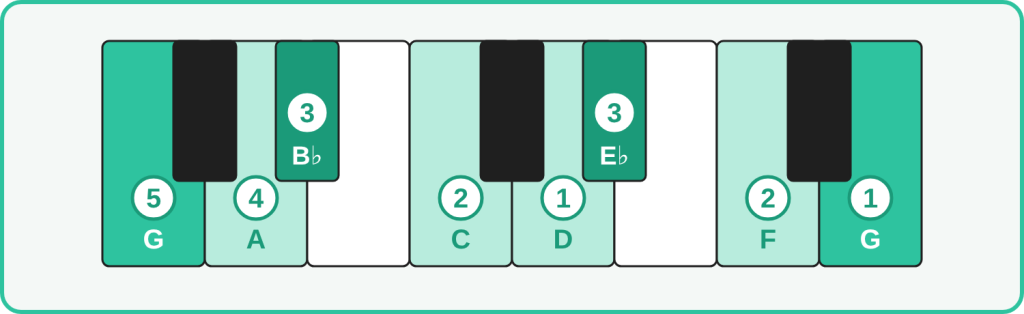
Putting both hands together
When both hands play at once, the thumbs move at different moments. Your right thumb tucks under after B♭, while your left middle finger crosses over after D. Start at about 60 beats per minute with one note per beat, and only speed up when the scale sounds even several times in a row.
One octave, going up. Reverse it on the way down.
Playing G minor over two octaves
For two octaves, repeat the same fingering pattern and let each hand move up the keyboard. In the right hand use 1 2 3 1 2 3 4 1 2 3 1 2 3 4 5. In the left hand use 5 4 3 2 1 3 2 1 4 3 2 1 3 2 1. Both fingerings follow the same logic as the one-octave version, so find each thumb tuck and crossover first and the rest follows.
Key signature of G minor: B♭ and E♭
The key signature of G minor has two flats, B♭ and E♭. They appear at the start of every line of music, and they tell you to play every B as B♭ and every E as E♭ in any octave unless an accidental says otherwise. That is how composers avoid writing a flat sign next to each of those notes.
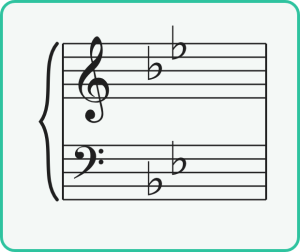
Flats always appear in the same order: B♭, E♭, A♭, D♭, G♭, C♭, F♭. A well-known mnemonic for it is Battle Ends And Down Goes Charles’ Father. To name a flat key from its signature, look at the second-to-last flat. With two flats that is B♭, so the signature belongs to B♭ major or its relative minor, G minor. Our guide to key signatures explains the full system.
G minor scale on the staff: Treble clef and bass clef
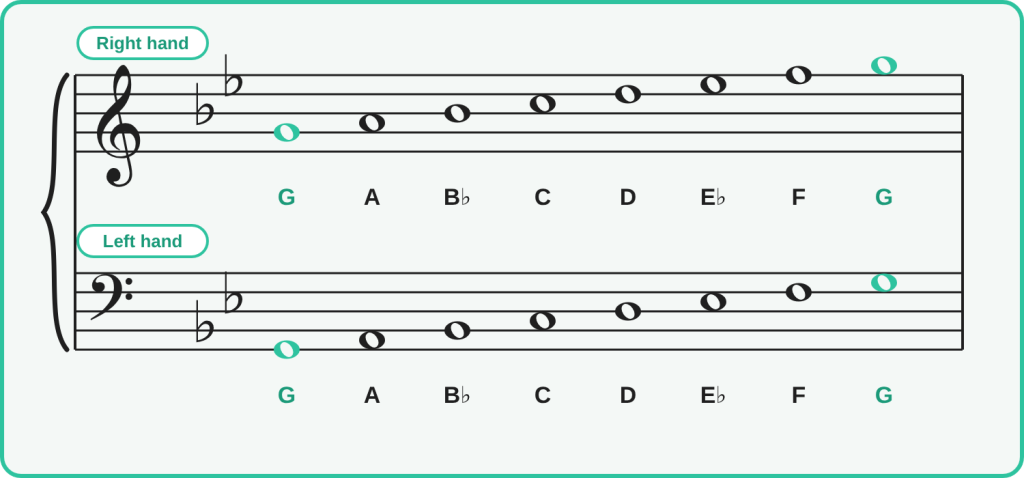
Your right hand usually reads treble clef and your left hand reads bass clef. In treble clef the scale starts on G on the second line, B♭ sits on the middle line and E♭ in the top space, and the scale ends on G in the space above the staff. If you want to review the lines and spaces first, start with treble clef notes.
The G minor scale in bass clef starts on G on the bottom line, with B♭ on the second line and E♭ in the third space, and it finishes on G in the top space. Both clefs show the same notes in different octaves, and our page on bass clef notes on piano helps you read the left-hand version.
Chords you can build in G minor
Stack every other note of the scale on top of each scale degree and you get seven triads. These are the diatonic chords of G minor, and they are the chords most songs in this key are built from. The home chord is the G minor chord: G B♭ D.
Seven triads, one on each note of G natural minor. Black pills mark the black keys.
Capital numerals mean major chords, lowercase numerals mean minor chords, and the ° sign marks a diminished chord. Songs in a minor key often use the harmonic minor version of the V chord, which turns Dm into D major (D F♯ A) and gives a stronger pull back to Gm.
Chord progressions to try in G minor
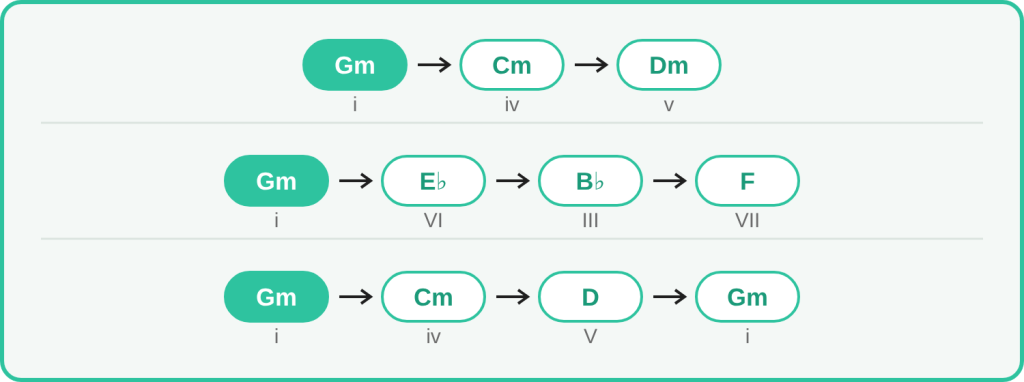
Play these three progressions with your left hand while the right hand plays notes from the scale. Change chords on the beat and move smoothly from one shape to the next. Once the basic shapes feel comfortable, experiment with chord inversions to make the changes smaller.
G minor and its relative major, B♭ major
The relative major of G minor is B♭ major. The two scales use the same seven notes and the same two flats, but they start in different places: G minor begins on G, B♭ major on B♭. To find the relative major of any minor key, count up three half steps from the home note or use the third note of the minor scale. Learn more about how these pairs work in our guide to relative major and minor scales.

To tell the keys apart in a piece of music, listen for the home note. A piece in G minor usually ends on G or a G minor chord, while one in B♭ major finishes on B♭. Play both scales one after the other and you will hear how the same notes can feel brighter or darker depending on where they start. If you want the major version, our B flat major scale page has the notes and fingering. G major, the parallel major, shares the home note but has one sharp instead of two flats, and you can compare it on the G major scale page.
G minor pentatonic scale
The G minor pentatonic scale takes five notes from the full scale: G, B♭, C, D and F. In scale-degree terms that is 1, ♭3, 4, 5 and ♭7. It leaves out A and E♭, the two notes that create the half steps in natural minor, so every note sounds good over a G minor chord. Hold a Gm chord in your left hand and play these five notes with your right to start improvising. There is more about this family of scales in our guide to pentatonic scales on piano.
Songs in G minor to practice
Playing real music is the best way to make a new scale stick, because you start to recognize its notes in melodies. These pieces are in G minor. Skoove’s beginner arrangement of “Carol of the Bells” is in E minor, so you can learn the tune there first and then try it in G minor.
| Song | Composer | Style |
|---|---|---|
| “Autumn Leaves” | Joseph Kosma | Jazz standard |
| “Carol of the Bells” | Mykola Leontovych | Christmas carol |
Ready to practice the G minor scale?
You now know the notes, fingering and key signature of the G minor scale. Start with natural minor, one hand at a time and at a slow tempo, then add hands together and two octaves. Keep B♭ and E♭ in mind and move on to the harmonic and melodic forms once the natural scale feels even. To keep building your skills with feedback as you play, try Skoove’s interactive piano lessons.
Author of this blog post:
Susana Pérez Posada

Susana Pérez Posada, Master in Music Therapy, Skoove Piano Educator With over seven years in piano education and a deep passion for music therapy, Susana brings a unique blend of expertise to Skoove. A graduate in Music Therapy from SRH Hochschule Heidelberg and an experienced classical pianist from Universidad EAFIT, she infuses her teaching with a holistic approach that transcends traditional piano lessons. In her writings for Skoove, Susana combines her rich musical knowledge with engaging storytelling, enriching the learning experience for pianists of all levels. Away from the piano, she loves exploring new places and immersing herself in a good book, believing these diverse experiences enhance her creative teaching style.