



The B flat major scale has five white keys and two black keys: B♭, C, D, E♭, F, G, A, B♭. Its key signature has two flats (B♭ and E♭), and it is also called the Bb major scale. It looks tricky because it starts on a black key, but once your hands know where the thumbs go, it is one of the most comfortable scales to play.
In this guide, you will learn the notes, the key signature, the fingering for both hands, how the scale looks in treble and bass clef, and a simple routine to practice it. Take it one hand at a time and you will have it under your fingers quickly.
What Is the B Flat Major Scale?
The B flat major scale is a series of eight notes that starts and ends on B♭ and follows the major scale pattern of whole and half steps. You will see it written as B♭ major, Bb major or B-flat major. They all mean the same thing.
Musicians use this scale all the time because B♭ is a friendly key for many instruments and voices. On piano, it is a great step up from C major: you meet black keys for the first time inside a scale, but only two of them, so the shape of your hands stays simple.
One thing to keep in mind: B♭ is the same key as A♯ on the piano. In the key of B♭ major we always call it B♭, because the scale uses each letter name once.
B Flat Major Scale Notes
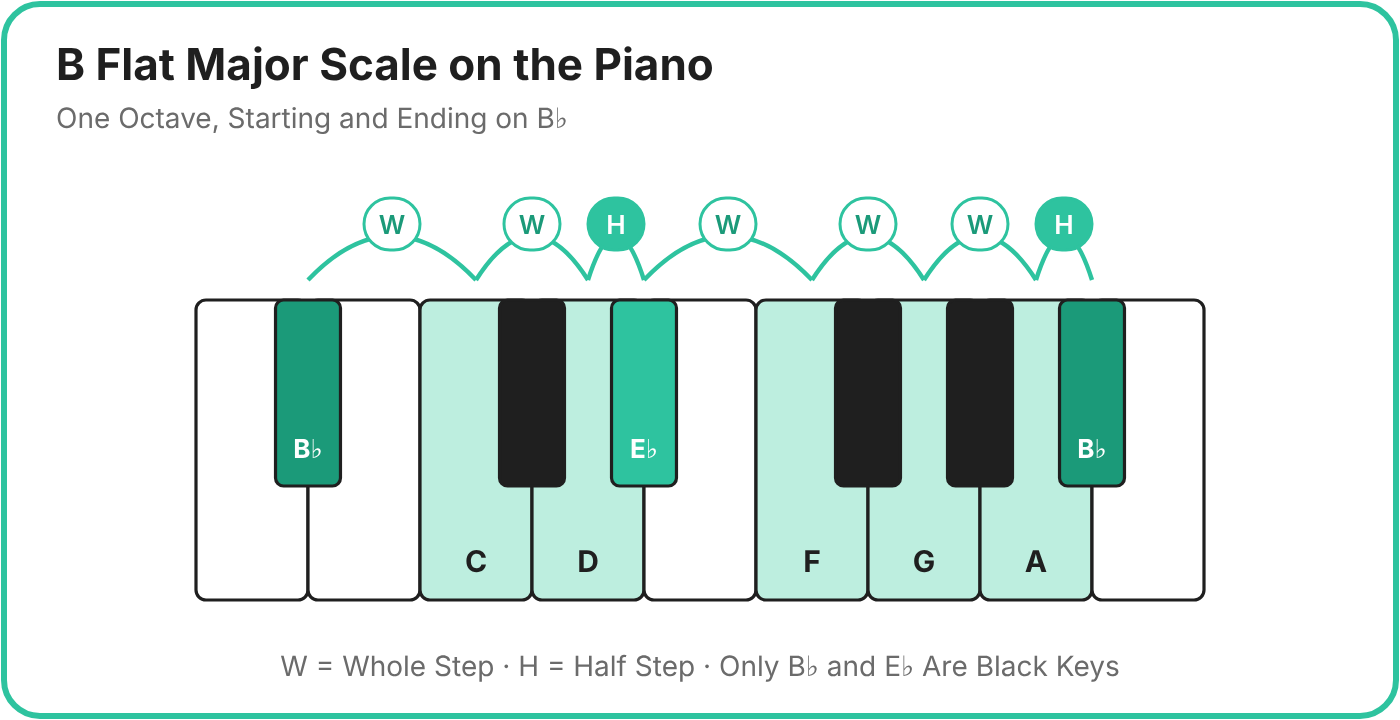
The notes of the B flat major scale, going up, are B♭ – C – D – E♭ – F – G – A – B♭. Only two of them are black keys, B♭ and E♭. The other five are white keys.
How to Build the B Flat Major Scale (Whole and Half Steps)
Every major scale follows the same pattern of whole steps (W) and half steps (H): W – W – H – W – W – W – H. A half step is the very next key, black or white. A whole step skips one key. Starting on B♭, it works out like this:
| Step | From | To | Interval |
|---|---|---|---|
| 1 | B♭ | C | Whole step |
| 2 | C | D | Whole step |
| 3 | D | E♭ | Half step |
| 4 | E♭ | F | Whole step |
| 5 | F | G | Whole step |
| 6 | G | A | Whole step |
| 7 | A | B♭ | Half step |
B Flat Major Scale Degrees
Each note of a scale has a number and a name. These come up in theory classes and exams, so it helps to know them for B♭ major.
| Degree | Name | Note in B♭ major |
|---|---|---|
| 1 | Tonic | B♭ |
| 2 | Supertonic | C |
| 3 | Mediant | D |
| 4 | Subdominant | E♭ |
| 5 | Dominant | F |
| 6 | Submediant | G |
| 7 | Leading tone | A |
So the 3rd note (the mediant) of the B♭ major scale is D, and the leading tone is A.
B Flat Major Key Signature: Two Flats
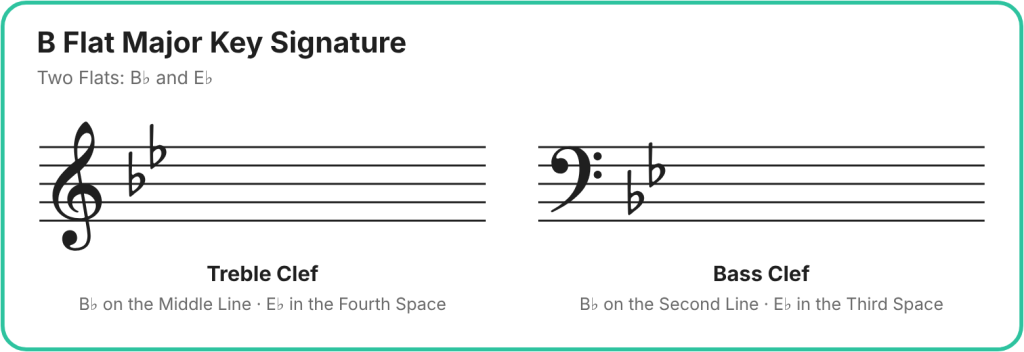
The B flat major key signature has two flats: B♭ and E♭. That means every B and every E in a piece in this key is played as a flat, unless the music says otherwise.
Flats always appear in the same order in all key signatures: B♭, E♭, A♭, D♭, G♭, C♭, F♭. B♭ major uses the first two. On the circle of fifths, B♭ major sits two steps counterclockwise from C major (C, then F, then B♭).
| Clef | B♭ is written on | E♭ is written on |
|---|---|---|
| Treble clef | Middle line | Fourth space (between the 4th and 5th lines) |
| Bass clef | Second line from the bottom | Third space from the bottom |
A quick trick for reading key signatures with flats: the second-to-last flat names the key. With B♭ and E♭, the second-to-last flat is B♭, so the key is B♭ major.
B Flat Major Scale on Piano
On the keyboard, the B flat major scale starts on a black key (B♭), moves to two white keys (C and D), goes up to a black key (E♭), runs along three white keys (F, G and A), and lands on a black key again (B♭). Feeling that pattern of black and white keys under your fingers is the easiest way to find the scale without looking.
Where Is B Flat on the Piano?
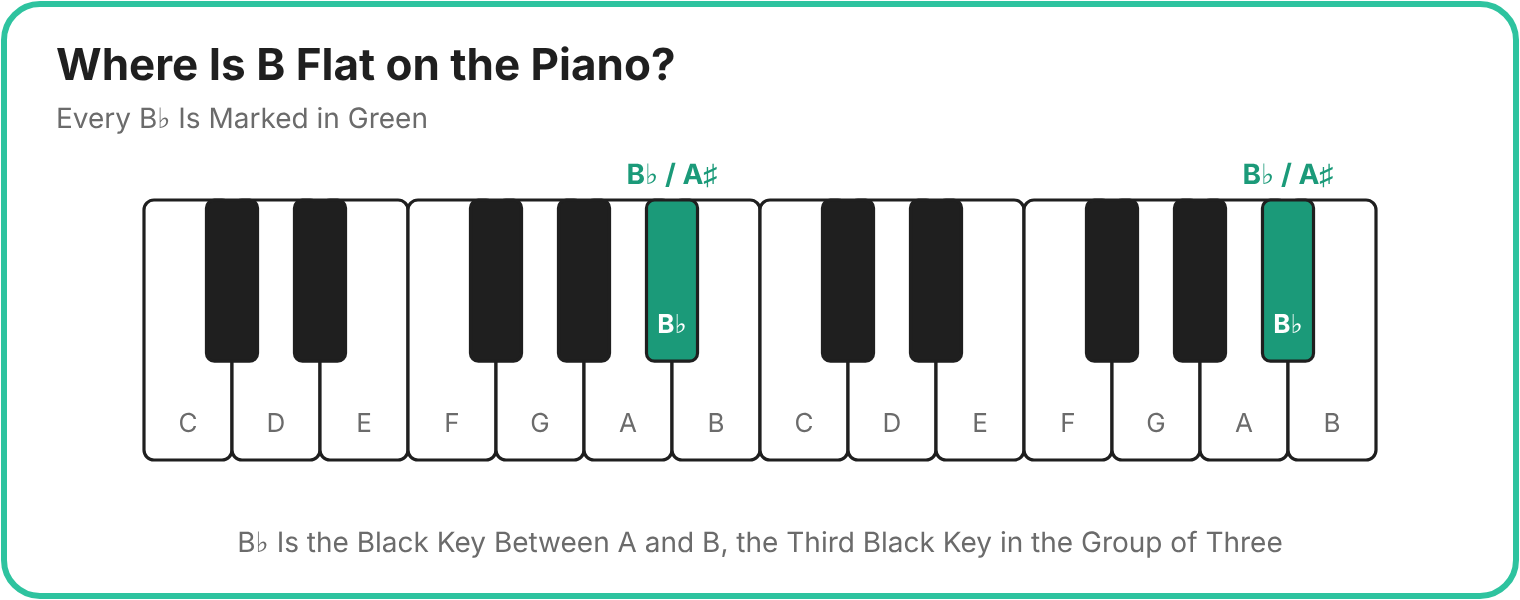
B♭ is the black key directly to the left of B, between A and B. It is the third black key in the group of three. The same key is also called A♯, and the name depends on the key you are playing in. E♭ is the second black key in the group of two, between D and E.
B Flat Major Scale Fingering
The B flat major scale does not start with the thumb, and neither hand uses the fifth finger. Fingers are numbered 1 (thumb) to 5 (pinky). The thumbs always land on white keys, which is the key to the whole scale.
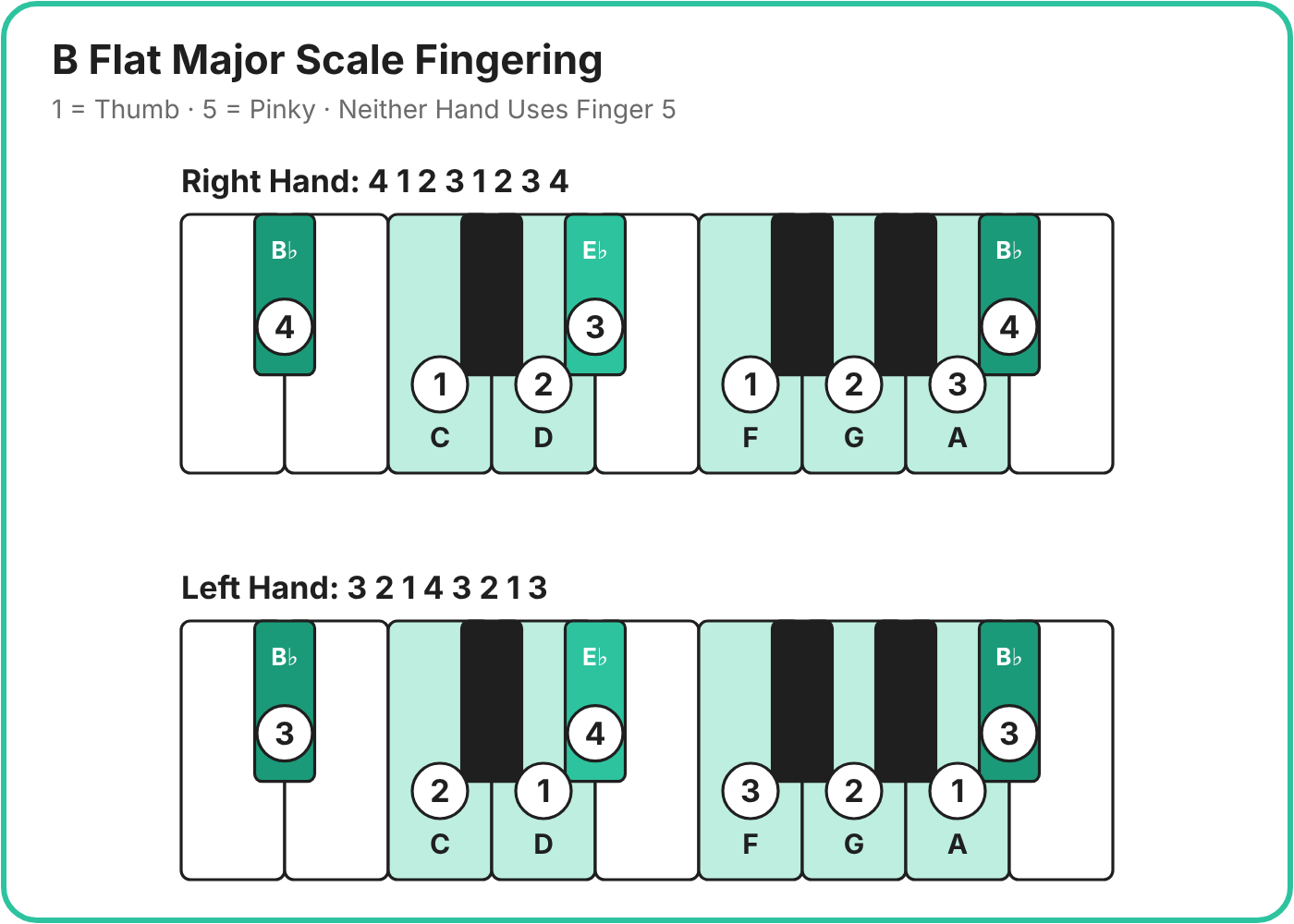
| Hand | B♭ | C | D | E♭ | F | G | A | B♭ |
|---|---|---|---|---|---|---|---|---|
| Right hand | 4 | 1 | 2 | 3 | 1 | 2 | 3 | 4 |
| Left hand | 3 | 2 | 1 | 4 | 3 | 2 | 1 | 3 |
Right Hand
Start on B♭ with your fourth finger. Your thumb then plays C, followed by D (2) and E♭ (3). Pass the thumb under to F, then play G (2), A (3) and finish on the top B♭ with finger 4. The right hand uses two groups of fingers: 1-2-3 and then 1-2-3-4.
Left Hand
Start on B♭ with your third finger, then play C (2) and D (1) with your thumb. Cross your fourth finger over to E♭, then play F (3), G (2) and A (1) and finish on B♭ with finger 3.
Both Hands Together
Playing with both hands is easier once each hand feels comfortable on its own. The hands move in parallel, an octave apart. Right after the opening B♭, the right thumb lands on C and the left thumb lands on D, so the thumbs mirror each other. The second fingers of both hands meet on G. Use these landing points to stay in sync. Start slowly, around 60 beats per minute, and speed up only when it feels even.
Two Octaves
Because neither hand uses the fifth finger, the pattern simply repeats. Right hand: 4 1 2 3 1 2 3 4 1 2 3 1 2 3 4. Left hand: 3 2 1 4 3 2 1 3 2 1 4 3 2 1 3. Both hands end on the same fingers they started on.
B Flat Major Scale on the Staff
On the staff, the B flat major scale is written with the two-flat key signature, so you do not need to write a flat in front of every B and E. Here is where each note sits in treble clef and bass clef, starting from the B♭ in each clef.
B Flat Major Scale in Treble Clef
In treble clef, one octave starts on the B♭ on the middle line and goes up to the next B♭ above the staff.
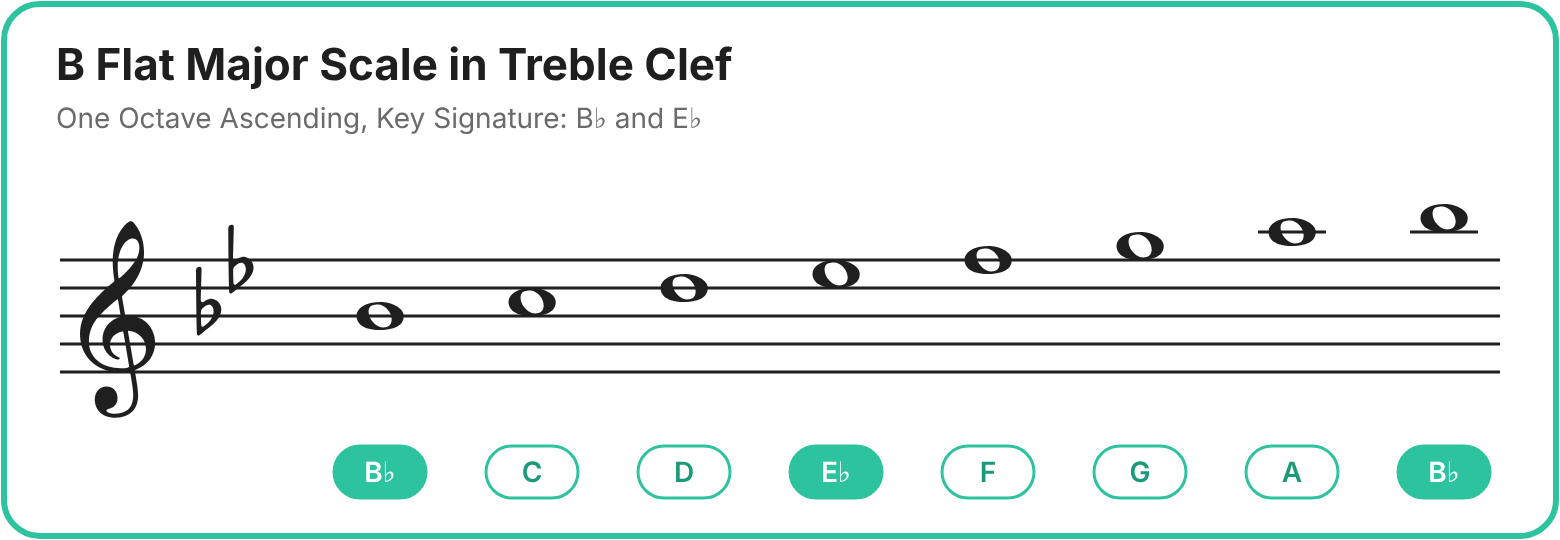
| Note | Position in treble clef |
|---|---|
| B♭ | Middle line |
| C | Third space |
| D | Fourth line |
| E♭ | Fourth space |
| F | Top line |
| G | Space above the staff |
| A | First ledger line above the staff |
| B♭ | Space above that ledger line |
B Flat Major Scale in Bass Clef
In bass clef, one octave starts on the B♭ on the second line from the bottom and ends on the B♭ just above the staff.
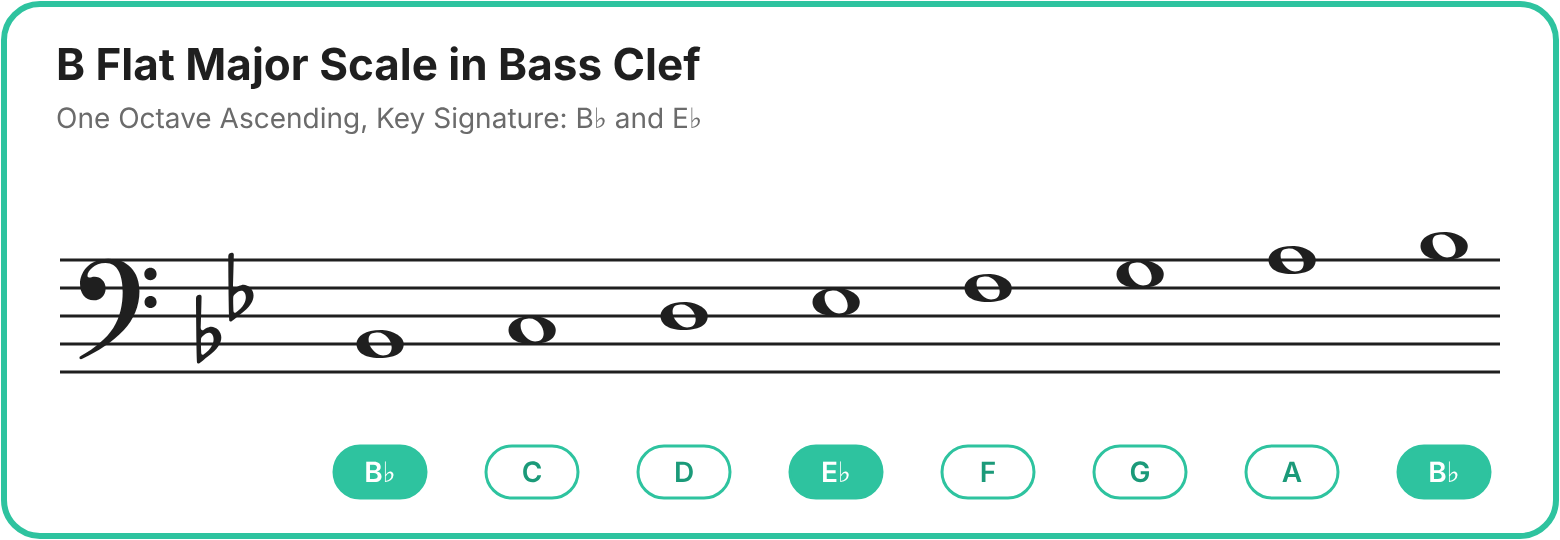
| Note | Position in bass clef |
|---|---|
| B♭ | Second line |
| C | Second space |
| D | Middle line |
| E♭ | Third space |
| F | Fourth line |
| G | Fourth space |
| A | Top line |
| B♭ | Space above the staff |
How to Practice the B Flat Major Scale
Five minutes a day is enough to make this scale feel natural. Work through these steps in order and move on only when the current step feels easy.
- Find the shape. Place your right thumb on C and your left thumb on D before you play anything. This sets your hands up for the rest of the scale.
- Right hand alone. Play one octave slowly, saying the finger numbers out loud: 4, 1, 2, 3, 1, 2, 3, 4.
- Left hand alone. Repeat with 3, 2, 1, 4, 3, 2, 1, 3.
- Hands together, one octave. Go slowly, around 60 beats per minute, and listen for an even sound.
- Add a second octave. The pattern repeats, so only the stretch gets longer.
- Use a metronome. Play quarter notes first, then move to eighth notes once it feels steady.
Play legato, so each note flows into the next, and keep your wrists relaxed. Speed comes later.
Common Mistakes
- Starting with the thumb. In C major, the scale starts with finger 1. Here the right hand starts with finger 4 and the left with finger 3.
- Missing E♭. E♭ sits alone between D and F. Let your third finger (right hand) or fourth finger (left hand) hover over it before you get there.
- Tension in the thumb. Let it glide under the hand, instead of jumping.
Chords in the Key of B Flat Major
Every major scale gives you seven chords, one built on each note, using only the notes of the scale. They are a mix of major and minor chords, plus one diminished chord. In B♭ major they are:
| Degree | Chord | Notes | Type |
|---|---|---|---|
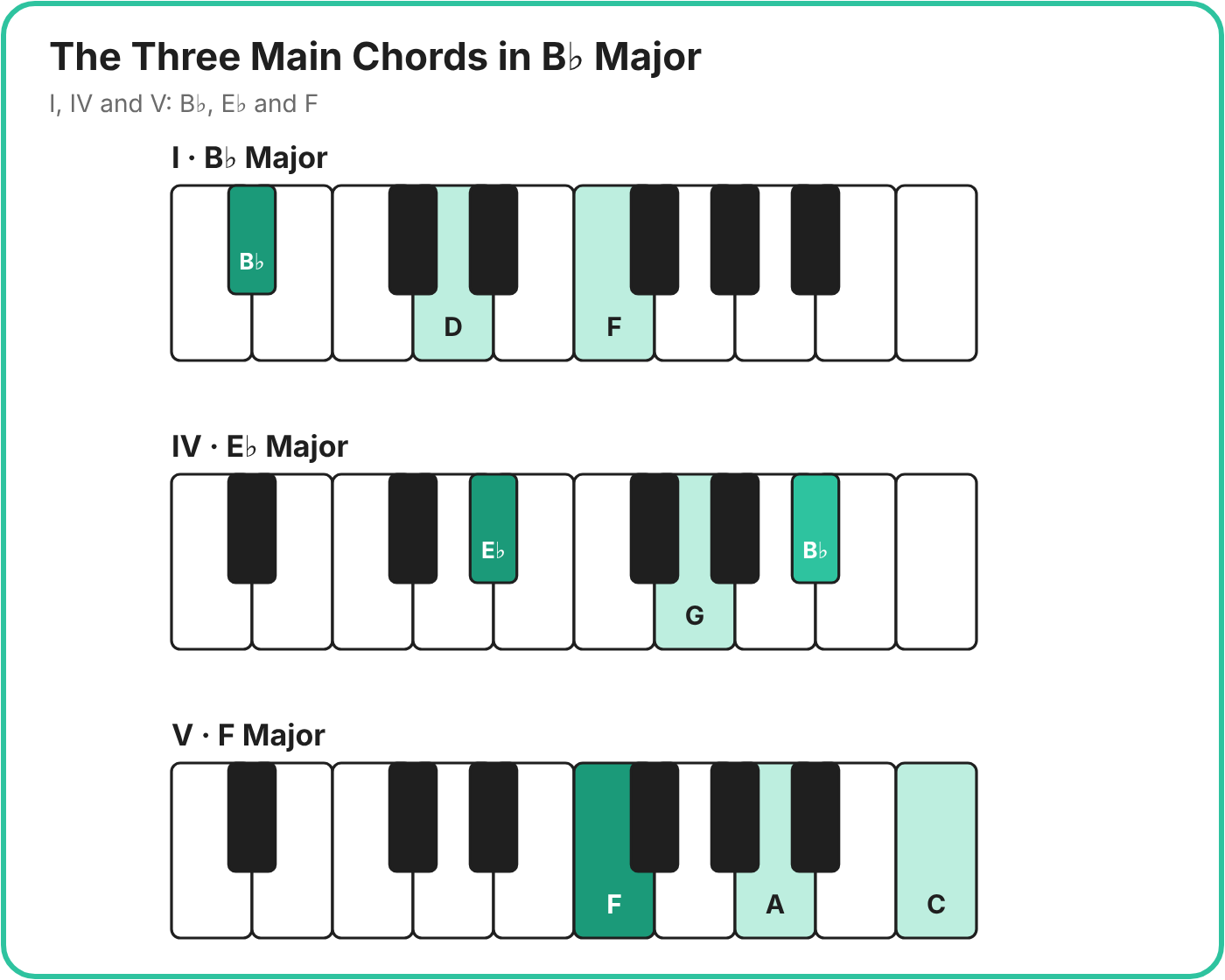
| I | B♭ major | B♭ – D – F | Major |
| ii | C minor | C – E♭ – G | Minor |
| iii | D minor | D – F – A | Minor |
| IV | E♭ major | E♭ – G – B♭ | Major |
| V | F major | F – A – C | Major |
| vi | G minor | G – B♭ – D | Minor |
| vii° | A diminished | A – C – E♭ | Diminished |
The three most useful chords are I, IV and V: B♭, E♭ and F. Many songs in this key are built on just these, and they are the starting point for most chord progressions. Learning the B♭ major chord first gives you the home chord of the scale, and your left hand will already know the shapes from playing the scale.
B Flat Major vs. Its Relative and Parallel Minor
Every major key has a minor key that shares its key signature. These pairs are called relative major and minor scales. The relative minor of B flat major is G minor. You find it by counting down three half steps from B♭ (B♭, A, A♭, G), or by starting on the sixth note of the scale. G minor uses the same notes as B♭ major (G, A, B♭, C, D, E♭, F) and also has two flats.
Scales that share the same starting note are called parallel scales. The parallel minor of B♭ major is B flat minor. It starts on B♭ too, but it has five flats (B♭, E♭, A♭, D♭, G♭), so it feels very different under the hands.
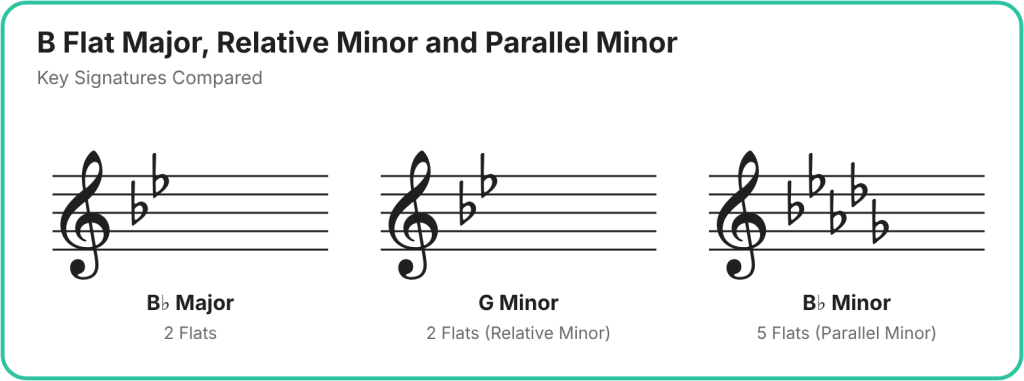
| Scale | Starting note | Flats in key signature | Relationship to B♭ major |
|---|---|---|---|
| B♭ major | B♭ | 2 (B♭, E♭) | – |
| G minor | G | 2 (B♭, E♭) | Relative minor |
| B♭ minor | B♭ | 5 (B♭, E♭, A♭, D♭, G♭) | Parallel minor |
A good next step after B♭ major is G minor, since the notes and the key signature are already familiar. B flat minor is a good challenge once the major scale feels comfortable.
Keep Building Your Scales with Skoove
The B flat major scale is a great way to get comfortable with black keys, thumb-under technique and key signatures, all in one pattern. Practice it for a few minutes each day and it will soon feel as natural as C major. When you are ready for more, explore the other piano scales next.
If you would like guidance as you go, download Skoove and let the interactive lessons take you through scales, note reading and technique step by step, with real-time feedback as you play.