
The F sharp minor scale is a seven-note scale that starts and ends on F♯ and uses the notes F♯, G♯, A, B, C♯, D and E. It has three sharps, F♯, C♯ and G♯, so you play three black keys and four white keys. Starting on a black key can look intimidating, but this scale is friendlier than it seems: your thumbs stay on white keys and your longer fingers take care of the black ones.
F♯ minor, also written F# minor, is the relative minor of A major, so the two keys share exactly the same notes․
In this guide you will learn the notes of the F♯ minor scale, how it is built, its key signature in treble and bass clef, the natural, harmonic and melodic forms, the chords it creates, and the fingering for each hand, hands together and over two octaves.
F sharp minor scale notes
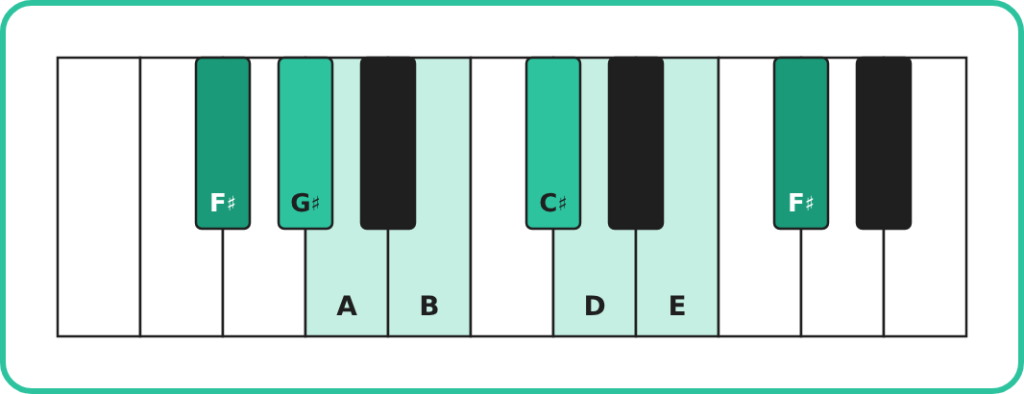
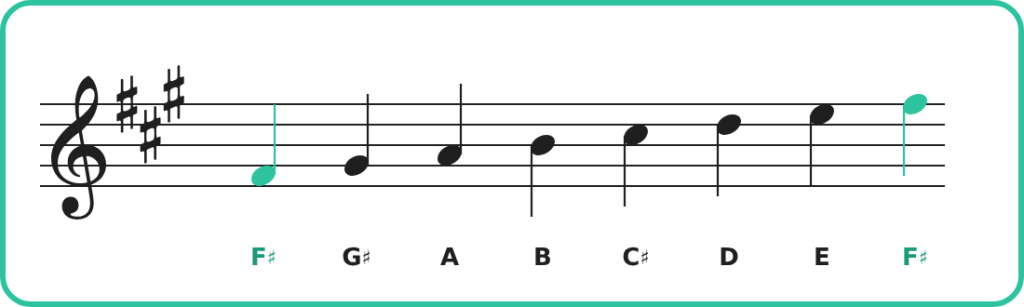
The notes of the F sharp minor scale are F♯, G♯, A, B, C♯, D, E and F♯ again an octave higher. Three of them, F♯, G♯ and C♯, are black keys. The other four, A, B, D and E, are white keys.
To find the scale on the keyboard, start on F♯, the first black key of the group of three. Play G♯, the second black key in that group, skip the third one, then play the white keys A and B. Next comes C♯, the first black key of the group of two, followed by the white keys D and E, and you land on F♯ again. This is the F♯ natural minor scale, the form most people mean when they say “the F♯ minor scale” or “the F♯m scale”. The harmonic and melodic forms are covered a little further down.
How the F sharp minor scale is built
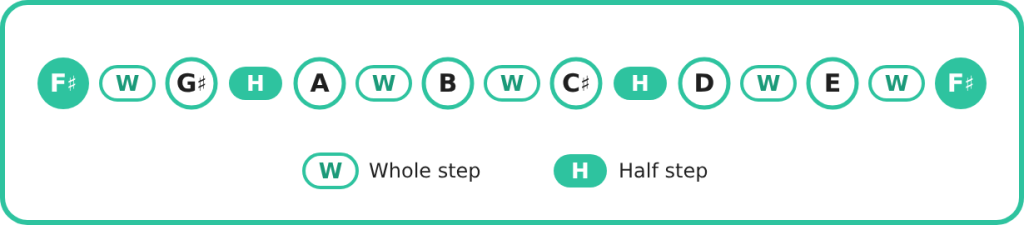
Every natural minor scale follows the same formula of whole steps (W) and half steps (H): W H W W H W W. A half step is the very next key, black or white. A whole step skips one key. Once you know the formula, you can build a minor scale from any note.
Start on F♯ and apply the formula: a whole step takes you to G♯, then a half step to A. From A, two whole steps give you B and C♯, a half step brings you to D, and two more whole steps take you through E and back to F♯. That is why F♯ minor needs three sharps: each one protects a whole step. G♯ keeps the first step from F♯ a whole step, C♯ does the same for the step after B, and the final F♯ keeps the last step from E whole, so the scale lands back on the note it started on.
F sharp minor scale degrees and intervals
Each note of the scale has a number and a name, called its scale degree. Knowing the scale degrees in music helps you talk about chords and melodies in any key. The interval column shows the distance from F♯ to each note.
| Degree | Note | Degree name | Interval from F♯ |
|---|---|---|---|
| 1 | F♯ | Tonic | Unison |
| 2 | G♯ | Supertonic | Major 2nd |
| 3 | A | Mediant | Minor 3rd |
| 4 | B | Subdominant | Perfect 4th |
| 5 | C♯ | Dominant | Perfect 5th |
| 6 | D | Submediant | Minor 6th |
| 7 | E | Subtonic | Minor 7th |
| 8 | F♯ | Tonic (octave) | Perfect octave |
The minor 3rd, 6th and 7th are what give minor scales their darker sound compared with major ones. Playing each of these piano intervals from F♯, one at a time, is a simple way to train your ear to hear what makes a scale sound minor.
F sharp minor key signature: How many sharps?
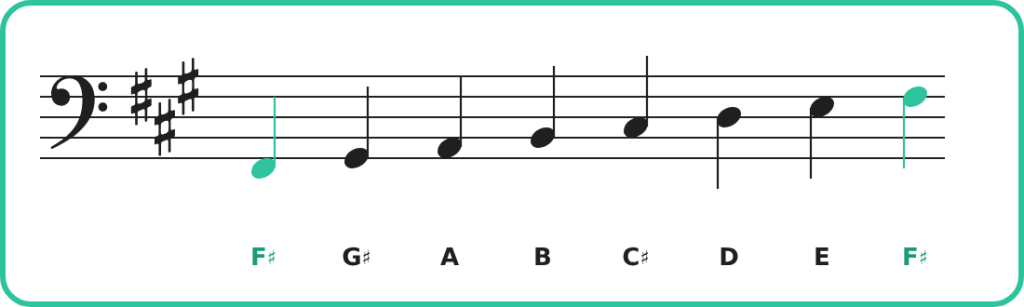
The F sharp minor key signature has three sharps: F♯, C♯ and G♯. In treble clef they sit on the top line, in the third space and in the space above the top line. In bass clef they sit on the fourth line, in the second space and in the fourth space. Once key signatures make sense, you can name the key of a piece at a glance.
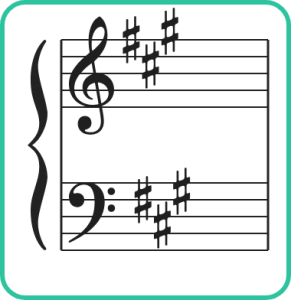
The same three sharps are also the key signature of A major, so how do you tell the two keys apart? Check which note feels like home: a piece in F♯ minor usually ends on F♯ or an F♯ minor chord. A raised E, written E♯, popping up in the music is another strong clue, because E♯ is the note that leads up to F♯. And on the circle of fifths, F♯ minor shares a slot with A major, three steps clockwise from C major and A minor.
F sharp minor scale in treble clef
In treble clef, the F♯ minor scale starts on F♯ in the first space and climbs to F♯ on the top line, so the whole scale fits on the staff with no ledger lines. The sharps come from the key signature, so you will not see one next to each note. If reading the lines and spaces still takes a moment, a quick review of treble clef notes makes this scale much easier to follow.
F sharp minor scale in bass clef
In bass clef, a comfortable left-hand F♯ minor scale starts on F♯ in the space just below the bottom line and finishes on F♯ on the fourth line. It covers the same notes, just lower on the keyboard. Scales like this one are a great way to get fluent with bass clef notes on piano, because every note appears in order.
F sharp minor scale: Natural, harmonic and melodic
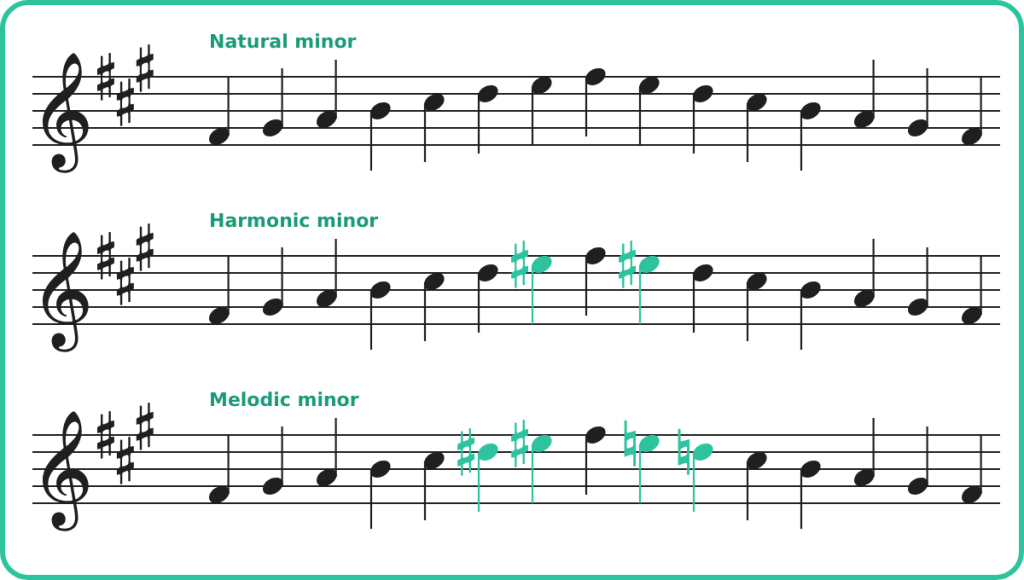
Minor scales come in three forms. All three share the same first five notes, F♯, G♯, A, B and C♯. They differ only in the 6th and 7th notes, which is where the harmonic and melodic forms get their distinctive sounds.
F sharp natural minor scale
The F♯ natural minor scale is the one you have seen so far: F♯ G♯ A B C♯ D E F♯. It uses only the notes of the key signature, so no accidentals are needed. It is the same going up and going down, and it is the form the chords and fingering below are based on.
F sharp harmonic minor scale
The F♯ harmonic minor scale raises the 7th note by a half step: F♯ G♯ A B C♯ D E♯ F♯. E♯ is played on the white key F, but it is spelled E♯ because a scale uses each letter name once. The jump from D to E♯ is larger than any other step in the scale, which gives it a dramatic, slightly exotic sound. You can explore this sound in more depth in our guide to the harmonic minor scale. The fingering stays the same as for the natural form, with E♯ played by finger 2 in the right hand and the thumb in the left.
F sharp melodic minor scale
The F♯ melodic minor scale smooths out that large jump. Going up, it raises both the 6th and 7th notes: F♯ G♯ A B C♯ D♯ E♯ F♯. Coming down, it returns to the natural minor: F♯ E D C♯ B A G♯ F♯. The raised notes make the way up sound more open, and the natural notes bring back the darker color on the way down. If you want to hear why this form is so singable, the melodic minor scale is worth a closer look.
| Form | Going up | Going down | What changes |
|---|---|---|---|
| Natural | F♯ G♯ A B C♯ D E F♯ | F♯ E D C♯ B A G♯ F♯ | Nothing, it follows the key signature |
| Harmonic | F♯ G♯ A B C♯ D E♯ F♯ | F♯ E♯ D C♯ B A G♯ F♯ | 7th note raised |
| Melodic | F♯ G♯ A B C♯ D♯ E♯ F♯ | F♯ E D C♯ B A G♯ F♯ | 6th and 7th raised going up only |
Chords in the F sharp minor scale
Stack every other note of the scale on top of each scale degree and you get the seven chords that belong to the key of F♯ minor. They are called diatonic chords, and they are the chords most songs in F♯ minor use. The home chord is the F sharp minor piano chord: F♯, A and C♯.
The 7 diatonic chords in F sharp minor
| Roman numeral | Chord | Notes | Type |
|---|---|---|---|
| i | F♯m | F♯ A C♯ | Minor |
| ii° | G♯dim | G♯ B D | Diminished |
| III | A | A C♯ E | Major |
| iv | Bm | B D F♯ | Minor |
| v | C♯m | C♯ E G♯ | Minor |
| VI | D | D F♯ A | Major |
| VII | E | E G♯ B | Major |
If you build the chords from the harmonic minor scale instead, the v chord becomes C♯ major (C♯ E♯ G♯), which pulls more strongly back to the home chord. That small change is one reason so many minor-key songs sound the way they do.
How to play the F sharp minor scale on piano
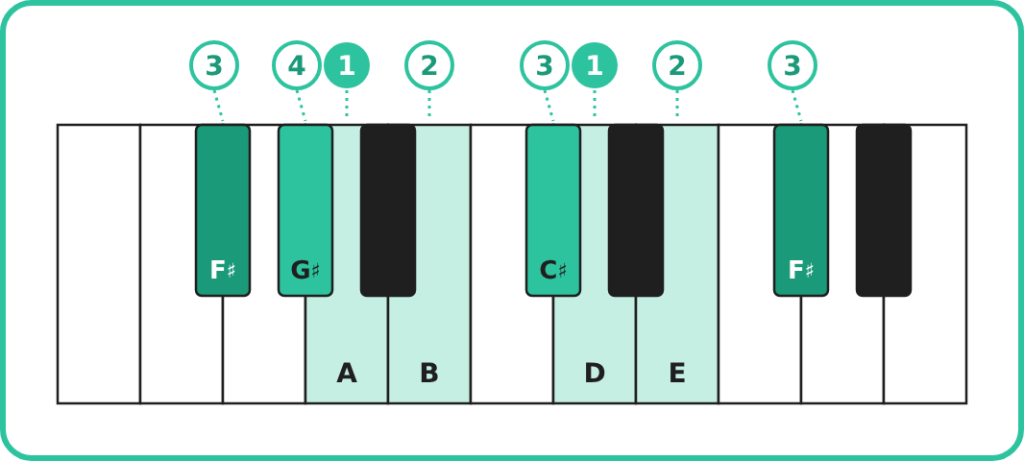
Good news if the black keys worry you: in the F♯ minor scale, fingers 3 and 4 play every black key, while your thumb and finger 2 stay on the white keys. Going up, the right hand plays 3 4 1 2 3 1 2 3 and the left hand plays 4 3 2 1 3 2 1 4.
Right-hand fingering
Going up, the right hand plays 3 4 1 2 3 1 2 3. Play F♯ and G♯ with fingers 3 and 4, then tuck your thumb under to land on A. Continue with B and C♯ on fingers 2 and 3, tuck the thumb under again onto D, and finish with E and F♯ on fingers 2 and 3. Coming down, reverse it: 3 2 1 on F♯, E and D, then cross finger 3 over your thumb onto C♯. Play B and A with fingers 2 and 1, cross finger 4 over onto G♯, and finish on F♯ with finger 3.
Left-hand fingering
Going up, the left hand plays 4 3 2 1 3 2 1 4. Start with finger 4 on F♯ and walk up to B with your thumb. Then cross finger 3 over your thumb onto C♯, play D and E with fingers 2 and 1, and cross finger 4 over the thumb onto the top F♯. Coming down, the left hand plays 4 on F♯, tucks the thumb under onto E, plays 2 3 on D and C♯, tucks the thumb under onto B, and plays 2 3 4 on A, G♯ and F♯.
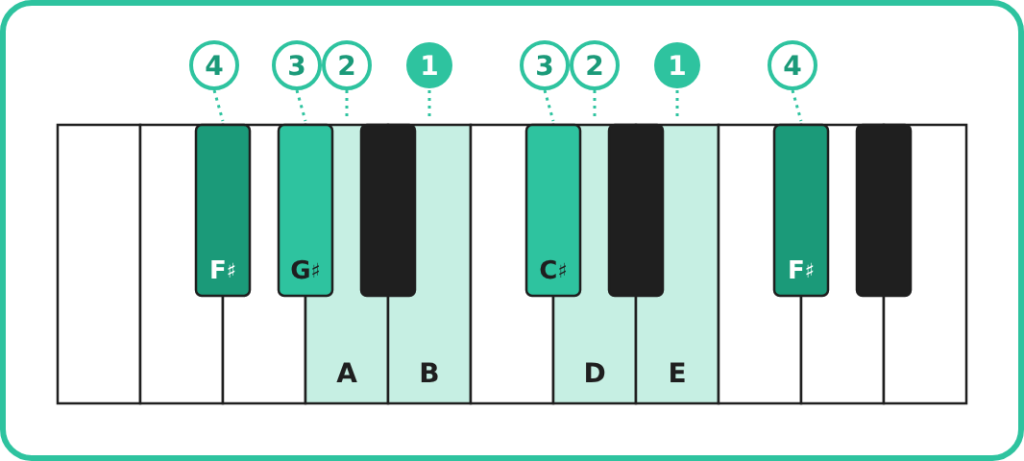
Playing the F sharp minor scale hands together
Hands together is where most beginners get stuck, because the two hands change position at different moments. The trick is to find the note where they match. In F♯ minor, going up, both hands play C♯ with finger 3. Treat that black key as your checkpoint: if both third fingers arrive together, everything in between is in the right place.
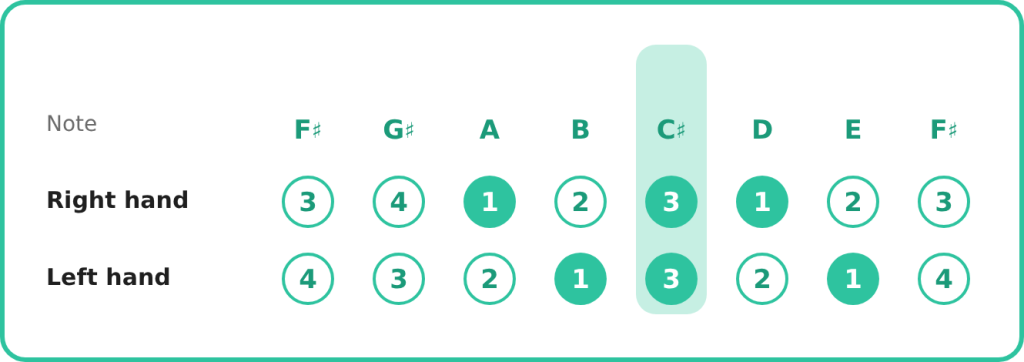
The thumbs never land together. The right thumb plays A and D while the left hand is on finger 2, and the left thumb plays B and E while the right hand is on finger 2. Practice this slowly, saying the finger numbers out loud, until the crossings feel smooth.
Black key shortcut: if your thumb or little finger is heading for a black key, something has slipped. In this scale, black keys always get finger 3 or 4, so you can check your hand position at F♯, G♯ and C♯ in one glance.
F sharp minor scale in two octaves
Over two octaves, the fingering pattern simply repeats. The right hand plays 3 4 1 2 3 1 2 once, lands on the second F♯ with finger 3 and starts the pattern again. The left hand does the same with 4 3 2 1 3 2 1, using finger 4 on each F♯.
| Hand | Notes (going up) | Fingering |
|---|---|---|
| Right hand | F♯ G♯ A B C♯ D E F♯ G♯ A B C♯ D E F♯ | 3 4 1 2 3 1 2 3 4 1 2 3 1 2 3 |
| Left hand | F♯ G♯ A B C♯ D E F♯ G♯ A B C♯ D E F♯ | 4 3 2 1 3 2 1 4 3 2 1 3 2 1 4 |
Common fingering mistakes
The most common slip is playing white keys instead of black ones. When you start on F♯, your hand wants to settle on the white keys, so say “F sharp, G sharp” in your head and name C♯ before you reach it. Another is putting the thumb on a black key, which usually means a crossing happened one note too early or too late. Crossing late is a third: if your thumb only starts moving once finger 4 or 3 has finished playing, you will hear a gap. Let the thumb travel under your hand while the long finger is still holding its note. Finally, watch out for a heavy thumb. Because the thumb is your strongest finger, A and D often sound louder than the rest, so listen for an even tone across all eight notes.
F sharp minor vs A major, F sharp major and F minor
Several scales sound or look close to F♯ minor, and mixing them up is easy. A major is the relative major of F♯ minor: it uses exactly the same seven notes and the same key signature, but starts on A (A B C♯ D E F♯ G♯). All relative major and minor scales pair up like this, with the minor starting on the 6th degree of the major. If you want to try the other half of the pair, our guide to the A major scale is a natural next step.
F♯ major is the parallel major: it starts on the same note but changes three of them. A, D and E become A♯, D♯ and E♯, which gives F♯ major a brighter sound and a key signature of six sharps. Pairs like this are called parallel scales, and you can see the full F sharp major scale on piano for comparison.
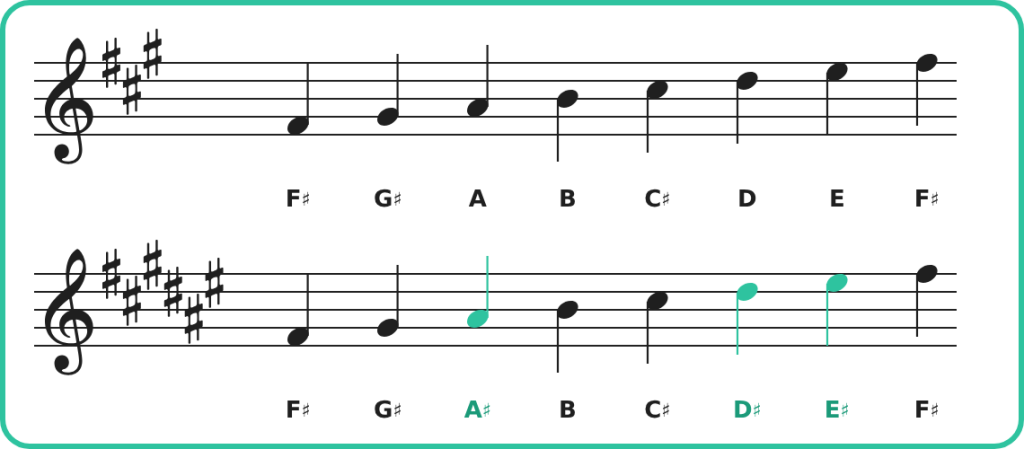
F minor is a completely different key, even though the names look alike. It sits a half step lower, has four flats instead of three sharps, and uses the notes F, G, A♭, B♭, C, D♭ and E♭. In the image above, the green notes are the three that change between F♯ minor and F♯ major.
| Scale | Notes | Key signature |
|---|---|---|
| F♯ minor | F♯ G♯ A B C♯ D E | 3 sharps |
| A major (relative) | A B C♯ D E F♯ G♯ | 3 sharps |
| F♯ major (parallel) | F♯ G♯ A♯ B C♯ D♯ E♯ | 6 sharps |
| F minor | F G A♭ B♭ C D♭ E♭ | 4 flats |
Other scales to play in F sharp minor
Once the natural minor scale feels secure, these related scales give you new sounds to improvise and play melodies with, all over the same F♯ minor chords.
F sharp minor pentatonic scale
The F sharp minor pentatonic scale keeps five notes of the natural minor scale and leaves out the 2nd and 6th: F♯, A, B, C♯, E. With no half steps, almost any combination of notes sounds good over F♯ minor chords. Because it has no clashing notes, the pentatonic scale on piano is a favorite starting point for first improvisations.
F sharp minor blues scale
The F sharp minor blues scale adds one “blue” note, C, to the minor pentatonic: F♯, A, B, C, C♯, E. Sliding from C to C♯ gives you an instant bluesy sound. If you are new to this sound, our guide to the piano blues scale for beginners shows how to use it.
How to practice the F sharp minor scale
| Step | What to do | Goal |
|---|---|---|
| 1 | Right hand alone, one octave, up and down, at 60 BPM, one note per click | Smooth thumb crossing onto A and D |
| 2 | Left hand alone, same tempo | Smooth finger 3 crossing onto C♯ and finger 4 crossing onto the top F♯ |
| 3 | Say “F sharp, G sharp, C sharp” out loud while you play | Never landing on a white key by mistake |
| 4 | Hands together, slowly | Both third fingers landing on C♯ together |
| 5 | Two notes per click, then two octaves | Even tone at a faster tempo |
| 6 | Play the harmonic form with E♯, then the melodic form going up | Hear how the 6th and 7th notes change the sound |
| 7 | Play the F♯ minor chord and its arpeggio | Connect the scale to the chords of the key |
Playing arpeggios on piano means spreading a chord’s notes into a flowing pattern. And if you want to hear the scale or check your fingering on screen while you practice, the interactive scale player at the top of this page plays every note and shows the fingering for both hands.
Ready to play the F sharp minor scale?
The F♯ minor scale has three black keys, F♯, G♯ and C♯, and a fingering pattern that keeps your thumbs on white keys. It is the key of pieces from classical piano music to pop songs. Along the way you have also met the harmonic and melodic forms, the chords of the key, and the checkpoint that makes hands together feel easier.
Play the scale hands separately every day, link the hands with the finger 3 checkpoint on C♯, and then play a song in F♯ minor. Skoove’s interactive piano lessons give you instant feedback on every note as you practice.
Author of this blog post:
Susana Pérez Posada

Susana Pérez Posada, Master in Music Therapy, Skoove Piano Educator With over seven years in piano education and a deep passion for music therapy, Susana brings a unique blend of expertise to Skoove. A graduate in Music Therapy from SRH Hochschule Heidelberg and an experienced classical pianist from Universidad EAFIT, she infuses her teaching with a holistic approach that transcends traditional piano lessons. In her writings for Skoove, Susana combines her rich musical knowledge with engaging storytelling, enriching the learning experience for pianists of all levels. Away from the piano, she loves exploring new places and immersing herself in a good book, believing these diverse experiences enhance her creative teaching style.