
F minor is a scale with four flats: B♭, E♭, A♭ and D♭. Its notes are F, G, A♭, B♭, C, D♭ and E♭, and the scale finishes on F an octave higher. It is the relative minor of A♭ major, so the two scales share the same notes and the same key signature.
Four black keys make F minor feel different under the hand from scales like A minor or C major, but the fingering is the same one you may know from F major. This article covers the notes, the finger positions for both hands, the key signature, how the scale looks on the staff, its three minor forms and the chords it contains.
F minor scale notes
The F minor scale on piano uses the notes F, G, A♭, B♭, C, D♭ and E♭, followed by F again an octave higher. This is the natural minor form, the version most people mean when they say F minor. Four of the seven notes are black keys (A♭, B♭, D♭ and E♭), and only F, G and C are white.
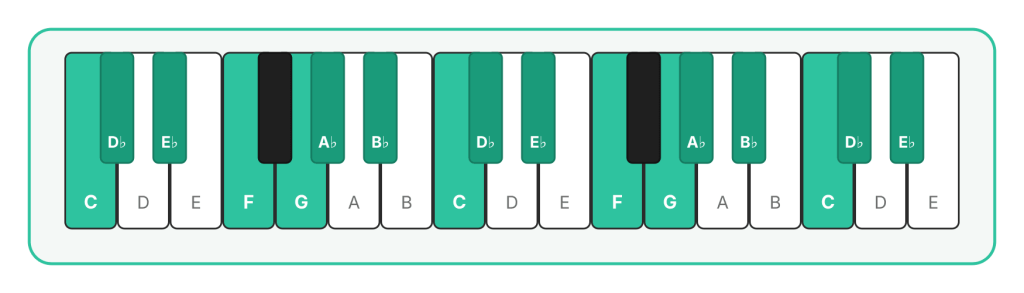
Start on F, the white key directly to the left of the group of three black keys. The scale skips the first black key of that group, then uses the other two, which are A♭ and B♭. After C, it uses both black keys of the pair, D♭ and E♭.
How the F minor scale is built
Every natural minor scale follows the same pattern of whole steps (W) and half steps (H) from its starting note:
W – H – W – W – H – W – W
A half step is the distance between two neighboring keys, black or white. A whole step is two half steps. In F minor, F to G is a whole step, G to A♭ is a half step, and C to D♭ is the second half step. The other four steps are whole steps.
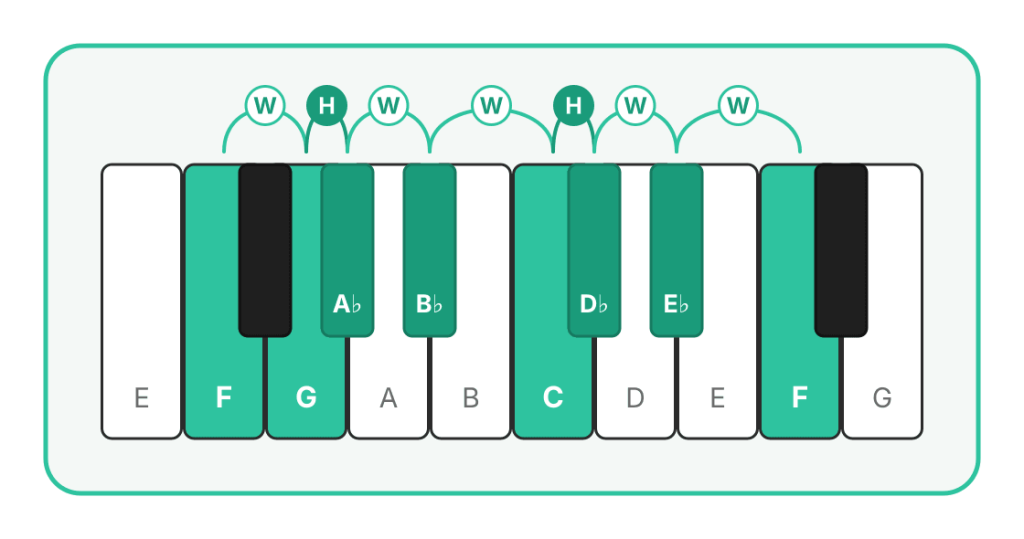
The two half steps, between the second and third notes and between the fifth and sixth, are what give the scale its darker, more serious sound compared with a major scale.
F minor scale degrees and intervals
Each note of the scale has a number and a name. These scale degrees describe the job a note does in the key, so they help when you start reading chords and melodies.
The flat signs show which notes are lower than in F major.
The flat signs in front of 3, 6 and 7 show that those notes sit a half step lower than they do in F major. Lowering those three notes is what turns a major scale into a minor one.
F minor scale finger positions for both hands
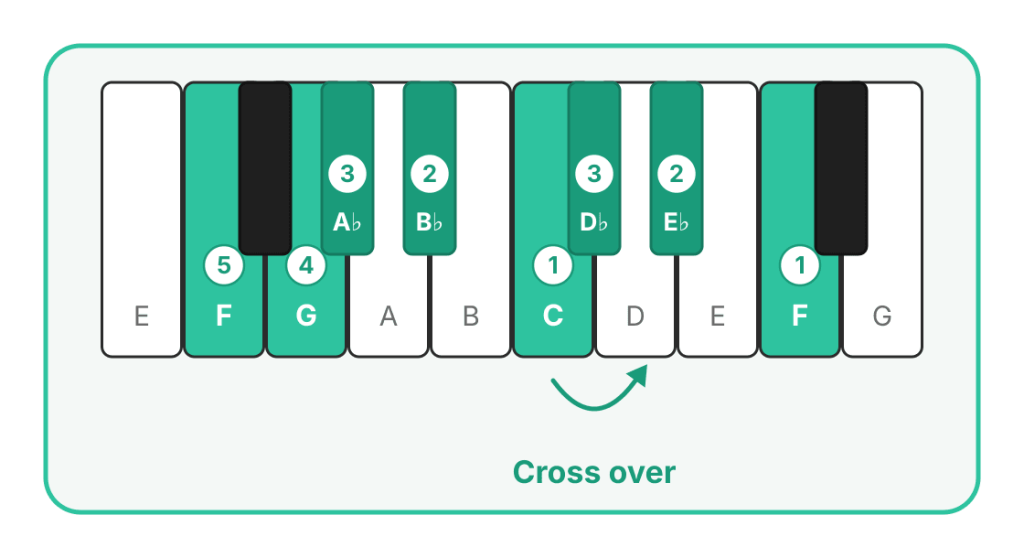
Finger numbers tell you which finger plays each note: 1 is the thumb, 2 the index finger, 3 the middle finger, 4 the ring finger and 5 the little finger. The F minor scale uses the same fingering as the F major scale, so if you know one, your hands already know the other. Practice each hand on its own first and make sure every note sounds even before you put the hands together.
F minor scale right-hand fingering
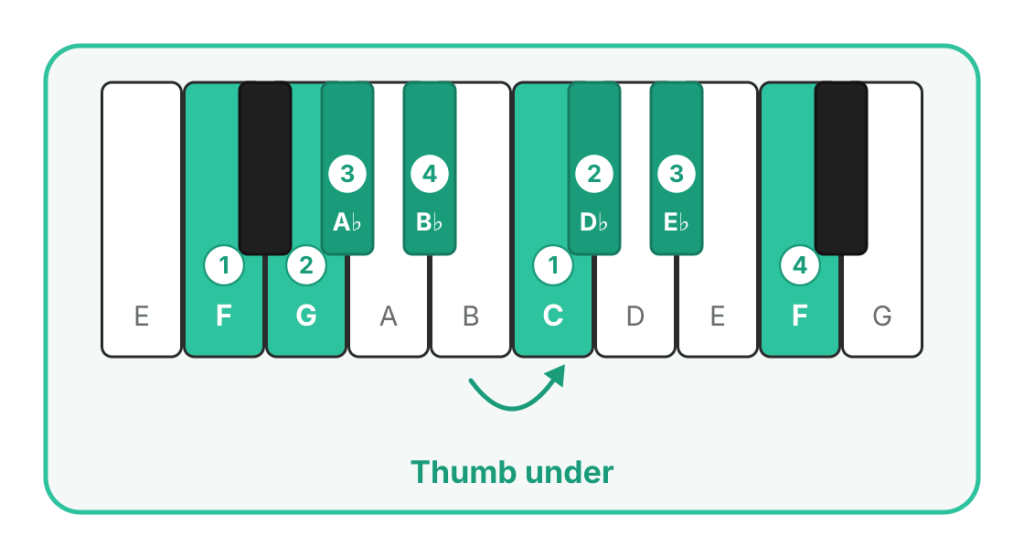
F (1) – G (2) – A♭ (3) – B♭ (4) – C (1) – D♭ (2) – E♭ (3) – F (4)
Start with your right thumb on F, then play G with finger 2, A♭ with finger 3 and B♭ with finger 4. Tuck your thumb under to reach C, then continue with D♭ (2), E♭ (3) and the top F (4). Your thumb only plays white keys here, F and C, while the longer fingers take the black keys. Keep your wrist level and let only the thumb travel under the hand.
F minor scale left-hand fingering
F (5) – G (4) – A♭ (3) – B♭ (2) – C (1) – D♭ (3) – E♭ (2) – F (1)
Start with your left little finger on F, then play G with finger 4, A♭ with finger 3, B♭ with finger 2 and C with your thumb. Cross your middle finger over the thumb to play D♭, then play E♭ with finger 2 and finish on F with your thumb. As in the right hand, the thumb plays F and C, both white keys.
Playing the F minor scale hands together
When both hands play together, the two thumbs land on C at the same moment. That makes C a useful checkpoint: if your thumbs meet on C, the rest of the scale is in place. Start slowly and listen for the notes sounding together. The right hand tucks its thumb under after B♭ while the left hand simply arrives on C, so the two hands do different jobs around the same note.
One octave, ascending. Reverse it on the way down.
F minor scale in two octaves
To play two octaves, keep going with the same pattern. After the first octave, the right thumb tucks under the third finger to play the next F.
Right hand: 1 – 2 – 3 – 4 – 1 – 2 – 3 – 1 – 2 – 3 – 4 – 1 – 2 – 3 – 4
Left hand: 5 – 4 – 3 – 2 – 1 – 3 – 2 – 1 – 4 – 3 – 2 – 1 – 3 – 2 – 1
A metronome set to around 60 beats per minute, with one note per beat, helps keep the notes even. Only speed up when you can play the whole scale smoothly several times in a row. Sitting tall with relaxed shoulders also makes the thumb tucks easier, so it is worth checking your piano posture and technique before you practice.
Common fingering mistakes
The most common mistake is tucking the thumb too early. In the right hand, finger 3 plays A♭ and finger 4 plays B♭, and only then does the thumb move under to C. If your thumb lands on B♭, the hand tenses up and the scale loses its flow.
The second mistake is letting the left-hand crossover rush. Play C with your thumb, then take your time lifting finger 3 over it to reach D♭. A third problem is a sinking wrist, which makes the black keys feel further away. Keep your hand shape rounded and your fingers close to the keys.
F minor key signature: Four flats
The key signature of F minor has four flats: B♭, E♭, A♭ and D♭. They are written at the start of every line of music and apply to every B, E, A and D in the piece, whatever octave they appear in. That is why sheet music in F minor does not need a flat sign in front of each of those notes.
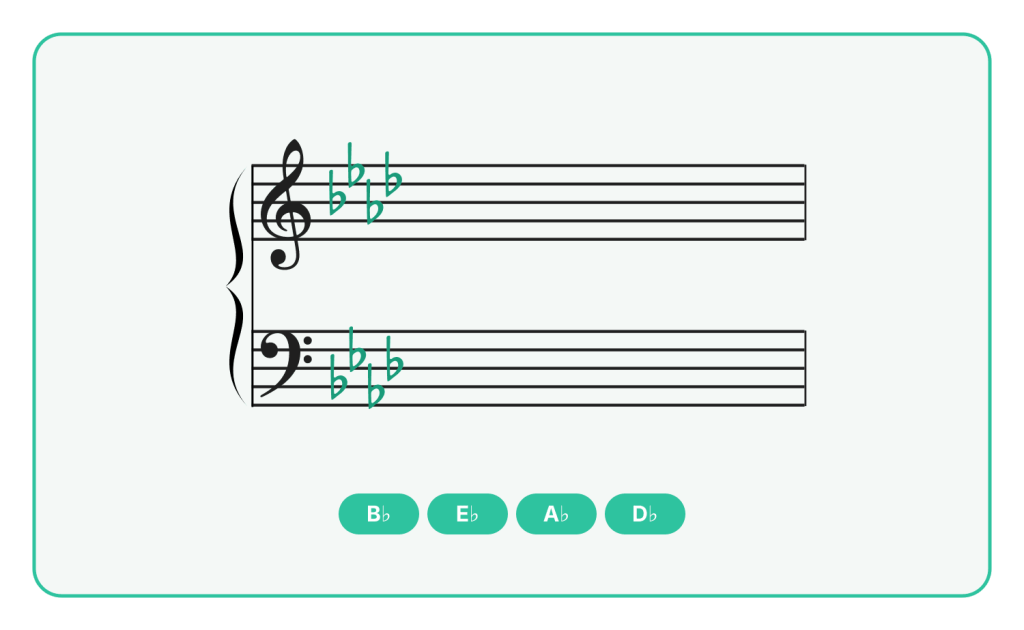
Flats always appear in the same order: B♭, E♭, A♭, D♭, G♭, C♭, F♭. F minor uses the first four. A mnemonic for this order is Battle Ends And Down Goes Charles’ Father. For a step-by-step look at how the order works, see this overview of key signatures.
There is a quick way to name a flat key. The second-to-last flat in the signature is the major key, here A♭. The minor key that shares the signature starts three half steps lower, on F. A piece in F minor often ends on an F or an F minor chord, and you will often see E♮ signs where the music borrows the raised seventh note.
F minor scale in treble and bass clef
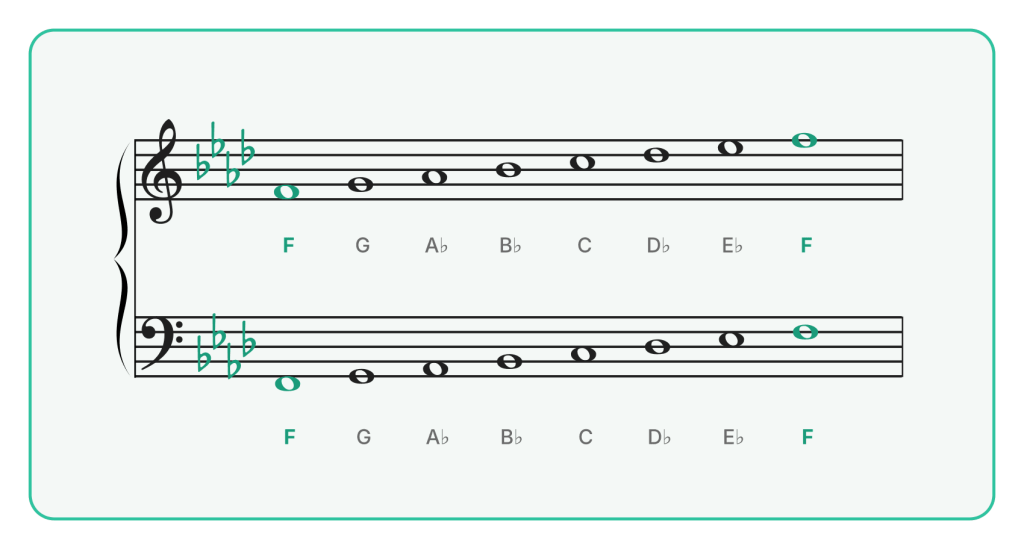
The right hand usually reads treble clef and the left hand reads bass clef. If you want a refresher on where each note sits, you can look at treble clef notes and bass clef notes on piano.
The F minor scale in treble clef fits inside the staff. F sits in the bottom space, B♭ on the middle line, D♭ on the fourth line and the top F on the top line. In the bass clef example below, the scale starts on F in the space under the bottom line, passes through B♭ on the second line and D♭ on the middle line, and finishes on F on the fourth line. The four flats in the key signature mean you never need to write a flat sign beside the notes.
F natural, harmonic and melodic minor scales
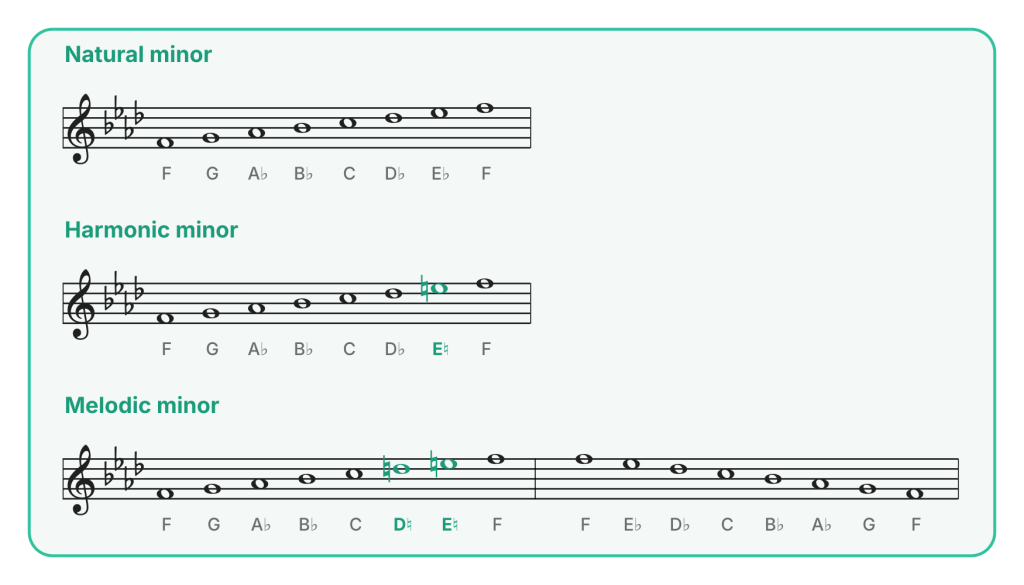
Minor scales come in three forms. They share the same first five notes and differ only in the sixth and seventh. Natural minor is the one you have seen so far, and the other two change one or two notes to create a stronger pull back to the home note.
F natural minor scale
The natural minor scale is F, G, A♭, B♭, C, D♭, E♭, F. It uses only the notes of the key signature, with no extra sharps or naturals.
F harmonic minor scale
The harmonic minor scale raises the seventh note by a half step, from E♭ to E♮. The notes are F, G, A♭, B♭, C, D♭, E♮, F. The jump from D♭ up to E♮ is three half steps, which is wider than any other step in the scale and gives harmonic minor its distinctive sound. The raised E♮ sits a half step below F, so it pulls strongly towards the home note. You can use the same fingering as natural minor and just play E♮ with the same finger in place of E♭.
F melodic minor scale
The melodic minor scale raises both the sixth and the seventh notes on the way up, so D♭ becomes D♮ and E♭ becomes E♮. The ascending notes are F, G, A♭, B♭, C, D♮, E♮, F. On the way down, the scale goes back to natural minor: F, E♭, D♭, C, B♭, A♭, G, F. The fingering stays the same in both directions.
Chords in the F minor scale
You can build a triad on each note of the F minor scale by stacking every other note, which gives seven chords. Capital Roman numerals mean a major chord, lowercase numerals mean a minor chord and the ° sign means a diminished chord.
Seven triads, one on each note of the scale. Black pills mark the black keys.
The three chords to learn first are F minor, B♭ minor and C minor, or C major when the music uses the raised seventh. To see the shape and fingering for the home chord, open the F minor chord page.
Chord progressions to try in F minor
A chord progression is a sequence of chords that forms the backbone of a song. Play these with your left hand while your right hand plays notes from the scale, and keep the changes slow and smooth.
Three progressions to play with your left hand. In the last one, C is a major chord because it uses the raised E from harmonic minor.
Once they feel comfortable, try different rhythms and chord inversions to keep your hand in one position. There are more ideas in this overview of chord progressions on piano.
F minor vs F major and A♭ major
F minor has two close relatives. F major starts on the same note but has only one flat, B♭, and its third, sixth and seventh notes are A, D and E instead of A♭, D♭ and E♭. Two scales that share a starting note but not a key signature are known as parallel scales.
The A♭ major scale is the relative major of F minor. It uses the same seven notes and the same four flats but starts on A♭, so it sounds brighter. This relationship is explained in more detail in the page on relative major and minor scales.
F minor and A♭ major share all seven notes. F major keeps the F but changes three of them. Green pills mark the starting note and black pills mark black keys.
To hear the difference, play the F minor scale and then the A♭ major scale back to back. The notes are identical, but the music feels settled on F in one and on A♭ in the other.
Other scales to play in F minor
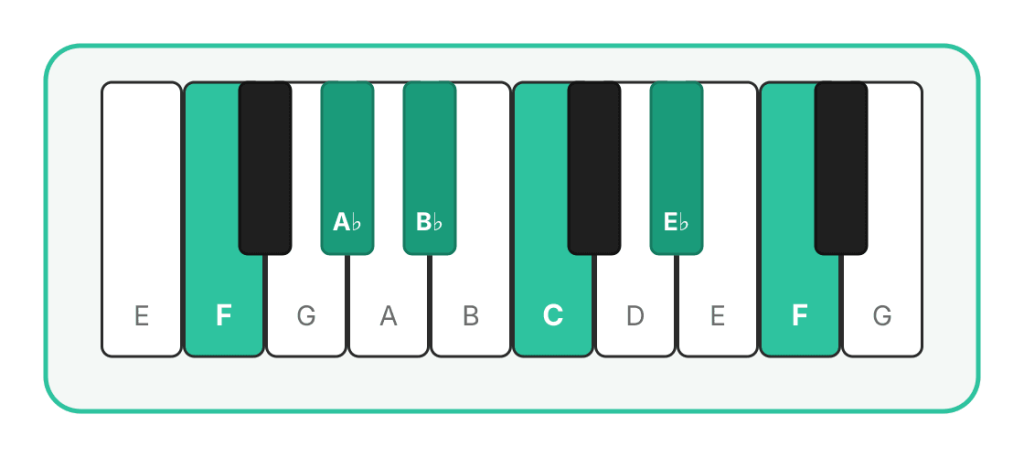
F minor pentatonic scale
The F minor pentatonic scale uses five notes: F, A♭, B♭, C and E♭. In scale-degree terms that is 1, ♭3, 4, 5 and ♭7. It leaves out G and D♭, the two notes that create half steps in natural minor, so every note sounds good over an F minor chord. Hold an F minor chord in your left hand and play these notes with your right to start improvising. There is more about this family of scales in the guide to pentatonic scales on piano.
F minor blues scale
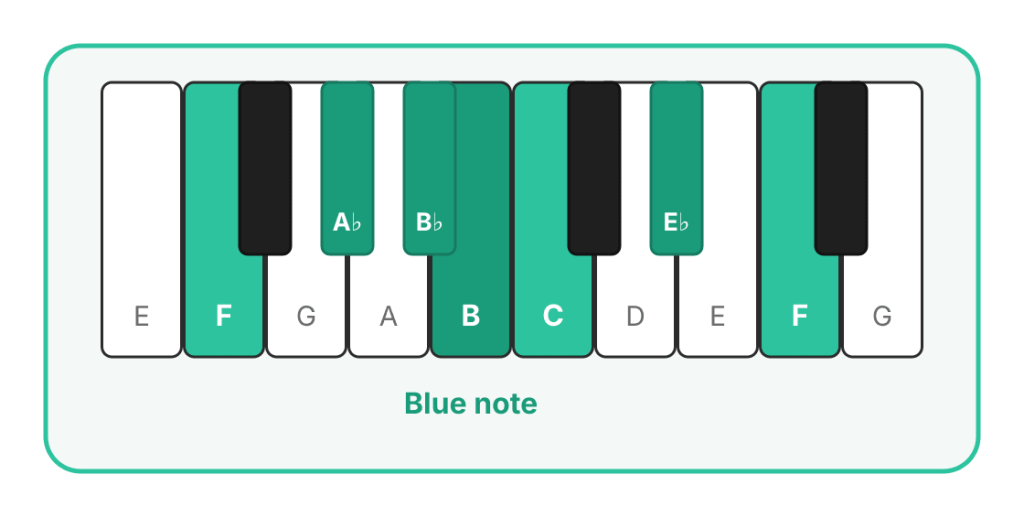
The F minor blues scale adds one extra note to the pentatonic scale: the flat fifth, which is the same key as B natural. The notes are F, A♭, B♭, B♮, C and E♭. That blue note sits between B♭ and C, and sliding through it is what creates the classic bluesy sound. You can find more patterns on the piano blues scale page.
How to practice the F minor scale
Start with natural minor, one hand at a time, at a slow tempo. Say the finger numbers aloud if it helps, and stop at the thumb tuck and the crossover to check the movement is relaxed. When each hand is steady, put them together for one octave, then try two.
Once the natural scale feels even, learn the harmonic minor by changing just one note, E♭ to E♮. Then try the melodic form, which changes two notes on the way up and returns to natural minor on the way down. Playing all three back to back is a good daily warm-up, and it trains your ear to hear the difference between them.
Ready to play the F minor scale?
You now know the notes, finger positions and key signature of the F minor scale. Start with natural minor, one hand at a time and at a slow tempo, then add both hands and two octaves. Keep the four flats in mind and move on to the harmonic and melodic forms once the natural scale feels even. To keep building your skills with feedback as you play, try Skoove’s interactive piano lessons.
Author of this blog post:
Susana Pérez Posada

Susana Pérez Posada, Master in Music Therapy, Skoove Piano Educator With over seven years in piano education and a deep passion for music therapy, Susana brings a unique blend of expertise to Skoove. A graduate in Music Therapy from SRH Hochschule Heidelberg and an experienced classical pianist from Universidad EAFIT, she infuses her teaching with a holistic approach that transcends traditional piano lessons. In her writings for Skoove, Susana combines her rich musical knowledge with engaging storytelling, enriching the learning experience for pianists of all levels. Away from the piano, she loves exploring new places and immersing herself in a good book, believing these diverse experiences enhance her creative teaching style.