




The E flat major scale is E♭, F, G, A♭, B♭, C, D, with three flats in the key signature. It’s a good first black-key scale because your longer fingers land on the black keys naturally.
Below you’ll find the notes, fingering for both hands, treble and bass clef versions, the Eb key signature and the chords in Eb major. Try the interactive piano above, then follow the practice ladder at the end.
E flat major scale notes
The e flat major scale uses seven different notes: E♭, F, G, A♭, B♭, C and D, then back to E♭ one octave higher. Three of them are flats (E♭, A♭ and B♭). The other four, F, G, C and D, are plain natural notes.
Like every major scale, it follows one simple recipe: whole step, whole step, half step, whole step, whole step, whole step, half step. A whole step is two keys up, and a half step is the very next key. Start on E♭, follow the recipe, and you land on exactly these notes.
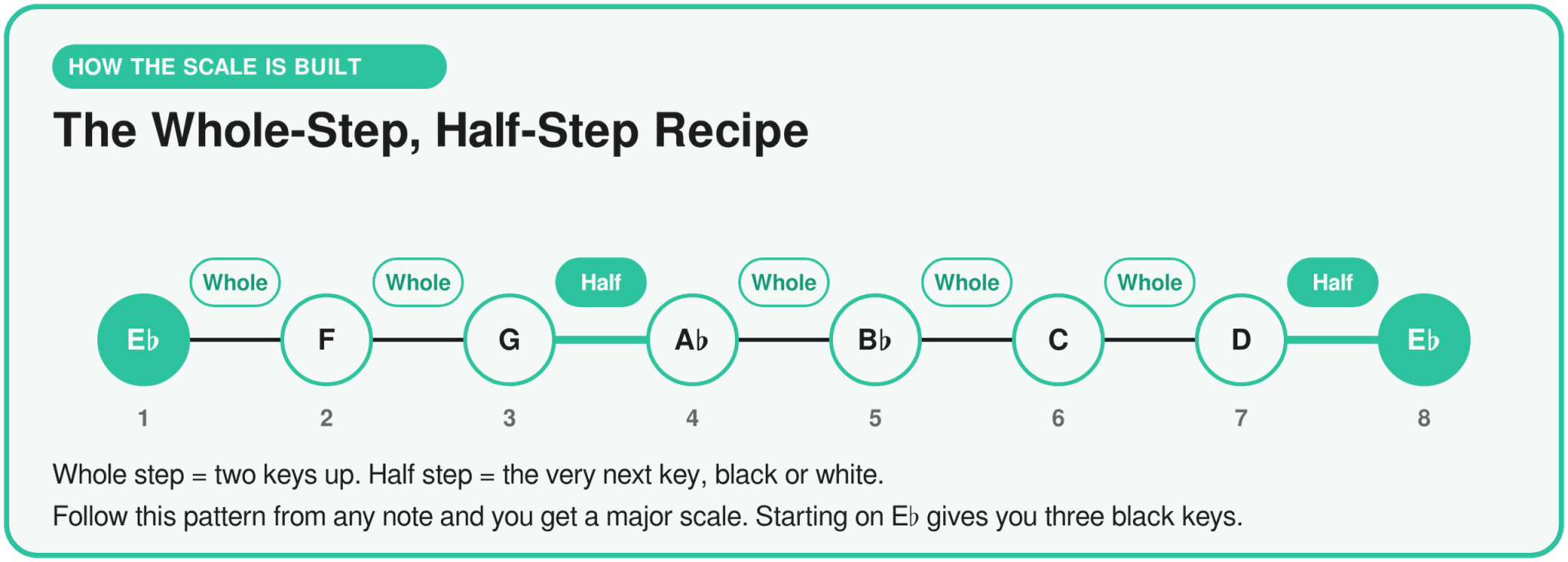
Seven notes, three black keys. Dark pills are black keys.
The two most important scale degrees are E♭, the tonic, and B♭, the dominant. Chord progressions in this key usually start on E♭ and use B♭ to lead back to it.
E flat major scale on piano
Playing the e flat major scale on piano feels different from the C major scale because three of the eight keys are black. Start on the black key just to the left of E (that is E♭), and move up through F, G, A♭, B♭, C and D to the next E♭.
The e flat major scale piano diagram below shows exactly which keys to press, with the black keys in this scale highlighted in green.
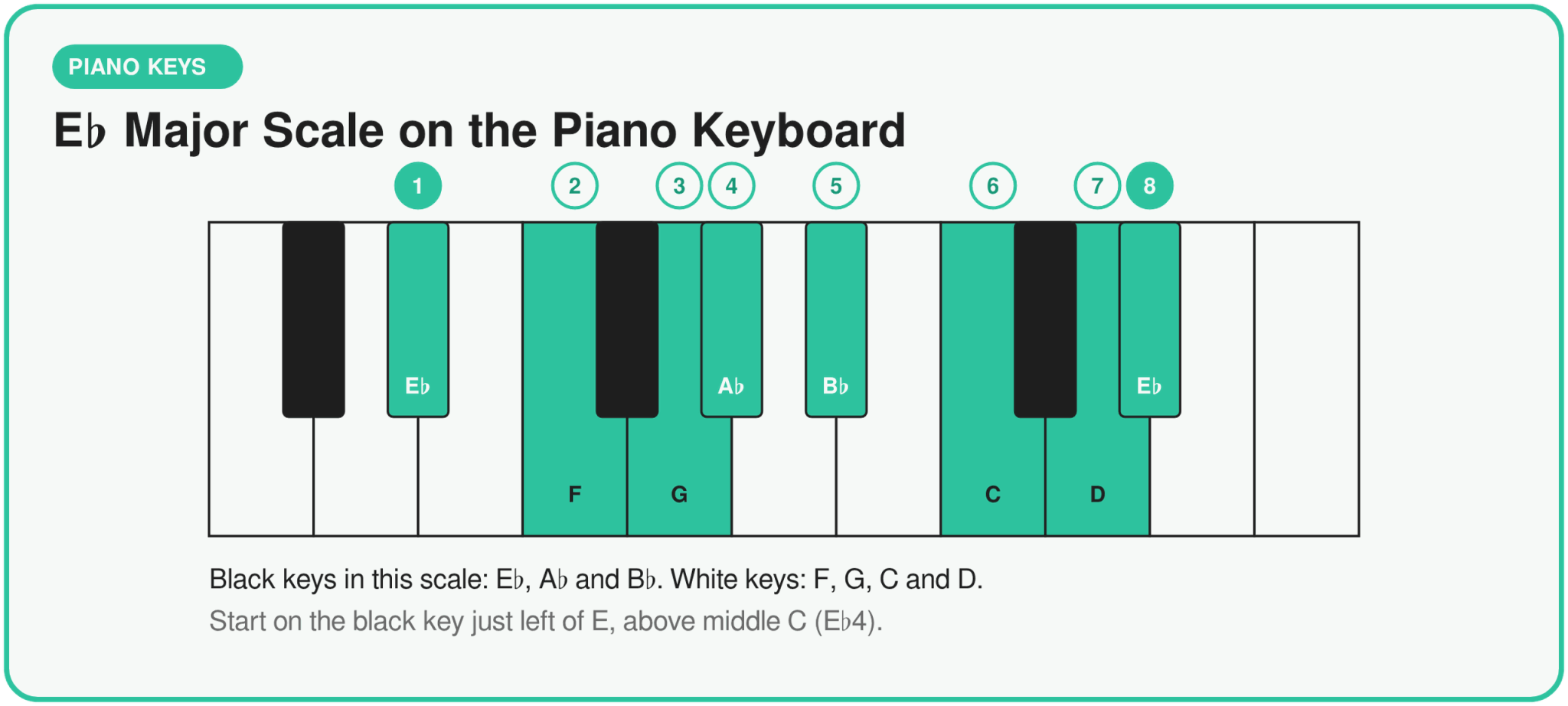
The three black keys sit under your longest fingers. Fingers 3 and 4 play E♭, A♭ and B♭, and your thumb only ever plays white keys. That keeps your hand in a relaxed, natural shape.
Fingering for both hands
Use these fingerings, where 1 is your thumb and 5 is your little finger:
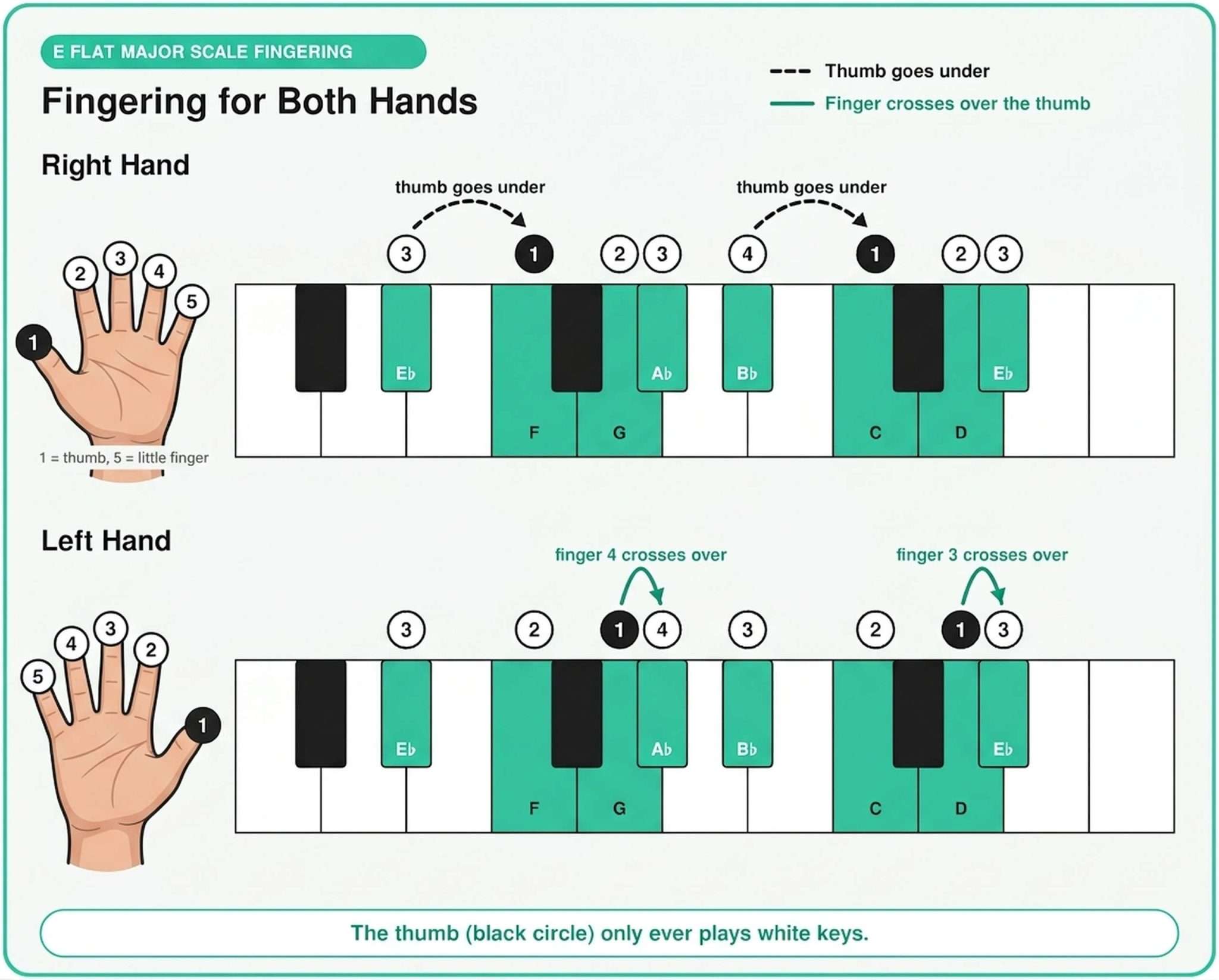
In the right hand, tuck your thumb under after finger 3 (to reach F) and again after finger 4 (to reach C). In the left hand, swing finger 4 over your thumb to reach A♭, and finger 3 over to reach the top E♭. Keep your wrist loose and let the arm travel with the hand rather than twisting at the thumb.
Where is E flat on the piano?
E♭ is a black key. Find a group of two black keys, and E♭ is the second one in that group, just to the left of the white key E. The same key can also be called D♯, because it sits between D and E. In the key of E♭ major we call it E♭, since every letter name in the scale is used once: E♭, F, G, A♭, B♭, C, D.
E flat major scale in treble clef
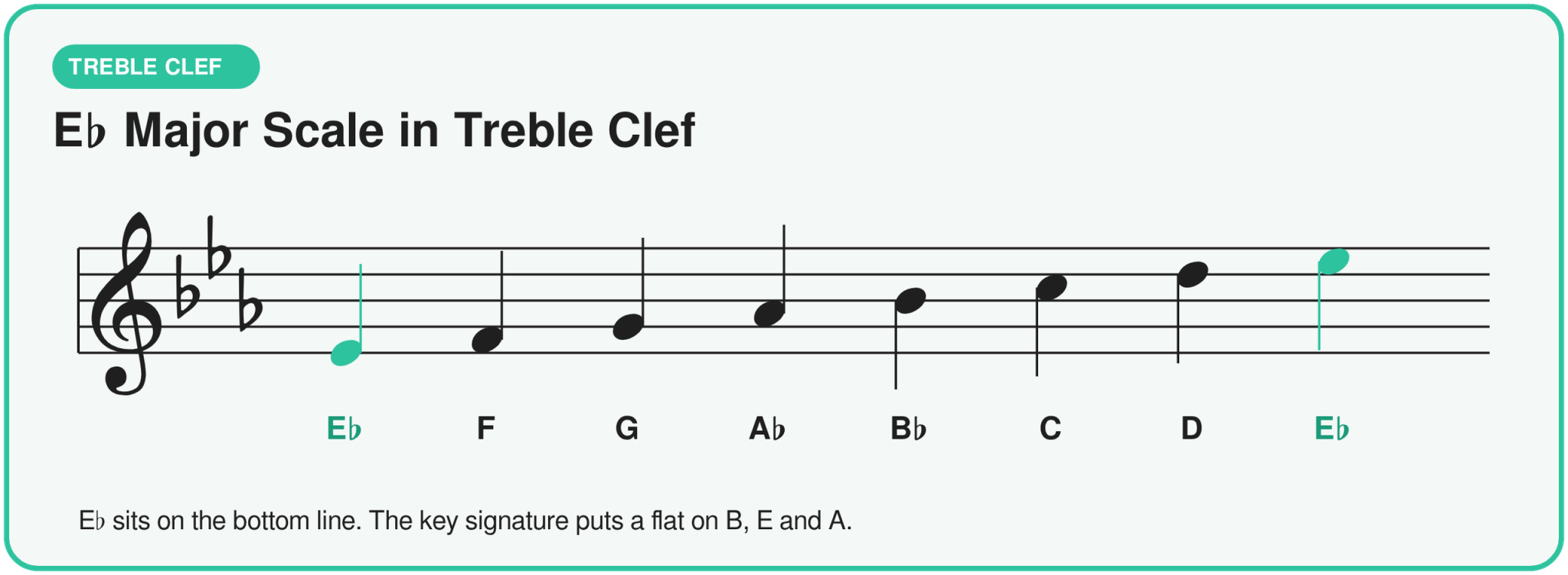
In the e flat major scale treble clef version, the scale starts on the bottom line of the staff (E♭4), the E♭ a little above middle C. The key signature puts one flat on each of B, E and A, so you don’t need to write a flat beside every note. If a treble clef staff still feels slow to read, brush up on the treble clef notes and the scale will make more sense.
E flat major scale in bass clef
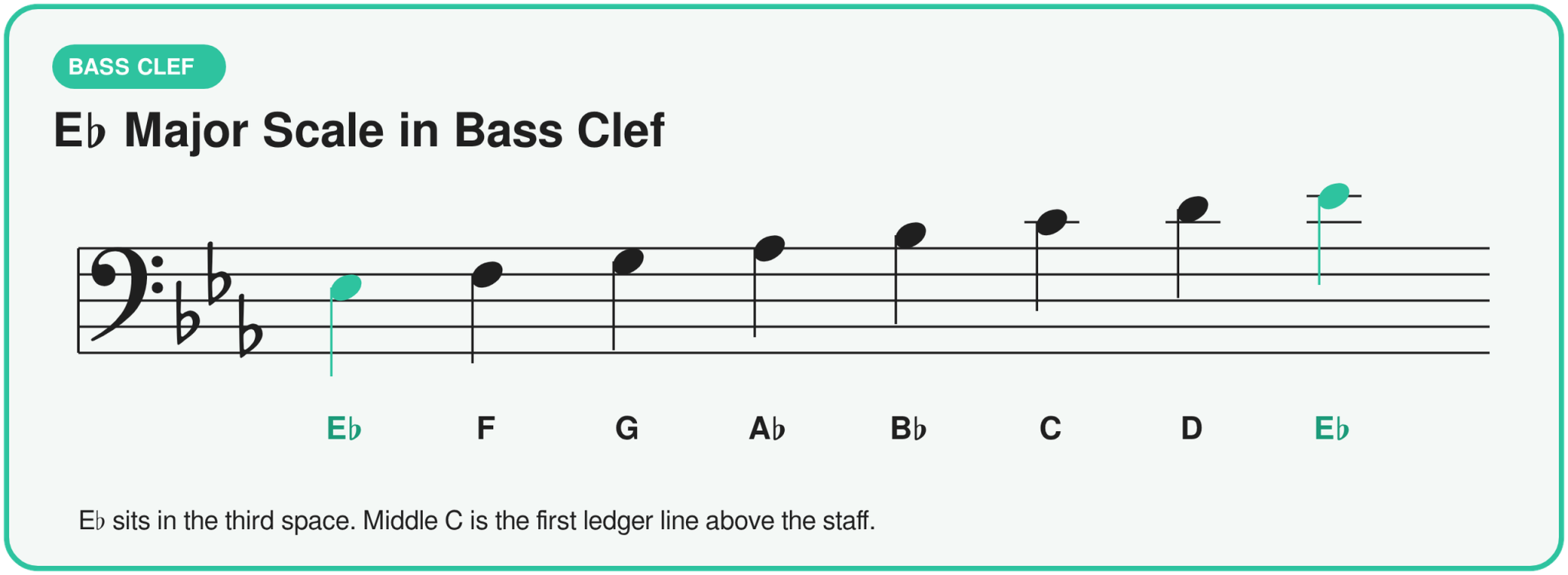
The e flat major scale bass clef version starts in the third space of the staff (E♭3) and climbs past the top line onto two ledger lines. Middle C, the first ledger line above the staff, appears as the sixth note. Left-hand scale practice happens here, so it’s worth getting comfortable with the bass clef notes on piano before you play it.
E flat key signature: what key has 3 flats?
The eb key signature has three flats: B♭, E♭ and A♭, written in that order at the start of every line of music. Whenever you see three flats there, you’re in either E♭ major or its relative minor, C minor. That is the answer to the common question “what key has 3 flats?”.

Here’s a quick way to name any flat key: look at the second-to-last flat. With B♭, E♭ and A♭, the second-to-last flat is E♭, so the key is E♭ major. The same trick works for the E flat major key signature in any clef, and for other flat key signatures too.
To remember the order of flats, use the classic phrase: Battle Ends And Down Goes Charles’ Father. The three-flat key uses the first three words.
What is E flat major?
E flat major is the major key built on E♭, with three flats in its key signature. It’s common in classical music: Beethoven chose it for his “Eroica” Symphony and “Emperor” Piano Concerto, and Chopin used it for his famous Nocturne Op. 9 No. 2.
Eb major also suits wind and brass players. In concert band, for example, B♭ instruments such as trumpets and clarinets read this key as F major, with only one flat. In the circle of fifths, E♭ major sits right beside B♭ major (two flats) and A♭ major (four flats), which makes it a natural stepping stone when you learn the flat keys in order.
Relative and parallel minor
Every major key has a relative minor that shares its key signature. For E♭ major, that is C minor: C D E♭ F G A♭ B♭, with the same three flats. People often mix this up with the parallel minor, which starts on the same note but has a different key signature. The parallel minor of E♭ major is E♭ minor, and it has six flats, so it is much harder to read.
Chords in E flat major (Eb major chords)
Build a triad on each note of the scale and you get the seven chords in eb major, a mix of major and minor chords: three major (E♭, A♭ and B♭), three minor (Fm, Gm and Cm) and one diminished chord (D dim). The chords in eb major are the toolkit behind most songs in this key.
The three green chords in the picture, E♭ (I), A♭ (IV) and B♭ (V), are the ones you’ll meet most. Try these chord progressions on piano: E♭ – A♭ – B♭ – E♭ with your left hand and the scale notes in your right hand, or a pop-style E♭ – B♭ – Cm – A♭.
How to practise the E flat major scale
Practise the scale for three to five minutes at the start of each session. Move up one level only when the current one feels even and relaxed. You’ll see this scale written as “Eb major scale”, “E-flat major” or “E♭ major”, but they all mean the same thing. Every one of the 12 major piano scales follows the same recipe, so what you learn here will help you with the others.
Five levels, one step at a time. Move up only when the level below feels easy.
Two small habits help a lot: play legato (smoothly connected), and listen for an even sound between the black and white keys. If one note jumps out, slow down until all eight notes sound the same.
Keep building your scales
Once the e flat major scale feels comfortable, you’ve unlocked a whole new set of black-key pieces, from classical nocturnes to modern ballads. Learn it a little at a time, and the other flat keys will follow quickly.
Want a teacher beside you while you practise? Practise with Skoove and get real-time feedback on every note you play.
Frequently asked questions
Author of this blog post:
Susana Pérez Posada

Susana Pérez Posada, Master in Music Therapy, Skoove Piano Educator With over seven years in piano education and a deep passion for music therapy, Susana brings a unique blend of expertise to Skoove. A graduate in Music Therapy from SRH Hochschule Heidelberg and an experienced classical pianist from Universidad EAFIT, she infuses her teaching with a holistic approach that transcends traditional piano lessons. In her writings for Skoove, Susana combines her rich musical knowledge with engaging storytelling, enriching the learning experience for pianists of all levels. Away from the piano, she loves exploring new places and immersing herself in a good book, believing these diverse experiences enhance her creative teaching style.
Published by Lydia Ogn from the Skoove team